
by Gary Alexander
September 22, 2026
Fed Chair Kevin Warsh set just the right tone (to me) in his blessedly brief (under 30 minute) press conference following the unanimous (12-0) Fed vote to raise short-term rates by 0.25% last week.
I have monitored Fed speeches since William McChesney Martin in the late 1960s, and it seems Kevin Warsh is the clearest-minded and best-spoken Fed chair since Paul Volcker (serving 1979 to 1987), but unlike Tall Paul, Warsh dares to greet us with a smiling face, unlike his predecessor, the dour Jay Powell.
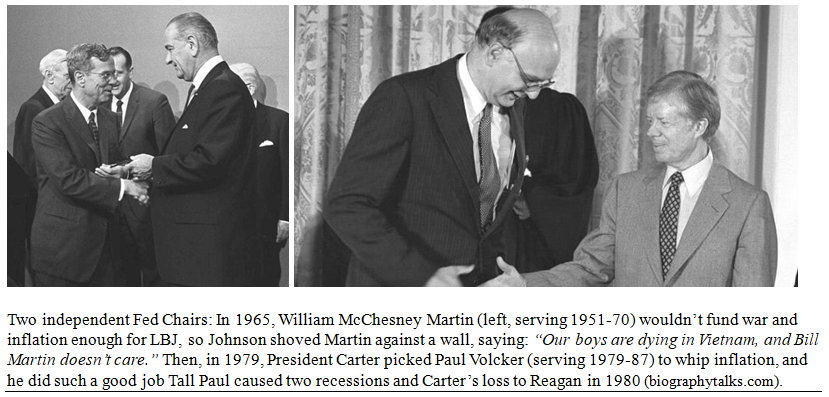
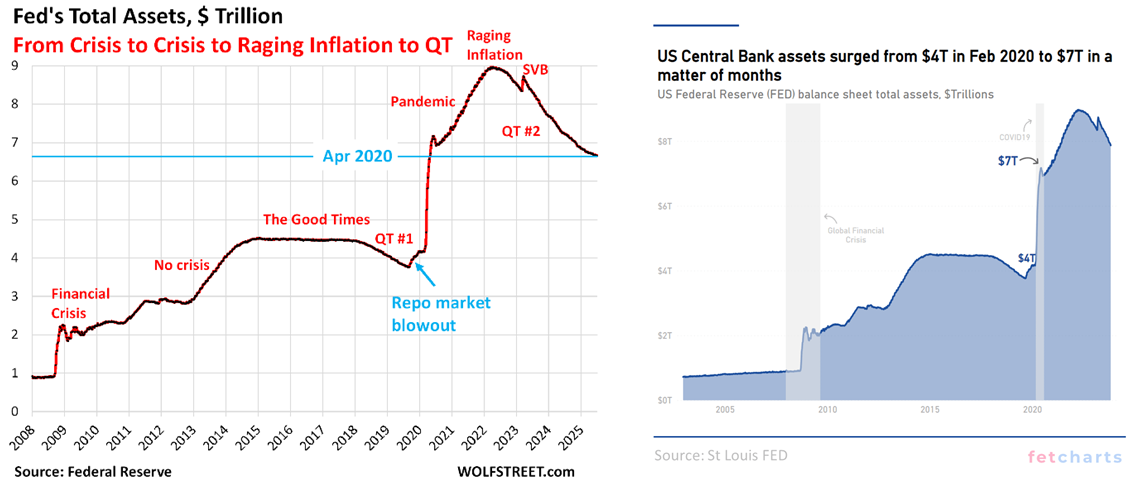
Warsh may go down in history as a strong hawk, like Martin and Volcker, not a money-manufacturing dove like Bernanke, Yellen or Powell, who doubled the Fed’s balance sheet in 2020-21 (chart below).
Graphs are for illustrative and discussion purposes only. Please read important disclosures at the end of this commentary.
Last week, Warsh’s statements and responses provided a wonderful economic lesson on navigating an unknown future. While the press seems fixated with the Fed’s interest rate decisions, Chairman Warsh dismisses that as mostly a side show. (The Fed has no choice but to follow market rates, as the Fed is incapable of lowering oil prices or moving long-term Treasury rates in their preferred direction).
Chairman Warsh focused more on the economy than interest rates, starting with his opening statement:
“Our decision comes at a time when the American economy appears to be strengthening. New hiring, private-sector earnings, business capital investment—each of these markers has improved in recent months and is pointing in a good direction. Credit flows have been robust, particularly for businesses.”
He continued: “Consider the geopolitical landscape of shocks and uncertainty, and you begin to appreciate the resilience of the U.S. economy. Given that resilience, and the potential for even greater performance, an attitude of optimism is exactly what I heard inside the FOMC these last two days.”
That was a great start, but then Warsh faced an onslaught by the nation’s best and brightest reporters.
- When asked by the New York Times to predict future rate changes, Warsh parried: “I’m not going to pre-judge any future decisions we make. You might have heard me say in Jackson Hole, I committed to a discipline, a set of principles…to look outside the window and see what I can observe.”
Here are a few more gems Warsh delivered in the press, asking basically trivial questions about how he would respond to that day’s retail sales report or any other indicator that “comes across his desk.”
- “…I’m not a data point dependent guy, so I won’t react one way or another to data that shows up on our doorstep. Trends matter… we need to look outside the window and interrogate reality.”
- To a Politico reporter, Warsh said we, as a nation, “have grown accustomed to waiting somewhat breathlessly on a data point. That isn’t my view. I was not waiting breathlessly on what any particular data was, whether it was retail sales this morning, or a CPI print last week. I’ll just reiterate, trends matter. Data points are noisy. Data point dependence is a dangerous preoccupation; it’s not something that concerns me. Markets over time will come to understand how this Fed makes its decisions, what’s relevant and not, and I wouldn’t want to editorialize that for them beyond it.”
Wow! How welcome is that?! Sadly, this candid economics lesson frustrated pundits like Jeff Gundlach, founder and CEO of Doubleline, the first guest interviewed by CNBC after the Warsh press conference.
Gundlach began his response with these fairly insulting words: “The press conference was kind of devoid of content. A lot of questions were asked but not a lot of answers given.” I beg to differ. I think Warsh gave us a masterful economics lesson, for those with ears to hear. For decades, after being influenced by great investment minds whose newsletters I edited, I learned to ignore most monthly economic releases, which are often revised drastically. We pay more attention to the running 12-month trend “in the bank.”
Speaking of newsletters, when asked about the meaning of economic statistics, Warsh quipped, “I’m not a Wall Street newsletter. Part of the independence of the Fed is we stay in our lane. Independence is a two-way street. We’ll let people that do trade policy and fiscal policy stay in their lane, too.”
Kevin Warsh made the same points at Jackson Hole in late August, but the press was reticent to quote his key passages there. The press, as always, focuses on interest rates more than economic trends, which whipsaw the market so much. Warsh frustrates the pundits by deflating their expectations of omniscience, saying “our knowledge doesn’t extend that far,” reminding the press, “We should pay attention to money created by the central bank.” That sounds logical to me, but not to the jackals in the financial media.
As Milton Friedman once said, “Inflation is always and everywhere a monetary phenomenon.”
For decades, the Fed has focused on setting short-term interest rates while ignoring money supply, even in the COVID years, when M2 money supply rose 40% and politicians began printing “helicopter money.”
That leads me to a second (related) subject – analyzing America’s rising income and wealth…accurately.
Economic Numbers Don’t Explain Themselves…They Need Deep Analysis and Translation
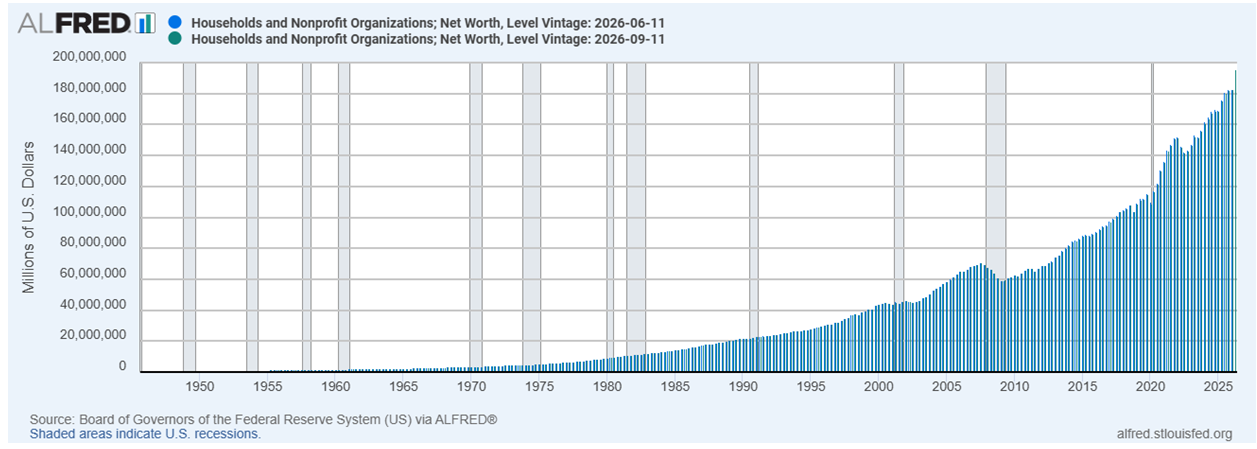
On September 11, the Fed announced national household wealth soared to over $185 trillion last quarter (or $196 trillion by some other accounts), reflecting the largest quarterly wealth gain in history, up $12.5 trillion in three-months. That single-quarter’s wealth increase exceeds the total annual GDP of every nation except the U.S. and China. It’s the 11th consecutive quarterly gain, doubling our wealth since 2020.
Graphs are for illustrative and discussion purposes only. Please read important disclosures at the end of this commentary.
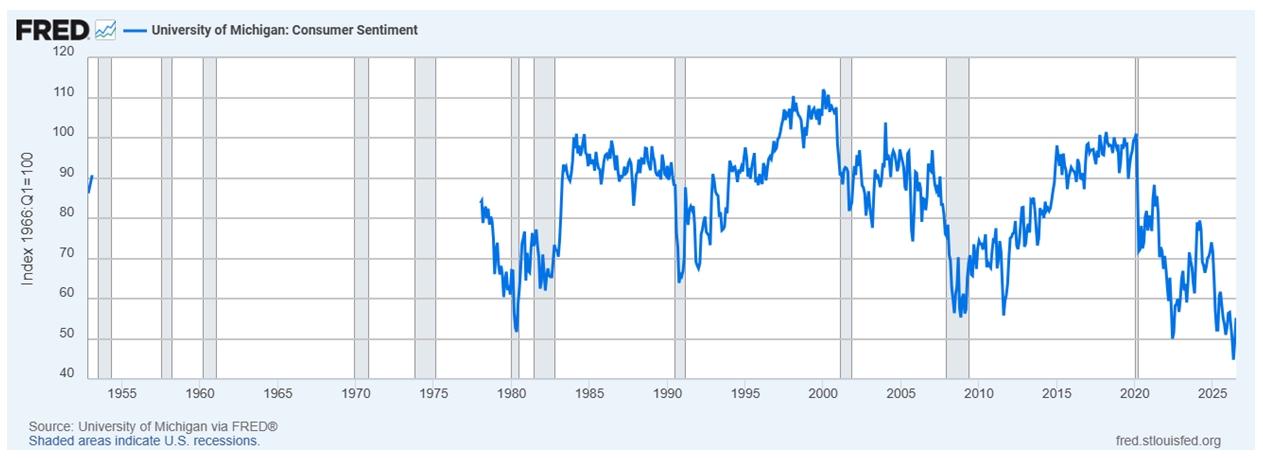
At $185 trillion, this represents over $550,000 net worth per American ($1.1 million for a couple, or $2.2 million for a family of four), but most people don’t feel that wealthy. August’s University of Michigan consumer sentiment came in at a super-low 55.2, a level the surveyors classify as “recessionary levels.” (I dissected sentiment last week: 9-15-26: The Monthly “Confidence Index” Reveals Irrational Fears – Navellier).
The University of Michigan Sentiment index reached its lowest level ever, at 44.2 in May 2026 – right in the middle of last quarter’s wealth explosion! That’s a tough anomaly to explain, but I’ll give it a try:
Graphs are for illustrative and discussion purposes only. Please read important disclosures at the end of this commentary.
One main reason for the recent dive in sentiment is a widening wealth gap, since the Fed’s wealth total is skewed by massive growth among the fully invested top 0.1%, warping the “arithmetical average.”
For a more “real world” look, the Census Bureau released their annual income and poverty report last week. This report ignores the arithmetical average (which can warp the number higher during a time of wealth inequality). In contrast, the median (mid-point) is a more reliable indicator. Also, the Census data is adjusted for inflation, unlike the “household wealth” survey, so it’s a more reliable real-world number.
The Census Bureau’s inflation-adjusted median household income rose 2.6% in 2025 to a record $87,460, but the Wall Street Journal’s analysis said, “The report’s details also show why so many Americans feel glum about the economy,” referring to the historically low “sentiment” readings we’ve seen lately.
The Journal bemoans the fact “Americans worked more. The number of men working full-time grew 1.3 million – and by 800,000 for women.” My first reaction is – “That’s great! It’s about time our men went back to work.” But the Journal continues: “However, the total number of workers increased by much less – 230,000 for men and 130,000 women. This suggests that part-time workers increased their hours…”
Well, that’s also great. We need more full-time workers and fewer “gig” workers, but the Journal totally missed the real reason why Americans are working more – the Big Beautiful Bill, passed in mid-2025, says overtime workers not only get 1.5 or double-rate pay per hour; they also pay no taxes on overtime!
Humans predictably respond to incentives. If you reward overtime pay, workers will want to work over 40-hours a week. They may sleep-walk through the first 40-hours to get to the candy store of “Overtime Pay,” but they will work more hours with no tax on overtime (or tips, as the wait staff wants a tax break, too).
The Census report had a couple of other shockers – the real income for college-educated workers declined 1.1% last year, while the real income for mere high-school grads grew by 5.5%. since there is still a gaping shortage of workers in Mike Rowe’s kinds of “dirty jobs,” which causes their incomes to rise.
In the real world, income will rise for jobs in demand, or fall for bloated desk jobs. That’s economics!
All content above represents the opinion of Gary Alexander of Navellier & Associates, Inc.
Also In This Issue
A Look Ahead by Louis Navellier
Is Canada Splitting Up – or Joining the European Union?
Income Mail by Bryan Perry
What’s Working and What’s Not in the Current Market Landscape
Growth Mail by Gary Alexander
Fed Chair Warsh Delivers a Fresh, Clear Perspective
Global Mail by Ivan Martchev
Most Markets Expect More Rate Hikes
Sector Spotlight by Jason Bodner
When Lights are Low, Our Vision Must Adjust
View Full Archive
Read Past Issues Here
Important Disclosures:
Although information in these reports has been obtained from and is based upon sources that Navellier believes to be reliable, Navellier does not guarantee its accuracy and it may be incomplete or condensed. All opinions and estimates constitute the authors opinions as of the date the report was created and are subject to change without notice. These reports are for informational purposes only and are not a solicitation for the purchase or sale of any securities or financial services. Any decision to purchase securities mentioned in these reports must take into account existing public information on such securities or any registered prospectus. To the extent permitted by law, neither Navellier & Associates, Inc., nor any of its affiliates, agents, or service providers are providing any investment advice herein and do not assume any liability or responsibility for the readers’ decisions if any. No reader should act or refrain from acting in reliance on the information contained in this communication or for any decision based on it.
None of the stock information, data, or company information presented herein constitutes investment advice or a recommendation by Navellier or a solicitation to buy or sell any securities. Any specific securities identified and described herein do not represent any investment advice.
Information presented is general information that does not take into account your individual circumstances, financial situation, or needs, nor does it present a personalized recommendation to you. Individual stocks presented may not be suitable for every investor. Investment in securities involves significant risk and has the potential for partial or complete loss of funds invested. Investment in fixed income securities has the potential for the investment return and principal value of an investment to fluctuate so that an investor’s holdings, when redeemed, may be worth less than their original cost.
- This report contains statements that are, or may be considered to be, forward-looking statements. All statements that are not historical facts, including statements about our beliefs or expectations, are “forward-looking statements” within the meaning of The U.S. Private Securities Litigation Reform Act of 1995. These statements may be identified by such forward-looking terminology as “expect,” “estimate,” “plan,” “intend,” “believe,” “anticipate,” “may,” “will,” “should,” “could,” “continue,” “project,” or similar statements or variations of such terms. Our forward-looking statements are based on a series of expectations, assumptions, and projections, are not investment advice. All of our forward-looking statements are as of the date of this report only.
- Federal Tax Advice Disclaimer: As required by U.S. Treasury Regulations, you are informed that, to the extent this presentation mentions any federal taxes, Navellier is not presenting any tax advice and should not be used or relied on as tax advice. Navellier does not advise on any income tax requirements or issues. Use of any information presented by Navellier is for general information only and does not represent tax advice either express or implied. You are encouraged to seek professional tax advice for income tax questions and assistance.
- FactSet Disclosure: Navellier does not independently calculate the statistical information included in the attached report. The calculation and the information are provided by FactSet, a company not related to Navellier. Although information contained in the report has been obtained from FactSet and is based on sources Navellier believes to be reliable, Navellier does not guarantee its accuracy, and it may be inaccurate, incomplete or condensed. The report and the related FactSet sourced information is for general information purposes only.