
by Bryan Perry
October 13, 2026
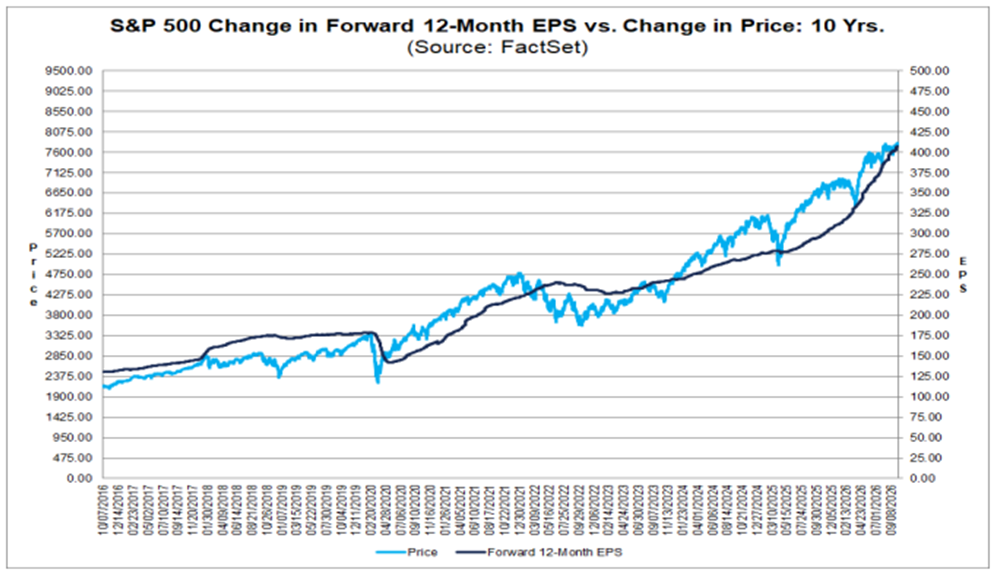
In equity markets, cash flows dictate valuations. While economic headlines and geopolitical friction can drive short-term volatility, corporate earnings serve as the ultimate anchor for equity prices over a medium-to-long-term horizon, and this fact goes a long way toward explaining the market’s resilience.
When S&P 500 aggregate earnings are expanding at a 30% year-over-year rate, as they are expected to do, expanding net income and cash flow absorb market shocks, compress elevated valuation multiples, and render cyclical headwinds secondary to balance sheet growth, so the consensus for the S&P 500 would support a move of 8,000 by year-end if the index earns $420 or better and trades at a 19 P/E ratio.
Graphs are for illustrative and discussion purposes only. Please read important disclosures at the end of this commentary.
Ongoing wars in Eastern Europe and the Middle East create direct friction in global supply chains, energy transport corridors and regional trade security. Investors see this impacting oil prices in real time.

Technology export restrictions, semiconductor manufacturing concentration in East Asia and evolving tariff policies continue to fragment global supply chains and increase regulatory overhead for multinational corporations, as the biggest chip fabrication plants are putting up torrid monthly manufacturing numbers.
Maritime transit security across key bottlenecks, such as the Strait of Hormuz and the Red Sea, introduces persistent shipping rate volatility and insurance premium spikes. But the U.S. Navy has made great progress in maintaining the operations of commercial shipping lanes even as isolated attacks ensue.

Policy pivots within the EU and elsewhere following major elections create fiscal uncertainty over tax policies, industrial subsidies and regulatory enforcement. The French bond market is undergoing severe turbulence, driven by political paralysis, fiscal slippage, and an uneasy reliance on foreign capital.
This friction has pushed the risk premium on the yield spread between 10-year French OATs and German bunds to 135-to-150 basis points, levels not seen since the height of the Eurozone sovereign debt crisis.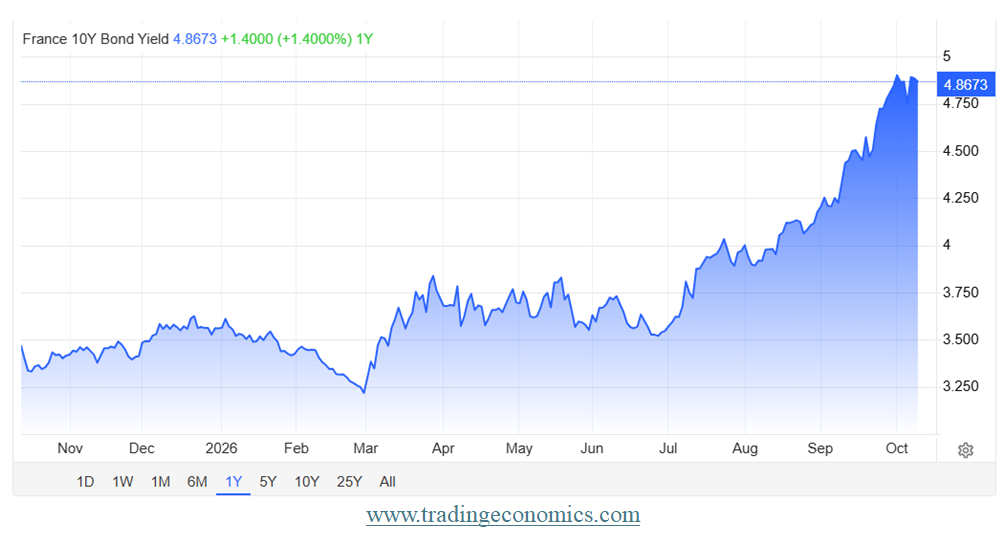
Graphs are for illustrative and discussion purposes only. Please read important disclosures at the end of this commentary.
Sticky sovereign bond yields increase enterprise debt refinancing costs and raise the discount rate used in discounted cash flow (DCF) valuation models. Input cost pressures across labor, logistics, and raw materials compress profit margins for companies lacking pricing power.
Stress across commercial property balance sheets creates localized credit tightening and non-performing loan exposure for mid-sized financial institutions. Regarding the $1.7 trillion private credit market, Fitch Ratings reported the trailing 12-month U.S. Private Credit Default Rate reached 6.3%, with middle-market loan defaults peaking even higher earlier in the year.
Here are why the numbers favor the bulls. When net corporate cash flow grows at 30% year-over-year, the numerator of discounted cash flow (DCF) equation grows significantly faster than typical adjustments to the discount rate caused by elevated interest rates or geopolitical risk premiums.
For instance, an increase in the equity risk premium or discount rate from 8% to 9.5% reduces present value multiples by roughly 10%-to-15%. However, a 30% expansion in corporate cash generation far exceeds that valuation contraction, generating net positive asset expansion.
Geopolitical shocks and macro uncertainties typically manifest as lower price-to-earnings (P/E) multiples, and thus, investors demand higher yields to hold risk assets during uncertain times. However, if earnings per share rise 30%, market indices can experience significant price appreciation as P/E levels contract.
Exceptional earnings growth absorbs multiple compression, converting headline-driven volatility into structural buying opportunities. A 30% growth rate in S&P 500 aggregate net income is not an accidental anomaly; it is driven by three structural market dynamics: High margin concentration in mega-cap technology, enterprise productivity via automation and AI realization, and corporate pricing power.
Historically, equity markets routinely advance through pronounced geopolitical and macroeconomic headwinds provided net earnings remain intact. In every era, short-term headline risk generates temporary volatility spikes, but market indexes can rise once reporting cycles confirm fundamental EPS execution.
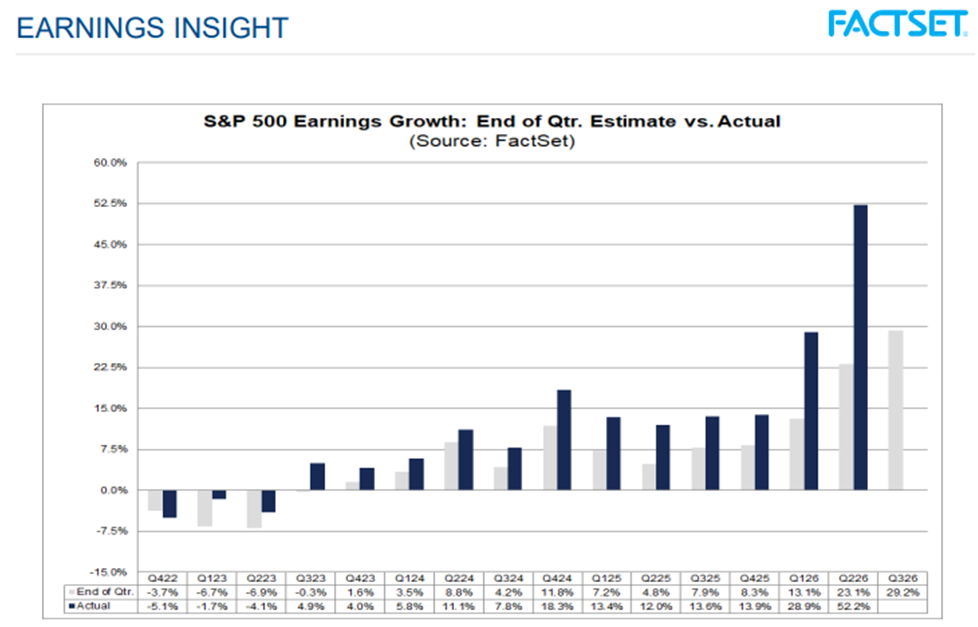
FactSet notes that historical trends of positive earnings surprises mean actual Q3 earnings growth could end up above 35%. This marks the third consecutive quarter of YoY earnings growth exceeding 25% for the index. For the full calendar year, consensus analyst projections collected by FactSet track full-year YoY S&P 500 earnings growth at 32.4% to 33.0%. Tech, Energy, and Communication Services are leading the expansion with robust profit margins (32.3% for IT). Corporate net profit margins are tracking well above their 5-year averages, driven by operational efficiency and pricing power.
Graphs are for illustrative and discussion purposes only. Please read important disclosures at the end of this commentary.
With earnings rising 30%, the S&P 500’s forward 12-month P/E ratio sits at 19.1, which is equal to its 10-year average (19.1) and slightly below its 5-year average (19.8). Strong bottom-line growth is expanding corporate earnings faster than share prices are rising, naturally compressing forward valuation multiples.
While geopolitical friction, yield fluctuations, and global trade realignments create market noise, equity valuations are fundamentally driven by corporate profitability. A 30% year-over-year surge in S&P 500 earnings provides a strong buffer against any headwinds. As long as global enterprises expand cash flow, broaden operating margins and maintain balance-sheet integrity, the underlying bull trend remains intact.
All content above represents the opinion of Bryan Perry of Navellier & Associates, Inc.
Also In This Issue
A Look Ahead by Louis Navellier
France is Falling Apart – Is the EU Next?
Income Mail by Bryan Perry
What Will (or Won’t) Generate A Bullish Year End Rally
Growth Mail by Gary Alexander
U.S. Growth is Better than Expected… But Debt is Worse
Global Mail by Ivan Martchev
More New Highs for Stocks
Sector Spotlight by Jason Bodner
The Market Resembles Two Rivers – Light and Dark – Running in Tandem
View Full Archive
Read Past Issues Here
Important Disclosures:
Although information in these reports has been obtained from and is based upon sources that Navellier believes to be reliable, Navellier does not guarantee its accuracy and it may be incomplete or condensed. All opinions and estimates constitute the authors opinions as of the date the report was created and are subject to change without notice. These reports are for informational purposes only and are not a solicitation for the purchase or sale of any securities or financial services. Any decision to purchase securities mentioned in these reports must take into account existing public information on such securities or any registered prospectus. To the extent permitted by law, neither Navellier & Associates, Inc., nor any of its affiliates, agents, or service providers are providing any investment advice herein and do not assume any liability or responsibility for the readers’ decisions if any. No reader should act or refrain from acting in reliance on the information contained in this communication or for any decision based on it.
None of the stock information, data, or company information presented herein constitutes investment advice or a recommendation by Navellier or a solicitation to buy or sell any securities. Any specific securities identified and described herein do not represent any investment advice.
Information presented is general information that does not take into account your individual circumstances, financial situation, or needs, nor does it present a personalized recommendation to you. Individual stocks presented may not be suitable for every investor. Investment in securities involves significant risk and has the potential for partial or complete loss of funds invested. Investment in fixed income securities has the potential for the investment return and principal value of an investment to fluctuate so that an investor’s holdings, when redeemed, may be worth less than their original cost.
- This report contains statements that are, or may be considered to be, forward-looking statements. All statements that are not historical facts, including statements about our beliefs or expectations, are “forward-looking statements” within the meaning of The U.S. Private Securities Litigation Reform Act of 1995. These statements may be identified by such forward-looking terminology as “expect,” “estimate,” “plan,” “intend,” “believe,” “anticipate,” “may,” “will,” “should,” “could,” “continue,” “project,” or similar statements or variations of such terms. Our forward-looking statements are based on a series of expectations, assumptions, and projections, are not investment advice. All of our forward-looking statements are as of the date of this report only.
- Federal Tax Advice Disclaimer: As required by U.S. Treasury Regulations, you are informed that, to the extent this presentation mentions any federal taxes, Navellier is not presenting any tax advice and should not be used or relied on as tax advice. Navellier does not advise on any income tax requirements or issues. Use of any information presented by Navellier is for general information only and does not represent tax advice either express or implied. You are encouraged to seek professional tax advice for income tax questions and assistance.
- FactSet Disclosure: Navellier does not independently calculate the statistical information included in the attached report. The calculation and the information are provided by FactSet, a company not related to Navellier. Although information contained in the report has been obtained from FactSet and is based on sources Navellier believes to be reliable, Navellier does not guarantee its accuracy, and it may be inaccurate, incomplete or condensed. The report and the related FactSet sourced information is for general information purposes only.