
by Ivan Martchev
June 2, 2026
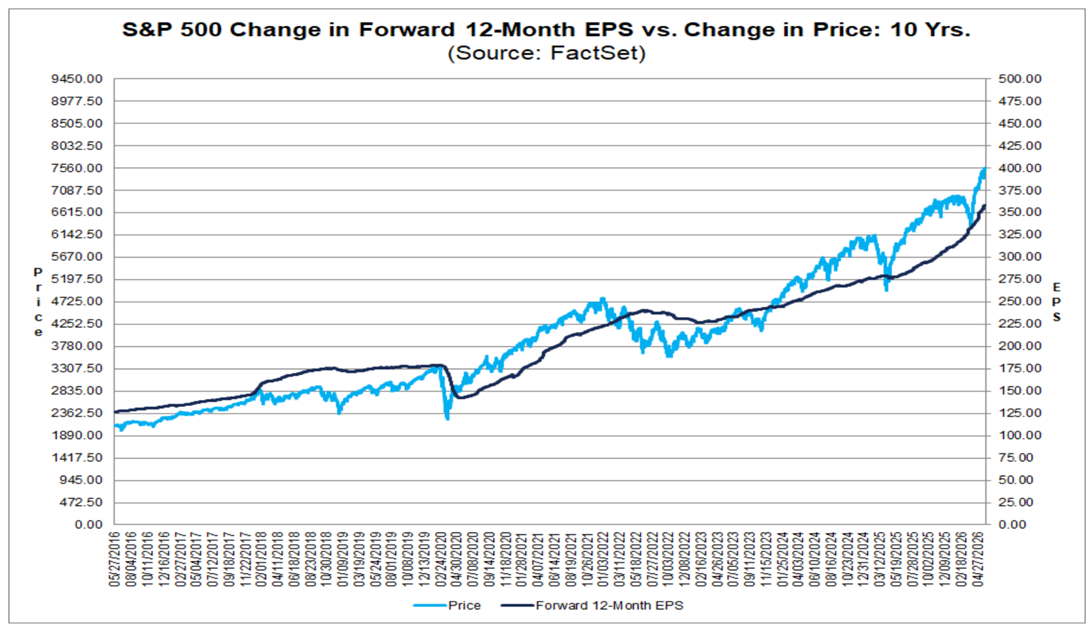
Perhaps the best explanation for this historic rip higher was simply great earnings. According to FactSet, which tracks those numbers closely, “For Q1 2026 (with 97% of S&P 500 companies reporting actual results), 85% of S&P 500 companies have reported a positive EPS surprise and 81% of S&P 500 companies have reported a positive revenue surprise. For Q1 2026, the blended (year-over-year) earnings growth rate for the S&P 500 is 28.6%. If 28.6% is the actual growth rate for the quarter, it will mark the highest earnings growth rate reported by the index since Q4 2021 (32.0%).”
Graphs are for illustrative and discussion purposes only. Please read important disclosures at the end of this commentary.
Most people I talked with recently feared that the Iran war would derail the U.S. economy. In the last month of the first quarter (March), oil prices and interest rates were spiking. While there is a delay before that hits the economy, I thought we would be lucky with 14%-16% EPS growth. Instead, we got 28.6%!
I must add this gain is dominated by the tech sector. Very high EPS growth in the “Mag 7” pulls the average dramatically higher, as Mag 7 gains were over 60% while the other 493 S&P companies gained about 17%. Because of Mag-7 multi-trillion-dollar market caps, average gains skew dramatically higher.
Still, earnings are growing across the board, and the market typically goes up in an accelerating earnings growth environment. If we keep accelerating to the upside like this on EPS growth, I am beginning to think my target of 8,000 on the S&P 500 – made at the beginning of the year – may be conservative.
Graphs are for illustrative and discussion purposes only. Please read important disclosures at the end of this commentary.
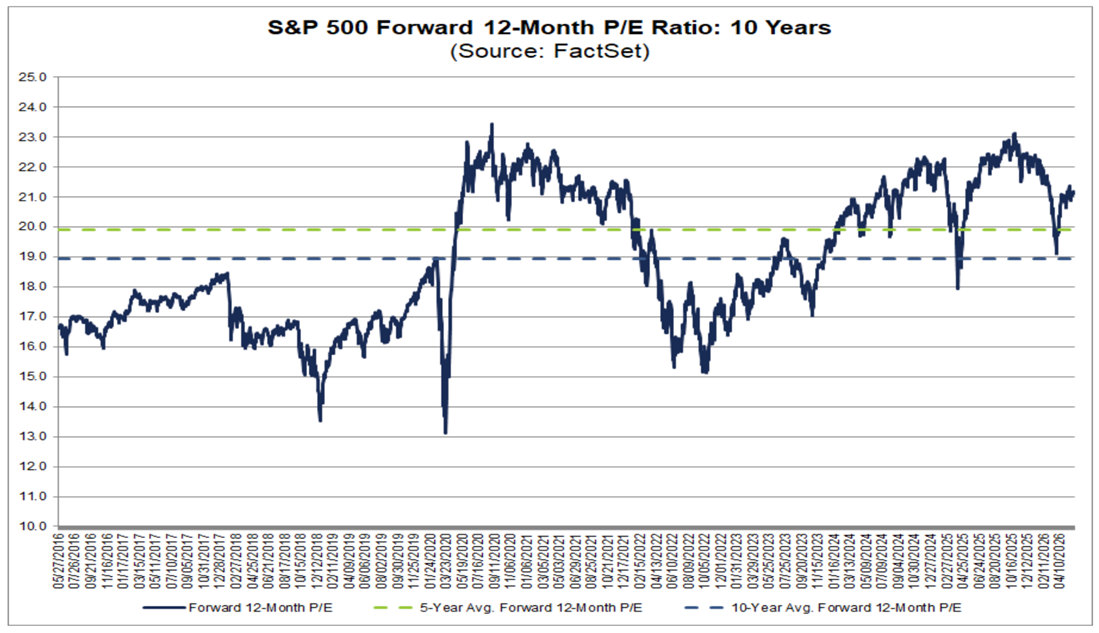
Although EPS is at a record high, earnings multiples aren’t. Stocks are not cheap at 21.2 forward P/E multiples, but that, too, is skewed. If it were not for the Mag 7, the S&P 500 median P/E would be closer to 17. All these numbers do not suggest that it is straight up from here, but they surely suggest more gains.
Still, it remains to be seen what happens when the SpaceX IPO takes $75-billion out of the rest of the market (a number that can go up to $100-billion if there is more investor interest). Will they raise the cash before the June 12 IPO date? There are more trillion-dollar IPOs coming later in the year, but they may very well come in late 2026, when the stock market is expected to be seasonally strong.
Graphs are for illustrative and discussion purposes only. Please read important disclosures at the end of this commentary.
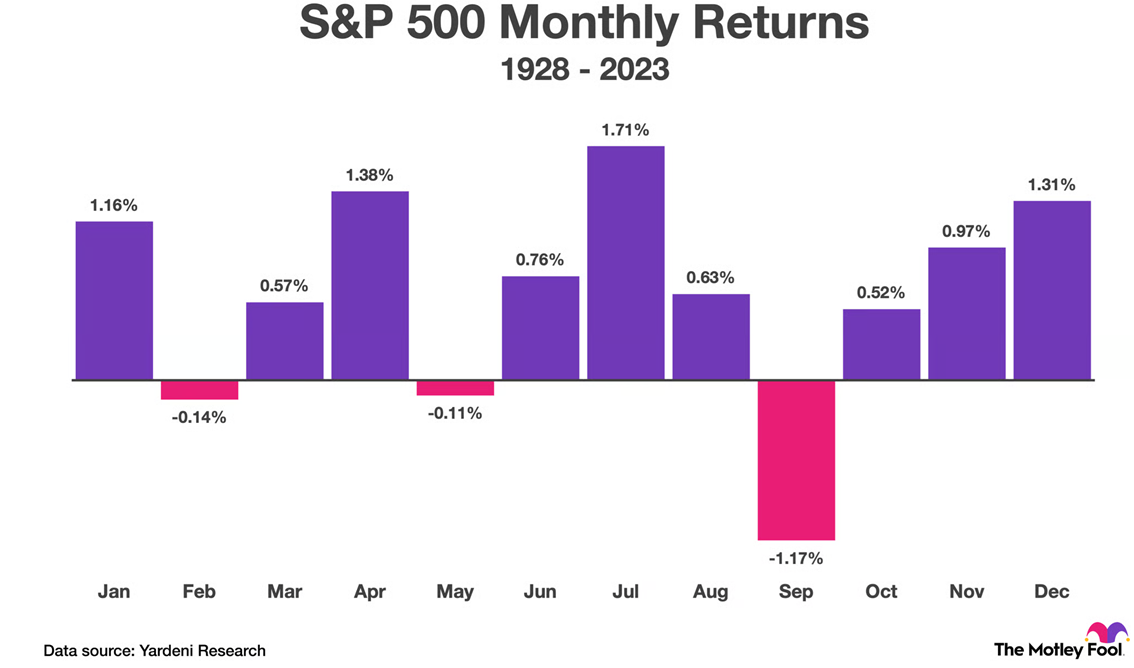
I never did believe in the “Sell in May and go away” theory. Historical 100-year returns are fine for defining trends, but the market can – and often will – sharply deviate from them in any given year.
In 2025, the trade war sharply skewed the averages. This year, it was the Iran war. It remains to be seen how close we track to the long-term average, but it is possible we’ll rally throughout the summer because the market was subdued in the first quarter due to the war – when markets should be seasonally strong.
We also have a new Fed Chairman, who can cause quite the volatility if he proceeds with his stated goal to shrink the Fed balance sheet and cut the Fed funds rate more dramatically. There are no signs this will happen anytime soon, and he needs the FOMC to vote on his dramatic ideas, which they may not do. It would be a warning sign if the FOMC votes against the Fed Chairman, which happened to Paul Volcker.
This is the historical record, per Google’s Gemini:
The “rebellion” against Federal Reserve Chairman Paul Volcker did not actually take place during a meeting of the Federal Open Market Committee (FOMC). Instead, it occurred during a meeting of the Federal Reserve Board of Governors on February 24, 1986.
Here is how the event—frequently dubbed a “coup” by the press—unfolded:
The “Gang of Four” Vote
By early 1986, President Ronald Reagan had appointed several new members to the Board of Governors who favored pro-growth policies and were eager to lower interest rates. Four of these Reagan appointees—Vice Chairman Preston Martin, Martha Seger, Wayne Angell, and Manuel Johnson (dubbed the Gang of Four)—outvoted Volcker 4 to 3 to slash the discount rate from 7.5% to 7%.
Volcker strongly opposed the immediate cut. He wasn’t entirely against lowering rates, but he wanted to delay the move until he could coordinate with the central banks of West Germany and Japan. He feared that if the U.S. cut interest rates unilaterally, foreign investors would pull their capital out, triggering a dangerous, uncontrolled collapse of the U.S. dollar.
The Compromise and Resolution
Being outvoted on a major policy decision was an unprecedented blow to a Fed Chairman’s authority, and rumors quickly spread through the central bank that Volcker was on the verge of resigning. Recognizing the potential chaos that a Volcker resignation would trigger in global financial markets, Governor Wayne Angell went to Volcker’s office later that afternoon to broker a compromise. By the end of the day, the Board reconvened and agreed to suspend the rate cut to give Volcker the time he requested to negotiate with foreign officials.
The strategy paid off. Less than two-weeks later, after West Germany and Japan agreed to reduce their own interest rates, the Board met again and unanimously voted to lower the discount rate to 7%, matching Volcker’s coordinated approach and restoring his command over monetary policy.
I would not be surprised if the new Fed Chair runs into some of his own rebellion issues later in 2026
All content above represents the opinion of Ivan Martchev of Navellier & Associates, Inc.
Also In This Issue
A Look Ahead by Louis Navellier
Some Surprising AI-Related Stock Selections
Income Mail by Bryan Perry
It’s Prime Time for Selling Covered Calls
Growth Mail by Gary Alexander
Forget the 1930s Market – The 2000-09 Crash Was Worse!
Global Mail by Ivan Martchev
What’s Behind This Late Cycle Acceleration?
Sector Spotlight by Jason Bodner
The Quietest Signals Often Have the Loudest Impact
View Full Archive
Read Past Issues Here

Ivan Martchev
INVESTMENT STRATEGIST
Ivan Martchev is an investment strategist with Navellier. Previously, Ivan served as editorial director at InvestorPlace Media. Ivan was editor of Louis Rukeyser’s Mutual Funds and associate editor of Personal Finance. Ivan is also co-author of The Silk Road to Riches (Financial Times Press). The book provided analysis of geopolitical issues and investment strategy in natural resources and emerging markets with an emphasis on Asia. The book also correctly predicted the collapse in the U.S. real estate market, the rise of precious metals, and the resulting increased investor interest in emerging markets. Ivan’s commentaries have been published by MSNBC, The Motley Fool, MarketWatch, and others. All content of “Global Mail” represents the opinion of Ivan Martchev
Important Disclosures:
Although information in these reports has been obtained from and is based upon sources that Navellier believes to be reliable, Navellier does not guarantee its accuracy and it may be incomplete or condensed. All opinions and estimates constitute Navellier’s judgment as of the date the report was created and are subject to change without notice. These reports are for informational purposes only and are not a solicitation for the purchase or sale of a security. Any decision to purchase securities mentioned in these reports must take into account existing public information on such securities or any registered prospectus.To the extent permitted by law, neither Navellier & Associates, Inc., nor any of its affiliates, agents, or service providers assumes any liability or responsibility nor owes any duty of care for any consequences of any person acting or refraining to act in reliance on the information contained in this communication or for any decision based on it.
Past performance is no indication of future results. Investment in securities involves significant risk and has the potential for partial or complete loss of funds invested. It should not be assumed that any securities recommendations made by Navellier. in the future will be profitable or equal the performance of securities made in this report. Dividend payments are not guaranteed. The amount of a dividend payment, if any, can vary over time and issuers may reduce dividends paid on securities in the event of a recession or adverse event affecting a specific industry or issuer.
None of the stock information, data, and company information presented herein constitutes a recommendation by Navellier or a solicitation to buy or sell any securities. Any specific securities identified and described do not represent all of the securities purchased, sold, or recommended for advisory clients. The holdings identified do not represent all of the securities purchased, sold, or recommended for advisory clients and the reader should not assume that investments in the securities identified and discussed were or will be profitable.
Information presented is general information that does not take into account your individual circumstances, financial situation, or needs, nor does it present a personalized recommendation to you. Individual stocks presented may not be suitable for every investor. Investment in securities involves significant risk and has the potential for partial or complete loss of funds invested. Investment in fixed income securities has the potential for the investment return and principal value of an investment to fluctuate so that an investor’s holdings, when redeemed, may be worth less than their original cost.
One cannot invest directly in an index. Index is unmanaged and index performance does not reflect deduction of fees, expenses, or taxes. Presentation of Index data does not reflect a belief by Navellier that any stock index constitutes an investment alternative to any Navellier equity strategy or is necessarily comparable to such strategies. Among the most important differences between the Indices and Navellier strategies are that the Navellier equity strategies may (1) incur material management fees, (2) concentrate its investments in relatively few stocks, industries, or sectors, (3) have significantly greater trading activity and related costs, and (4) be significantly more or less volatile than the Indices.
ETF Risk: We may invest in exchange traded funds (“ETFs”) and some of our investment strategies are generally fully invested in ETFs. Like traditional mutual funds, ETFs charge asset-based fees, but they generally do not charge initial sales charges or redemption fees and investors typically pay only customary brokerage fees to buy and sell ETF shares. The fees and costs charged by ETFs held in client accounts will not be deducted from the compensation the client pays Navellier. ETF prices can fluctuate up or down, and a client account could lose money investing in an ETF if the prices of the securities owned by the ETF go down. ETFs are subject to additional risks:
- ETF shares may trade above or below their net asset value;
- An active trading market for an ETF’s shares may not develop or be maintained;
- The value of an ETF may be more volatile than the underlying portfolio of securities the ETF is designed to track;
- The cost of owning shares of the ETF may exceed those a client would incur by directly investing in the underlying securities; and
- Trading of an ETF’s shares may be halted if the listing exchange’s officials deem it appropriate, the shares are delisted from the exchange, or the activation of market-wide “circuit breakers” (which are tied to large decreases in stock prices) halts stock trading generally.
Grader Disclosures: Investment in equity strategies involves substantial risk and has the potential for partial or complete loss of funds invested. The sample portfolio and any accompanying charts are for informational purposes only and are not to be construed as a solicitation to buy or sell any financial instrument and should not be relied upon as the sole factor in an investment making decision. As a matter of normal and important disclosures to you, as a potential investor, please consider the following: The performance presented is not based on any actual securities trading, portfolio, or accounts, and the reported performance of the A, B, C, D, and F portfolios (collectively the “model portfolios”) should be considered mere “paper” or pro forma performance results based on Navellier’s research.
Investors evaluating any of Navellier & Associates, Inc.’s, (or its affiliates’) Investment Products must not use any information presented here, including the performance figures of the model portfolios, in their evaluation of any Navellier Investment Products. Navellier Investment Products include the firm’s mutual funds and managed accounts. The model portfolios, charts, and other information presented do not represent actual funded trades and are not actual funded portfolios. There are material differences between Navellier Investment Products’ portfolios and the model portfolios, research, and performance figures presented here. The model portfolios and the research results (1) may contain stocks or ETFs that are illiquid and difficult to trade; (2) may contain stock or ETF holdings materially different from actual funded Navellier Investment Product portfolios; (3) include the reinvestment of all dividends and other earnings, estimated trading costs, commissions, or management fees; and, (4) may not reflect prices obtained in an actual funded Navellier Investment Product portfolio. For these and other reasons, the reported performances of model portfolios do not reflect the performance results of Navellier’s actually funded and traded Investment Products. In most cases, Navellier’s Investment Products have materially lower performance results than the performances of the model portfolios presented.
This report contains statements that are, or may be considered to be, forward-looking statements. All statements that are not historical facts, including statements about our beliefs or expectations, are “forward-looking statements” within the meaning of The U.S. Private Securities Litigation Reform Act of 1995. These statements may be identified by such forward-looking terminology as “expect,” “estimate,” “plan,” “intend,” “believe,” “anticipate,” “may,” “will,” “should,” “could,” “continue,” “project,” or similar statements or variations of such terms. Our forward-looking statements are based on a series of expectations, assumptions, and projections, are not guarantees of future results or performance, and involve substantial risks and uncertainty as described in Form ADV Part 2A of our filing with the Securities and Exchange Commission (SEC), which is available at www.adviserinfo.sec.gov or by requesting a copy by emailing info@navellier.com. All of our forward-looking statements are as of the date of this report only. We can give no assurance that such expectations or forward-looking statements will prove to be correct. Actual results may differ materially. You are urged to carefully consider all such factors.
FEDERAL TAX ADVICE DISCLAIMER: As required by U.S. Treasury Regulations, you are informed that, to the extent this presentation includes any federal tax advice, the presentation is not written by Navellier to be used, and cannot be used, for the purpose of avoiding federal tax penalties. Navellier does not advise on any income tax requirements or issues. Use of any information presented by Navellier is for general information only and does not represent tax advice either express or implied. You are encouraged to seek professional tax advice for income tax questions and assistance.
IMPORTANT NEWSLETTER DISCLOSURE:The hypothetical performance results for investment newsletters that are authored or edited by Louis Navellier, including Louis Navellier’s Growth Investor, Louis Navellier’s Breakthrough Stocks, Louis Navellier’s Accelerated Profits, and Louis Navellier’s Platinum Club, are not based on any actual securities trading, portfolio, or accounts, and the newsletters’ reported hypothetical performances should be considered mere “paper” or proforma hypothetical performance results and are not actual performance of real world trades. Navellier & Associates, Inc. does not have any relation to or affiliation with the owner of these newsletters. There are material differences between Navellier Investment Products’ portfolios and the InvestorPlace Media, LLC newsletter portfolios authored by Louis Navellier. The InvestorPlace Media, LLC newsletters contain hypothetical performance that do not include transaction costs, advisory fees, or other fees a client might incur if actual investments and trades were being made by an investor. As a result, newsletter performance should not be used to evaluate Navellier Investment services which are separate and different from the newsletters. The owner of the newsletters is InvestorPlace Media, LLC and any questions concerning the newsletters, including any newsletter advertising or hypothetical Newsletter performance claims, (which are calculated solely by Investor Place Media and not Navellier) should be referred to InvestorPlace Media, LLC at (800) 718-8289.
Please note that Navellier & Associates and the Navellier Private Client Group are managed completely independent of the newsletters owned and published by InvestorPlace Media, LLC and written and edited by Louis Navellier, and investment performance of the newsletters should in no way be considered indicative of potential future investment performance for any Navellier & Associates separately managed account portfolio. Potential investors should consult with their financial advisor before investing in any Navellier Investment Product.
Navellier claims compliance with Global Investment Performance Standards (GIPS). To receive a complete list and descriptions of Navellier’s composites and/or a presentation that adheres to the GIPS standards, please contact Navellier or click here. It should not be assumed that any securities recommendations made by Navellier & Associates, Inc. in the future will be profitable or equal the performance of securities made in this report.
FactSet Disclosure: Navellier does not independently calculate the statistical information included in the attached report. The calculation and the information are provided by FactSet, a company not related to Navellier. Although information contained in the report has been obtained from FactSet and is based on sources Navellier believes to be reliable, Navellier does not guarantee its accuracy, and it may be incomplete or condensed. The report and the related FactSet sourced information are provided on an “as is” basis. The user assumes the entire risk of any use made of this information. Investors should consider the report as only a single factor in making their investment decision. The report is for informational purposes only and is not intended as an offer or solicitation for the purchase or sale of a security. FactSet sourced information is the exclusive property of FactSet. Without prior written permission of FactSet, this information may not be reproduced, disseminated or used to create any financial products. All indices are unmanaged and performance of the indices include reinvestment of dividends and interest income, unless otherwise noted, are not illustrative of any particular investment and an investment cannot be made in any index. Past performance is no guarantee of future results.