
by Gary Alexander
June 16, 2026
As we approach our nation’s 250th birthday – 18-days from now – it may be time to ask why so few other nations adopted our winning approach. Why not Declare your own Independence, fight for it (if tyrants don’t surrender), then copy our Constitution – minus its obvious flaws – and emulate our success story?
Outside of tiny San Marino (with just 24-square miles), the USA is the world’s oldest representative constitutional government in existence today. Our Constitution took effect in 1789, the same year the French stormed the Bastille, seeking freedom, but France ended up with a Reign of Terror, including massive guillotine executions, then a worthless currency and a squat little military dictator from Corsica taking over the nation within a decade. In our first decade, by contrast, we had a Whiskey Rebellion in which President George Washington defeated, then forgave, all the miscreants. (In the same decade, in 1798, Haiti staged a revolution from European control, and yet they remain dirt poor, 228-years later).
In the same year our Declaration of Independence was drafted, Adam Smith published “Inquiry into the Wealth of Nations.” Taken together with Tom Paine’s “Common Sense,” these major 1776 masterpieces still provide a road map to national health and individual wealth, so why do so few nations follow them?
In 2024, I retired from my regular conference stage jobs – MC at the New Orleans Investment Conference and panel moderator at FreedomFest (usually in Las Vegas) – but I plan to come out of retirement one more time to partake in a celebration of our July 1776 national birthday at this year’s FreedomFest (July 8-11), where I play John Adams once again, in a re-enactment of our nation’s birth (more on that later).
In that conference, I will also moderate two or three film panels, since I have been one of the founding judges (now “Senior Judge”) of the Anthem Film Festival, created and led by Jo Ann Skousen, wife of FreedomFest director, Mark Skousen. She selects films based on quality and a freedom theme and here are four films I’d like to summarize as case studies in the search for national health and personal wealth – two once-wealthy socialist basket cases in our hemisphere, and two recovering socialist nations abroad.

Millions Flee Cuba and Venezuela – At Great Danger – Seeking Freedom
The first two films (pictured above) cover massive migration out of Cuba and Venezuela recently.
In the last five-years, Cuba has lost at least 1.2-million citizens (out of barely 10-million population), due to a crackdown after massive street demonstrations for freedom on July 11, 2021. Cuba’s new dictators (no better than Fidel Castro) threw thousands in jail for very long prison terms and threatened others if they did not remain silent. This July 11, on the final night of this FreedomFest, we present various film awards, and it would be ironic if “Cuba’s Eternal Night” wins – on the fifth anniversary of July 11, 2021.
The most poignant story in this film is that of Ariadna Mena Rubio and her husband Enrique on their incredibly long and hard journey, starting with a flight to Surinam, then mostly hiking across a dozen nations to reach America. (The roughest patch was 50-miles of the Darien Gap entering Panama, with no roads). Now, they happily share with us the amazing freedom of speech and riches in America – at a time when so many native-born Americans can only complain about the division of wealth or political issues.
Adriana’s Long March is typical of a million others, as Cuba lost 1.2 to 1.4-million citizens after the 2021 revolt. Filmed mostly inside Cuba (by brave directors and camera operators), “Cuba’s Eternal Night” follows Ariadna and four other families over the last five-years as they struggle with scarcity of food and medicine leading to the biggest mass exodus Cuba has ever experienced – barely covered in our news.
I’m old enough to recall the day Castro took over Cuba on January 1, 1959. After our Christmas break (in 8th grade at Puget Sound Junior High, Seattle), we kids were excited and hopeful for freedom in Cuba, but our wise teacher, Miss Perry, said, “Let’s wait a while to see how things turn out there.” Wise counsel, as Fidel Castro quickly turned toward the Soviet Union for help and then began persecuting his own people.
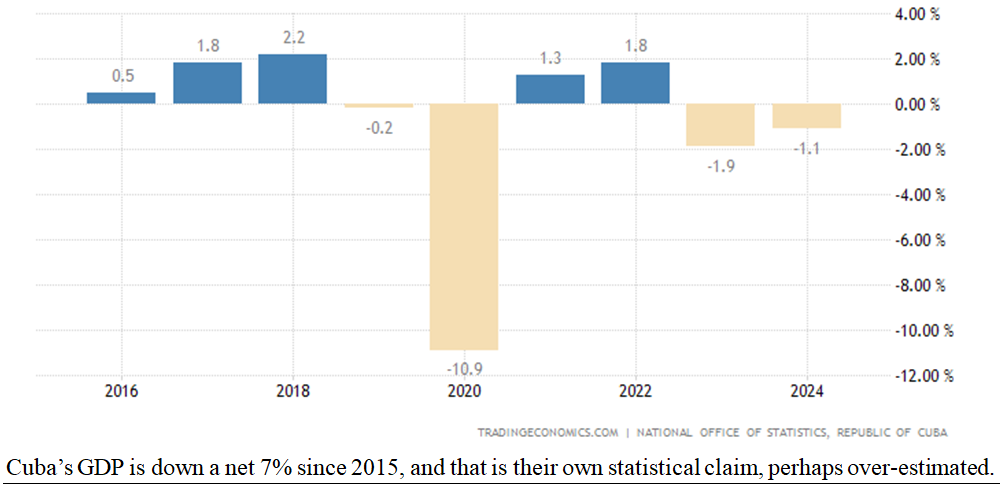
Since this is an economic column, I want to give some time to national GDP figures among these four-nations. The official economic situation in Cuba is anemic, with a net decline of 7% in GDP since 2015:
Graphs are for illustrative and discussion purposes only. Please read important disclosures at the end of this commentary.
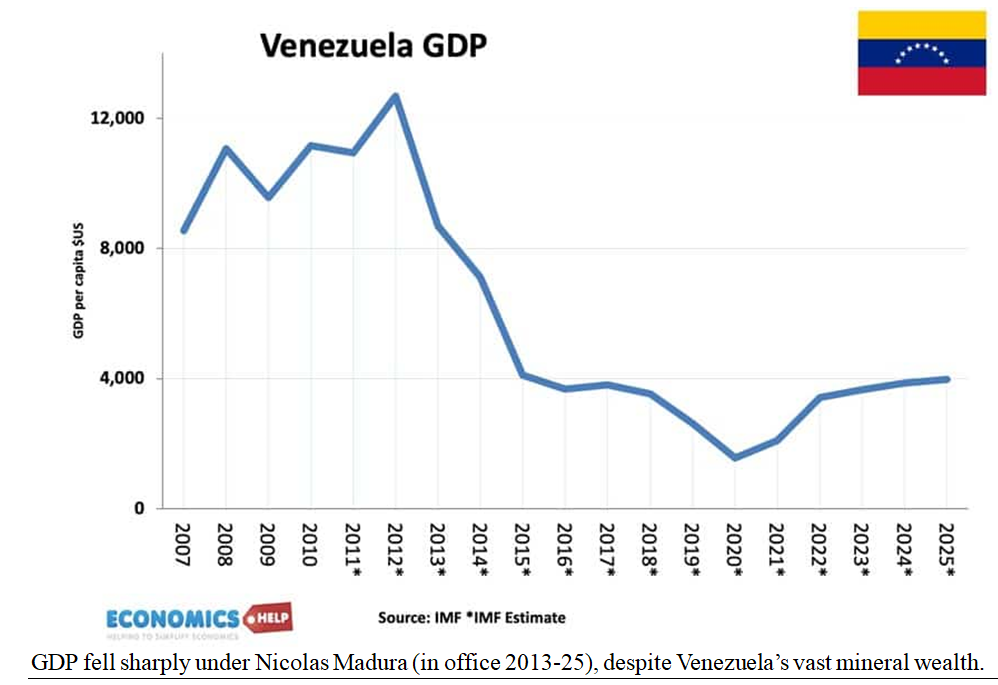
Venezuela provides an even more dramatic tale, as an estimated 7.9-million Venezuelans have left that country in the last decade, especially after high inflation and famine accelerated in 2015, under the new President Nicolas Maduro – who made his predecessor Hugo Chavez seem like a friendly old Santa Claus. The loss of nearly eight-million Venezuelans in a decade represents roughly 23% of the population, which makes their exodus one of the largest global dispersion and refugee crises in modern history.
This exodus is all the more amazing since Venezuela was once one of the richest countries in the world. It was even the richest nation in South America at one point, controlling the largest fossil fuel reserves of any nation on earth – making it (temporarily) the Saudi (literally “good fortune”) Arabia of the Americas.
Then, Venezuela suffered the first of its socialist takeovers under Carlos Andrés Pérez, president of Venezuela from 1974 to 1979 and again from 1989 to 1993. He nationalized the oil industry in 1976, and Venezuela began to suffer under his control before Hugo Chavez came in to blame poverty and famine on capitalists, not socialists. This began one of the worst economic collapses ever suffered in peacetime.
Graphs are for illustrative and discussion purposes only. Please read important disclosures at the end of this commentary.
Like the Cuba film, above, “Escaping Venezuela” focuses on the fate of one family, led by a businessman father, Carlos Mora, imprisoned and tortured for 45-days before negotiating a path out of the nation he loves. It took a while for his family to be reunited in America, but that made for a touching film finale.
Syria and Sweden Go on a Roller Coast Ride Toward Freedom
Cuba and Venezuela are long documentaries (over an hour each), while the Syria and Sweden films are shorter (16 and 36-minutes, respectively). They are also much more interested in historical perspectives, based on comparative financial prosperity (or relative poverty) in their past, going back a century or more.
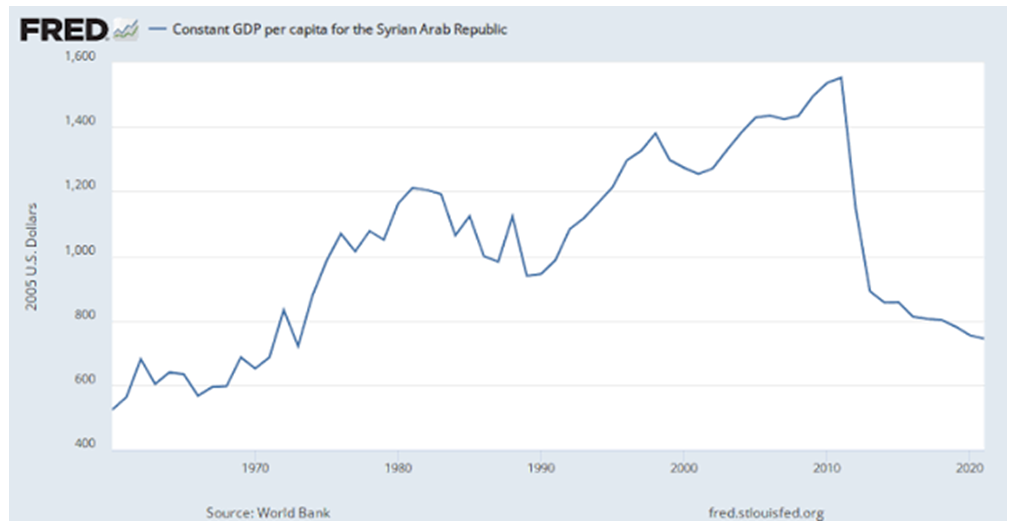
Syria sported a fairly sound economy and stable political structure until Gamal Abdel Nasser took control of Egypt in the 1950s, soon exporting his brand of tyrannical socialism into neighbor nations, including Syria. Then, for more than half a century, the Assad regime strangled Syria — silencing dissent, attacking business owners and driving millions into exile. From 2011 to 2016, a national civil war destroyed the economy and drove millions of Syrians out of that relatively small nation.
In those five-years, around five million Syrians migrated to other nearby countries, seeking asylum. Nearly one-million fled to Europe in the 2015–2016 migrant wave alone, and about four-million Syrian refugees fled to neighboring countries, such as Turkey, Lebanon, Jordan, Iraq, Egypt, and North Africa, according to the UNHCR, the UN’s lead refugee agency. Some are now returning. “Free Syria: Syria’s Economic Renewal” focuses on Mazen Derawan, a Syrian American entrepreneur returning to Damascus.
Graphs are for illustrative and discussion purposes only. Please read important disclosures at the end of this commentary.
The Assad regime was overthrown in December 2024, and this film starts reporting on homecomings in January 2025, just a month after the collapse of the Assad dictatorship. This is a case where I’d recall my 8th grade Social Studies teacher, Miss Perry, saying “wait and see” a bit before feeling secure about Syria.
Unlike the other three-nations profiled here, Sweden is still a great place to visit – and to end this film survey with a real success story. For decades, Sweden has been held up by the soft socialists in America as the ideal “mixed” (-up) economy, half socialist, half capitalist – or so say Bernie Sanders, Alexandria Ocasio Cortez and New York City major Zohran Mamdani. They laud the Scandinavian model, especially Sweden, for their nationalized healthcare and generous welfare programs funded by a super-high tax rate.
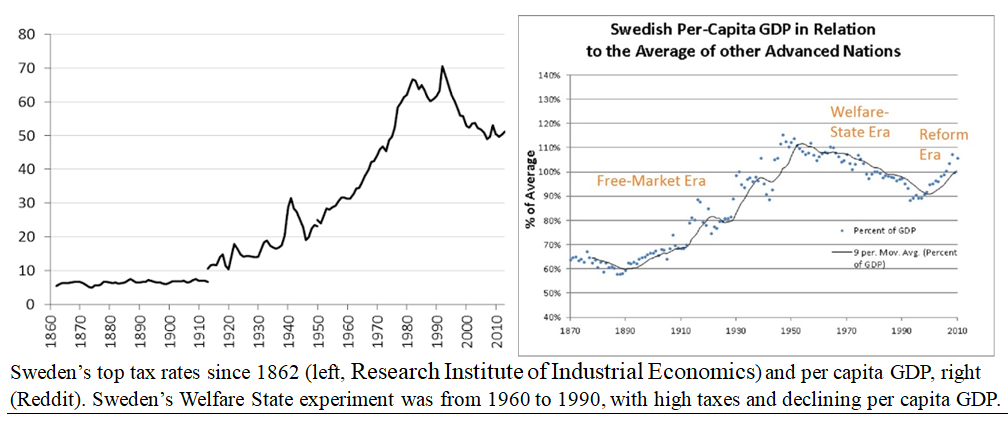
On a closer look, however, Sweden’s socialist phase lasted barely 25-years, and, in the process, Sweden drove its richest and most creative citizens and companies abroad, seeking more tax-friendly lands.
According to the creators of “What Sweden Got Right” (and others didn’t), Sweden was one of Europe’s poorest countries in the mid-1800s, when the economy was rescued by pro-market reforms with lower taxes and open trade, making Sweden one of the world’s richest nations by the mid-20th century.
That bred complacency. In the radicalized 1960s and 1970s, when Keynesian economics and bigger governments charmed way too many politicians and voters, worldwide, Sweden experimented with radical social programs, including sky-high taxes, massive welfare expansion, and heavy regulation.
Sweden’s economy stagnated under socialism, amidst soaring inflation, and a devastating financial crisis in the early 1990s, nearly bankrupting the country. In this film, as in previous Anthem Film Festival entries (about Vietnam and Poland). German economist Rainer Zitelmann and Polish director Tomasz Agencki traced Sweden’s dramatic rise and fall and resurrection – all in the last century, a fascinating tale.
Graphs are for illustrative and discussion purposes only. Please read important disclosures at the end of this commentary.
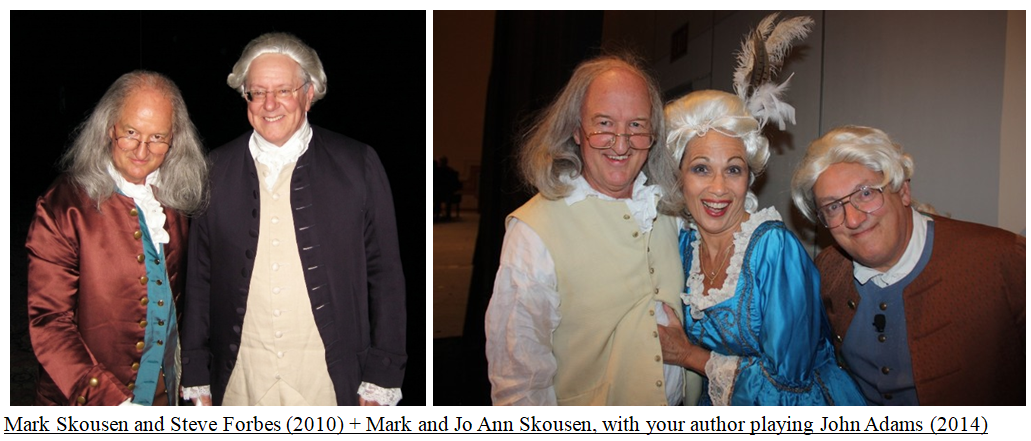
And now, for something totally different. FreedomFest organizers – Mark and Jo Ann Skousen and their family – have decided to repeat parts of our previous skit on the creation of Jefferson’s 1776 Declaration, with Dr. Skousen as Ben Franklin and Steve Forbes playing General George Washington. I’ll play John Adams. In this skit, I offer a song on how Adams could have written a better Declaration–of book length.
Come join us: Here are two photographs from two previous FreedomFest Follies, from 2010 and 2014:
All content above represents the opinion of Gary Alexander of Navellier & Associates, Inc.
Also In This Issue
A Look Ahead by Louis Navellier
The ECB Raises Rates – to Bring Inflation Down?
Income Mail by Bryan Perry
The Countdown to “Q-Day” Begins
Growth Mail by Gary Alexander
Freedom and Capitalism Can Still Boost the Wealth of Nations
Global Mail by Ivan Martchev
This Market Looks Like a “Best-Case Scenario”
Sector Spotlight by Jason Bodner
Elon Musk’s Wealth Soars “To Infinity and Beyond”
View Full Archive
Read Past Issues Here
About The Author

Gary Alexander
SENIOR EDITOR
Gary Alexander has been Senior Writer at Navellier since 2009. He edits Navellier’s weekly Marketmail and writes a weekly Growth Mail column, in which he uses market history to support the case for growth stocks. For the previous 20-years before joining Navellier, he was Senior Executive Editor at InvestorPlace Media (formerly Phillips Publishing), where he worked with several leading investment analysts, including Louis Navellier (since 1997), helping launch Louis Navellier’s Blue Chip Growth and Global Growth newsletters.
Prior to that, Gary edited Wealth Magazine and Gold Newsletter and wrote various investment research reports for Jefferson Financial in New Orleans in the 1980s. He began his financial newsletter career with KCI Communications in 1980, where he served as consulting editor for Personal Finance newsletter while serving as general manager of KCI’s Alexandria House book division. Before that, he covered the economics beat for news magazines. All content of “Growth Mail” represents the opinion of Gary Alexander
Important Disclosures:
Although information in these reports has been obtained from and is based upon sources that Navellier believes to be reliable, Navellier does not guarantee its accuracy and it may be incomplete or condensed. All opinions and estimates constitute Navellier’s judgment as of the date the report was created and are subject to change without notice. These reports are for informational purposes only and are not a solicitation for the purchase or sale of a security. Any decision to purchase securities mentioned in these reports must take into account existing public information on such securities or any registered prospectus.To the extent permitted by law, neither Navellier & Associates, Inc., nor any of its affiliates, agents, or service providers assumes any liability or responsibility nor owes any duty of care for any consequences of any person acting or refraining to act in reliance on the information contained in this communication or for any decision based on it.
Past performance is no indication of future results. Investment in securities involves significant risk and has the potential for partial or complete loss of funds invested. It should not be assumed that any securities recommendations made by Navellier. in the future will be profitable or equal the performance of securities made in this report. Dividend payments are not guaranteed. The amount of a dividend payment, if any, can vary over time and issuers may reduce dividends paid on securities in the event of a recession or adverse event affecting a specific industry or issuer.
None of the stock information, data, and company information presented herein constitutes a recommendation by Navellier or a solicitation to buy or sell any securities. Any specific securities identified and described do not represent all of the securities purchased, sold, or recommended for advisory clients. The holdings identified do not represent all of the securities purchased, sold, or recommended for advisory clients and the reader should not assume that investments in the securities identified and discussed were or will be profitable.
Information presented is general information that does not take into account your individual circumstances, financial situation, or needs, nor does it present a personalized recommendation to you. Individual stocks presented may not be suitable for every investor. Investment in securities involves significant risk and has the potential for partial or complete loss of funds invested. Investment in fixed income securities has the potential for the investment return and principal value of an investment to fluctuate so that an investor’s holdings, when redeemed, may be worth less than their original cost.
One cannot invest directly in an index. Index is unmanaged and index performance does not reflect deduction of fees, expenses, or taxes. Presentation of Index data does not reflect a belief by Navellier that any stock index constitutes an investment alternative to any Navellier equity strategy or is necessarily comparable to such strategies. Among the most important differences between the Indices and Navellier strategies are that the Navellier equity strategies may (1) incur material management fees, (2) concentrate its investments in relatively few stocks, industries, or sectors, (3) have significantly greater trading activity and related costs, and (4) be significantly more or less volatile than the Indices.
ETF Risk: We may invest in exchange traded funds (“ETFs”) and some of our investment strategies are generally fully invested in ETFs. Like traditional mutual funds, ETFs charge asset-based fees, but they generally do not charge initial sales charges or redemption fees and investors typically pay only customary brokerage fees to buy and sell ETF shares. The fees and costs charged by ETFs held in client accounts will not be deducted from the compensation the client pays Navellier. ETF prices can fluctuate up or down, and a client account could lose money investing in an ETF if the prices of the securities owned by the ETF go down. ETFs are subject to additional risks:
- ETF shares may trade above or below their net asset value;
- An active trading market for an ETF’s shares may not develop or be maintained;
- The value of an ETF may be more volatile than the underlying portfolio of securities the ETF is designed to track;
- The cost of owning shares of the ETF may exceed those a client would incur by directly investing in the underlying securities; and
- Trading of an ETF’s shares may be halted if the listing exchange’s officials deem it appropriate, the shares are delisted from the exchange, or the activation of market-wide “circuit breakers” (which are tied to large decreases in stock prices) halts stock trading generally.
Grader Disclosures: Investment in equity strategies involves substantial risk and has the potential for partial or complete loss of funds invested. The sample portfolio and any accompanying charts are for informational purposes only and are not to be construed as a solicitation to buy or sell any financial instrument and should not be relied upon as the sole factor in an investment making decision. As a matter of normal and important disclosures to you, as a potential investor, please consider the following: The performance presented is not based on any actual securities trading, portfolio, or accounts, and the reported performance of the A, B, C, D, and F portfolios (collectively the “model portfolios”) should be considered mere “paper” or pro forma performance results based on Navellier’s research.
Investors evaluating any of Navellier & Associates, Inc.’s, (or its affiliates’) Investment Products must not use any information presented here, including the performance figures of the model portfolios, in their evaluation of any Navellier Investment Products. Navellier Investment Products include the firm’s mutual funds and managed accounts. The model portfolios, charts, and other information presented do not represent actual funded trades and are not actual funded portfolios. There are material differences between Navellier Investment Products’ portfolios and the model portfolios, research, and performance figures presented here. The model portfolios and the research results (1) may contain stocks or ETFs that are illiquid and difficult to trade; (2) may contain stock or ETF holdings materially different from actual funded Navellier Investment Product portfolios; (3) include the reinvestment of all dividends and other earnings, estimated trading costs, commissions, or management fees; and, (4) may not reflect prices obtained in an actual funded Navellier Investment Product portfolio. For these and other reasons, the reported performances of model portfolios do not reflect the performance results of Navellier’s actually funded and traded Investment Products. In most cases, Navellier’s Investment Products have materially lower performance results than the performances of the model portfolios presented.
This report contains statements that are, or may be considered to be, forward-looking statements. All statements that are not historical facts, including statements about our beliefs or expectations, are “forward-looking statements” within the meaning of The U.S. Private Securities Litigation Reform Act of 1995. These statements may be identified by such forward-looking terminology as “expect,” “estimate,” “plan,” “intend,” “believe,” “anticipate,” “may,” “will,” “should,” “could,” “continue,” “project,” or similar statements or variations of such terms. Our forward-looking statements are based on a series of expectations, assumptions, and projections, are not guarantees of future results or performance, and involve substantial risks and uncertainty as described in Form ADV Part 2A of our filing with the Securities and Exchange Commission (SEC), which is available at www.adviserinfo.sec.gov or by requesting a copy by emailing info@navellier.com. All of our forward-looking statements are as of the date of this report only. We can give no assurance that such expectations or forward-looking statements will prove to be correct. Actual results may differ materially. You are urged to carefully consider all such factors.
FEDERAL TAX ADVICE DISCLAIMER: As required by U.S. Treasury Regulations, you are informed that, to the extent this presentation includes any federal tax advice, the presentation is not written by Navellier to be used, and cannot be used, for the purpose of avoiding federal tax penalties. Navellier does not advise on any income tax requirements or issues. Use of any information presented by Navellier is for general information only and does not represent tax advice either express or implied. You are encouraged to seek professional tax advice for income tax questions and assistance.
IMPORTANT NEWSLETTER DISCLOSURE:The hypothetical performance results for investment newsletters that are authored or edited by Louis Navellier, including Louis Navellier’s Growth Investor, Louis Navellier’s Breakthrough Stocks, Louis Navellier’s Accelerated Profits, and Louis Navellier’s Platinum Club, are not based on any actual securities trading, portfolio, or accounts, and the newsletters’ reported hypothetical performances should be considered mere “paper” or proforma hypothetical performance results and are not actual performance of real world trades. Navellier & Associates, Inc. does not have any relation to or affiliation with the owner of these newsletters. There are material differences between Navellier Investment Products’ portfolios and the InvestorPlace Media, LLC newsletter portfolios authored by Louis Navellier. The InvestorPlace Media, LLC newsletters contain hypothetical performance that do not include transaction costs, advisory fees, or other fees a client might incur if actual investments and trades were being made by an investor. As a result, newsletter performance should not be used to evaluate Navellier Investment services which are separate and different from the newsletters. The owner of the newsletters is InvestorPlace Media, LLC and any questions concerning the newsletters, including any newsletter advertising or hypothetical Newsletter performance claims, (which are calculated solely by Investor Place Media and not Navellier) should be referred to InvestorPlace Media, LLC at (800) 718-8289.
Please note that Navellier & Associates and the Navellier Private Client Group are managed completely independent of the newsletters owned and published by InvestorPlace Media, LLC and written and edited by Louis Navellier, and investment performance of the newsletters should in no way be considered indicative of potential future investment performance for any Navellier & Associates separately managed account portfolio. Potential investors should consult with their financial advisor before investing in any Navellier Investment Product.
Navellier claims compliance with Global Investment Performance Standards (GIPS). To receive a complete list and descriptions of Navellier’s composites and/or a presentation that adheres to the GIPS standards, please contact Navellier or click here. It should not be assumed that any securities recommendations made by Navellier & Associates, Inc. in the future will be profitable or equal the performance of securities made in this report.
FactSet Disclosure: Navellier does not independently calculate the statistical information included in the attached report. The calculation and the information are provided by FactSet, a company not related to Navellier. Although information contained in the report has been obtained from FactSet and is based on sources Navellier believes to be reliable, Navellier does not guarantee its accuracy, and it may be incomplete or condensed. The report and the related FactSet sourced information are provided on an “as is” basis. The user assumes the entire risk of any use made of this information. Investors should consider the report as only a single factor in making their investment decision. The report is for informational purposes only and is not intended as an offer or solicitation for the purchase or sale of a security. FactSet sourced information is the exclusive property of FactSet. Without prior written permission of FactSet, this information may not be reproduced, disseminated or used to create any financial products. All indices are unmanaged and performance of the indices include reinvestment of dividends and interest income, unless otherwise noted, are not illustrative of any particular investment and an investment cannot be made in any index. Past performance is no guarantee of future results.