
by Gary Alexander
September 9, 2026
Labor Day marks a time for a clear-eyed view of the U.S. labor market as a competitive force in the world, but I sometimes wonder why we celebrate Labor Day when the value of work to many Americans seems to be rapidly diminishing. Before addressing that, let me celebrate (or note) two-historic events:
- Happy 250th Birthday to the USA! Even though the idea of an independent America was born on July 4th, 1776, our infant Republic was officially named 250-years ago today. On September 9, 1776, the Second Continental Congress in Philadelphia officially adopted our full national name as “The United States of America.” Previously, the term “United Colonies” was used to identify the union.
- In contrast, this Friday marks the sad 25th anniversary of the 9-11 (2001) Attack on America. Three-weeks ago, I wrote about five financial repercussions of that terrible tragedy, fueling 25-years of wars and huge budget deficits: 8-18-26: Five Big Financial Surprises in the Last 25-Years – Navellier.
Now, let’s celebrate Labor Day. I’m a big fan of working hard and smart for a variety of reasons, as a life of leisure is often over-rated. Even in semi-retirement, I want to keep working to keep my mind sharp.
President John Adams is the unsung hero of our nation’s founding, according to many authors, so let me quote the irascible Adams on the changing nature of work, especially since I played John Adams recently:
“I must study politics and war, that my sons may have liberty to study mathematics and philosophy, geography, natural history and naval architecture, navigation, commerce, and agriculture, in order to give their children the right to study painting, poetry, music, architecture, statuary, tapestry, and porcelain.”
-–John Adams, in a letter to his wife Abigail on May 12, 1780
The Adams family fulfilled that prophecy, with some exceptions. John and Abigail’s oldest son, John Quincy, became a profoundly successful diplomat from age 14 on, then our 6th President, followed by his best work – as an aging abolitionist congressman. John and Abigail also spawned a wastrel alcoholic son, but that’s life’s cruel lottery. John Quincy Adams’ grandson, Henry Adams (1838-1918), was a notable author and historian who wrote The Education of Henry Adams and The Dynamic Theory of History.
This brief rundown of the Adams family tree reveals few grandkids dabbling in “tapestry and porcelain,” but perhaps a modern Adams would grumble over their Gen Z descendants playing video games at home or seeking careers as tattoo artists, internet influencers, baristas, or other dead-end low-paying side shows.
Part of the problem is how COVID introduced office workers to the option of working from home. That happened a century earlier, too, after World War I and a pandemic, as reflected in a #1 hit song: “How Ya Gonna Keep ‘em Down on the Farm (After They’ve Seen Paree?).” I suppose a post-COVID equivalent rap riff would start: “Why should workers ever commute to their jobs, after they’ve worked from home?”
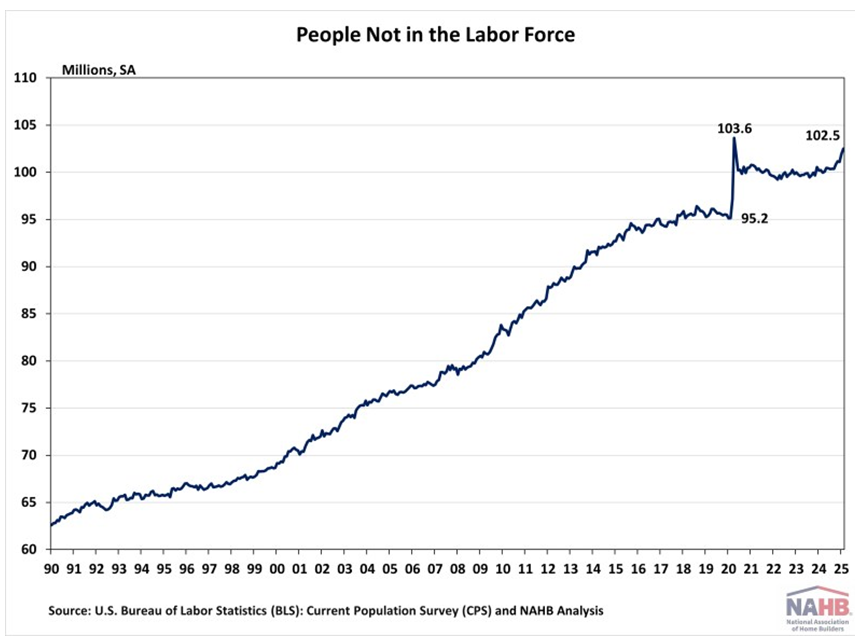
After America suffered the new Four Horsemen of the 21st Century – the Dot-com bubble, the 9-11 attack in 2001, the 2008 Great Recession and the 2020 COVID pandemic – the U.S. labor force went on strike. Since COVID, over 100 million adult Americans have chosen to remain outside the labor force. That figure rose 65% from 1990 to 2020 with over 100 million workers still on strike, ever since COVID.
Graphs are for illustrative and discussion purposes only. Please read important disclosures at the end of this commentary.
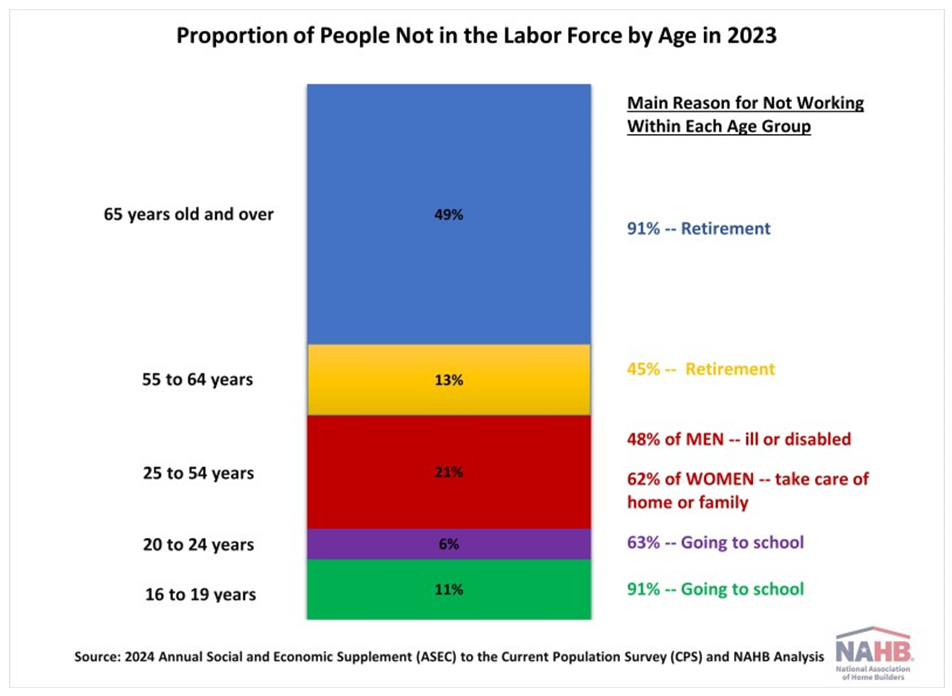
Worse yet, prime-age workers, age 25 to 54, the largest bloc of active workers, finds almost half of men outside the labor force citing illness or disability as their reason, even though jobs are safer than ever.
Graphs are for illustrative and discussion purposes only. Please read important disclosures at the end of this commentary.
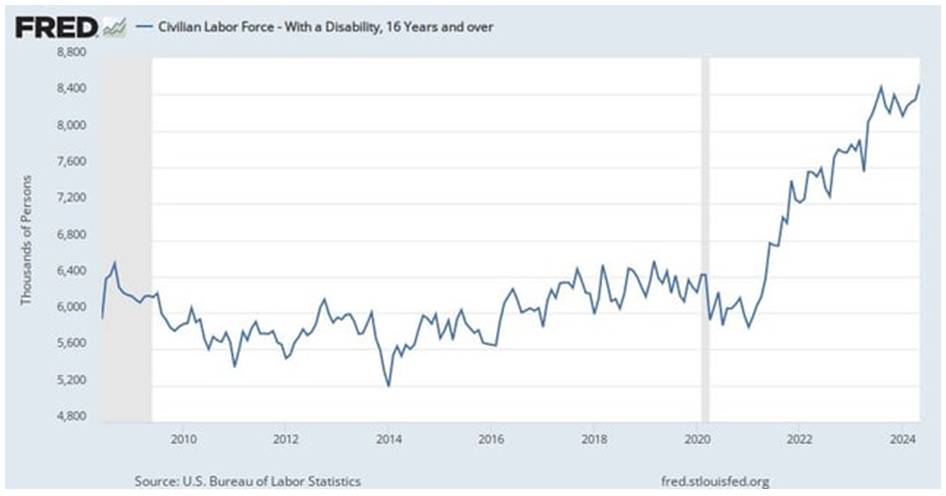
In 1960, only about 1% of workers claimed disability. Now, with safer jobs, disability claims are over 10%. According to the U.S. Census Bureau, the total civilian non-institutionalized population with an officially reported disability reached an all-time high of 45.8 million (13.7% of the population) last year.
Many disability claims are marginal, not defined by physical limitations. Motivated Americans work around their limits. I worked for a paraplegic CEO in the 1980s, and quadriplegic Charles Krauthammer was on my New Orleans Investment Conference political panel from 2009 until his final illness in 2017.
Even before COVID, we witnessed a new relationship between work and life in America. More workers were “playing the system,” opting for early retirement at generous pension levels through government or union contracts, or gaming the disability system. With far safer workplaces than in the coal-mining era of 70-years (and 16-tons) ago, millions of workers discovered bad backs or designer diseases to retire early.
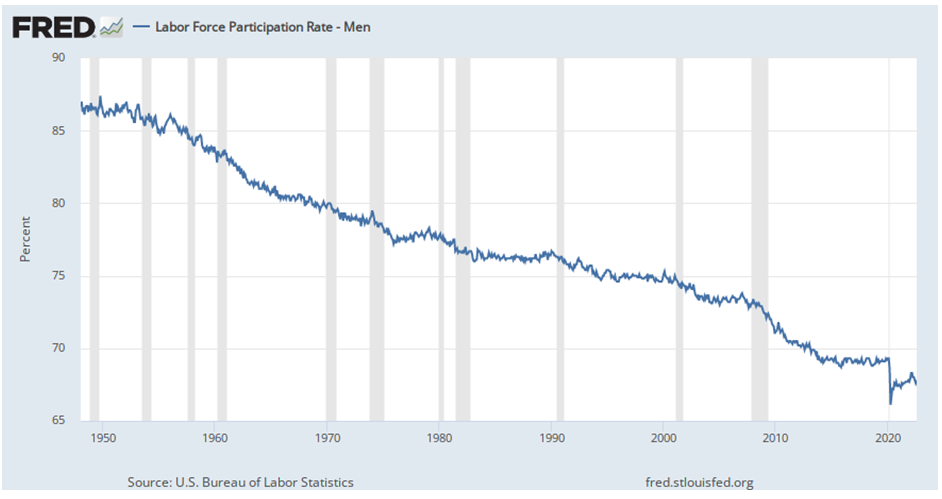
In the 1950s, most men felt they had to work, as sole breadwinners, so 87% of men of working age were at work or looking for work. Since 2013, that number has remained below 70% (see chart, below).
Graphs are for illustrative and discussion purposes only. Please read important disclosures at the end of this commentary.
About one of every three working-age men today are not in the labor force – the lowest rate ever – but today’s disabled workers on relief are not generally in wheelchairs. They have sore backs or mental issues or drug addiction. Before the pandemic, the major reasons for avoiding work were: (1) disability claims or drug addiction; (2) lower incentives for work and higher rewards for not working; or (3) better off-the-grid options. Alan Krueger, a Princeton University economist, cited findings showing nearly half of all prime working age males not in the labor force were taking (mostly prescribed) pain drugs each day.
This is not the America of my youth, when thousands of workers died in coal mines or in construction or in road work, or war, but the number of such ultra-dangerous jobs has fallen sharply since the 1950s:

According to the CDC, in a little over a century (1900 to 2006), 513-underground mine disasters (mostly explosions and fires) killed 11,606 coal miners, an average of 110-deaths per year, mostly pre-1970, not counting premature deaths from “black lung” diseases. Thankfully, those jobs are now rare, and much safer, as America has 88% fewer coal miners, even though our total work force has tripled since 1950.
Graphs are for illustrative and discussion purposes only. Please read important disclosures at the end of this commentary.
The Great American Dream Still Lives – But It Involves…(wait for it) Hard Work
Let me close on a positive note. While work (“labor,” in the standard definition of a 9-5 job) is falling out of favor, entrepreneurial Americans are flourishing. The Great American Dream isn’t owning a home – as politicians and real estate agents assure us: The Dream is founding, owning and growing your business.
In a fine Labor Day weekend “Review” section of The Wall Street Journal (September 5-6, 2026), the front-page feature was titled, “The American Dream is Alive, and it’s Minting Millionaires: Meet the ‘Everywhere Millionaires’ who prove that elite degrees aren’t a prerequisite for building massive wealth.”
The article covers several examples, starting with Dick Portillo, who opened a hot dog stand in 1963 without knowing how to cook a hot dog but he learned fast. Now he’s living a plush retirement in Florida.
There are three-million of these “everywhere millionaires” who are “collectively worth more than $65 trillion,” according to the Survey of Consumer Finances. The number of $100+ million business owners has quadrupled since 2001, adjusted for inflation. The typical case is not a rich kid. “Most come from poor or middle-class families,” the Journal says, and most are invisible: They don’t flaunt their wealth.
Three-books I’m currently reading put this Labor Day dichotomy (a career vs. a job) in stark contrast:
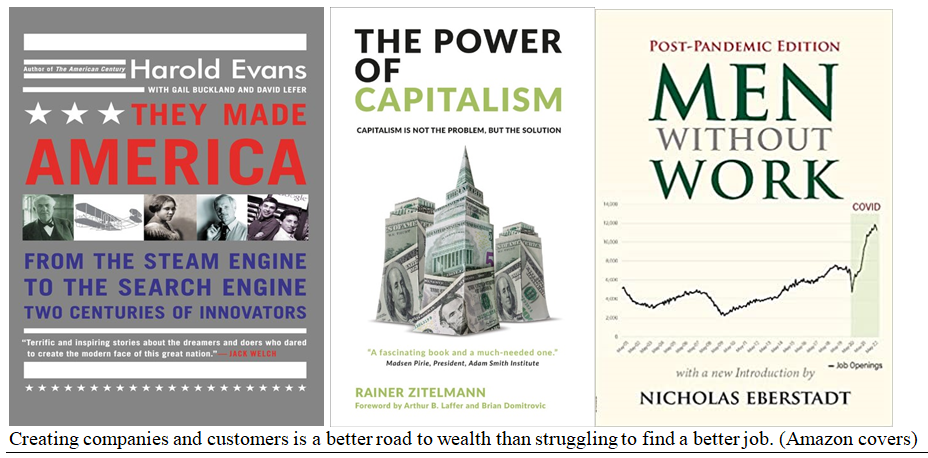
As for the mundane world of jobs, we need more people thinking in terms of careers and businesses than jobs. We’ve come a long way from days of hauling 16-tons of coal and getting deeper in debt. There’s no need to enter a coal mine today, but American men need to put their big-boy pants on and create a career.
All content above represents the opinion of Gary Alexander of Navellier & Associates, Inc.
Also In This Issue
A Look Ahead by Louis Navellier
Friday’s Jobs Report and Other Indicators Look Strong
Income Mail by Bryan Perry
The Opponents of Data Centers Just Don’t Get It
Growth Mail by Gary Alexander
What Happened to America’s Work Ethic?
Global Mail by Ivan Martchev
The President is on a Collision Course with the Fed
Sector Spotlight by Jason Bodner
Applying Leverage to the Upcoming Elections
View Full Archive
Read Past Issues Here
About The Author

Gary Alexander
SENIOR EDITOR
Gary Alexander has been Senior Writer at Navellier since 2009. He edits Navellier’s weekly Marketmail and writes a weekly Growth Mail column, in which he uses market history to support the case for growth stocks. For the previous 20-years before joining Navellier, he was Senior Executive Editor at InvestorPlace Media (formerly Phillips Publishing), where he worked with several leading investment analysts, including Louis Navellier (since 1997), helping launch Louis Navellier’s Blue Chip Growth and Global Growth newsletters.
Prior to that, Gary edited Wealth Magazine and Gold Newsletter and wrote various investment research reports for Jefferson Financial in New Orleans in the 1980s. He began his financial newsletter career with KCI Communications in 1980, where he served as consulting editor for Personal Finance newsletter while serving as general manager of KCI’s Alexandria House book division. Before that, he covered the economics beat for news magazines. All content of “Growth Mail” represents the opinion of Gary Alexander
Important Disclosures:
Although information in these reports has been obtained from and is based upon sources that Navellier believes to be reliable, Navellier does not guarantee its accuracy and it may be incomplete or condensed. All opinions and estimates constitute Navellier’s judgment as of the date the report was created and are subject to change without notice. These reports are for informational purposes only and are not a solicitation for the purchase or sale of a security. Any decision to purchase securities mentioned in these reports must take into account existing public information on such securities or any registered prospectus.To the extent permitted by law, neither Navellier & Associates, Inc., nor any of its affiliates, agents, or service providers assumes any liability or responsibility nor owes any duty of care for any consequences of any person acting or refraining to act in reliance on the information contained in this communication or for any decision based on it.
Past performance is no indication of future results. Investment in securities involves significant risk and has the potential for partial or complete loss of funds invested. It should not be assumed that any securities recommendations made by Navellier. in the future will be profitable or equal the performance of securities made in this report. Dividend payments are not guaranteed. The amount of a dividend payment, if any, can vary over time and issuers may reduce dividends paid on securities in the event of a recession or adverse event affecting a specific industry or issuer.
None of the stock information, data, and company information presented herein constitutes a recommendation by Navellier or a solicitation to buy or sell any securities. Any specific securities identified and described do not represent all of the securities purchased, sold, or recommended for advisory clients. The holdings identified do not represent all of the securities purchased, sold, or recommended for advisory clients and the reader should not assume that investments in the securities identified and discussed were or will be profitable.
Information presented is general information that does not take into account your individual circumstances, financial situation, or needs, nor does it present a personalized recommendation to you. Individual stocks presented may not be suitable for every investor. Investment in securities involves significant risk and has the potential for partial or complete loss of funds invested. Investment in fixed income securities has the potential for the investment return and principal value of an investment to fluctuate so that an investor’s holdings, when redeemed, may be worth less than their original cost.
One cannot invest directly in an index. Index is unmanaged and index performance does not reflect deduction of fees, expenses, or taxes. Presentation of Index data does not reflect a belief by Navellier that any stock index constitutes an investment alternative to any Navellier equity strategy or is necessarily comparable to such strategies. Among the most important differences between the Indices and Navellier strategies are that the Navellier equity strategies may (1) incur material management fees, (2) concentrate its investments in relatively few stocks, industries, or sectors, (3) have significantly greater trading activity and related costs, and (4) be significantly more or less volatile than the Indices.
ETF Risk: We may invest in exchange traded funds (“ETFs”) and some of our investment strategies are generally fully invested in ETFs. Like traditional mutual funds, ETFs charge asset-based fees, but they generally do not charge initial sales charges or redemption fees and investors typically pay only customary brokerage fees to buy and sell ETF shares. The fees and costs charged by ETFs held in client accounts will not be deducted from the compensation the client pays Navellier. ETF prices can fluctuate up or down, and a client account could lose money investing in an ETF if the prices of the securities owned by the ETF go down. ETFs are subject to additional risks:
- ETF shares may trade above or below their net asset value;
- An active trading market for an ETF’s shares may not develop or be maintained;
- The value of an ETF may be more volatile than the underlying portfolio of securities the ETF is designed to track;
- The cost of owning shares of the ETF may exceed those a client would incur by directly investing in the underlying securities; and
- Trading of an ETF’s shares may be halted if the listing exchange’s officials deem it appropriate, the shares are delisted from the exchange, or the activation of market-wide “circuit breakers” (which are tied to large decreases in stock prices) halts stock trading generally.
Grader Disclosures: Investment in equity strategies involves substantial risk and has the potential for partial or complete loss of funds invested. The sample portfolio and any accompanying charts are for informational purposes only and are not to be construed as a solicitation to buy or sell any financial instrument and should not be relied upon as the sole factor in an investment making decision. As a matter of normal and important disclosures to you, as a potential investor, please consider the following: The performance presented is not based on any actual securities trading, portfolio, or accounts, and the reported performance of the A, B, C, D, and F portfolios (collectively the “model portfolios”) should be considered mere “paper” or pro forma performance results based on Navellier’s research.
Investors evaluating any of Navellier & Associates, Inc.’s, (or its affiliates’) Investment Products must not use any information presented here, including the performance figures of the model portfolios, in their evaluation of any Navellier Investment Products. Navellier Investment Products include the firm’s mutual funds and managed accounts. The model portfolios, charts, and other information presented do not represent actual funded trades and are not actual funded portfolios. There are material differences between Navellier Investment Products’ portfolios and the model portfolios, research, and performance figures presented here. The model portfolios and the research results (1) may contain stocks or ETFs that are illiquid and difficult to trade; (2) may contain stock or ETF holdings materially different from actual funded Navellier Investment Product portfolios; (3) include the reinvestment of all dividends and other earnings, estimated trading costs, commissions, or management fees; and, (4) may not reflect prices obtained in an actual funded Navellier Investment Product portfolio. For these and other reasons, the reported performances of model portfolios do not reflect the performance results of Navellier’s actually funded and traded Investment Products. In most cases, Navellier’s Investment Products have materially lower performance results than the performances of the model portfolios presented.
This report contains statements that are, or may be considered to be, forward-looking statements. All statements that are not historical facts, including statements about our beliefs or expectations, are “forward-looking statements” within the meaning of The U.S. Private Securities Litigation Reform Act of 1995. These statements may be identified by such forward-looking terminology as “expect,” “estimate,” “plan,” “intend,” “believe,” “anticipate,” “may,” “will,” “should,” “could,” “continue,” “project,” or similar statements or variations of such terms. Our forward-looking statements are based on a series of expectations, assumptions, and projections, are not guarantees of future results or performance, and involve substantial risks and uncertainty as described in Form ADV Part 2A of our filing with the Securities and Exchange Commission (SEC), which is available at www.adviserinfo.sec.gov or by requesting a copy by emailing info@navellier.com. All of our forward-looking statements are as of the date of this report only. We can give no assurance that such expectations or forward-looking statements will prove to be correct. Actual results may differ materially. You are urged to carefully consider all such factors.
FEDERAL TAX ADVICE DISCLAIMER: As required by U.S. Treasury Regulations, you are informed that, to the extent this presentation includes any federal tax advice, the presentation is not written by Navellier to be used, and cannot be used, for the purpose of avoiding federal tax penalties. Navellier does not advise on any income tax requirements or issues. Use of any information presented by Navellier is for general information only and does not represent tax advice either express or implied. You are encouraged to seek professional tax advice for income tax questions and assistance.
IMPORTANT NEWSLETTER DISCLOSURE:The hypothetical performance results for investment newsletters that are authored or edited by Louis Navellier, including Louis Navellier’s Growth Investor, Louis Navellier’s Breakthrough Stocks, Louis Navellier’s Accelerated Profits, and Louis Navellier’s Platinum Club, are not based on any actual securities trading, portfolio, or accounts, and the newsletters’ reported hypothetical performances should be considered mere “paper” or proforma hypothetical performance results and are not actual performance of real world trades. Navellier & Associates, Inc. does not have any relation to or affiliation with the owner of these newsletters. There are material differences between Navellier Investment Products’ portfolios and the InvestorPlace Media, LLC newsletter portfolios authored by Louis Navellier. The InvestorPlace Media, LLC newsletters contain hypothetical performance that do not include transaction costs, advisory fees, or other fees a client might incur if actual investments and trades were being made by an investor. As a result, newsletter performance should not be used to evaluate Navellier Investment services which are separate and different from the newsletters. The owner of the newsletters is InvestorPlace Media, LLC and any questions concerning the newsletters, including any newsletter advertising or hypothetical Newsletter performance claims, (which are calculated solely by Investor Place Media and not Navellier) should be referred to InvestorPlace Media, LLC at (800) 718-8289.
Please note that Navellier & Associates and the Navellier Private Client Group are managed completely independent of the newsletters owned and published by InvestorPlace Media, LLC and written and edited by Louis Navellier, and investment performance of the newsletters should in no way be considered indicative of potential future investment performance for any Navellier & Associates separately managed account portfolio. Potential investors should consult with their financial advisor before investing in any Navellier Investment Product.
Navellier claims compliance with Global Investment Performance Standards (GIPS). To receive a complete list and descriptions of Navellier’s composites and/or a presentation that adheres to the GIPS standards, please contact Navellier or click here. It should not be assumed that any securities recommendations made by Navellier & Associates, Inc. in the future will be profitable or equal the performance of securities made in this report.
FactSet Disclosure: Navellier does not independently calculate the statistical information included in the attached report. The calculation and the information are provided by FactSet, a company not related to Navellier. Although information contained in the report has been obtained from FactSet and is based on sources Navellier believes to be reliable, Navellier does not guarantee its accuracy, and it may be incomplete or condensed. The report and the related FactSet sourced information are provided on an “as is” basis. The user assumes the entire risk of any use made of this information. Investors should consider the report as only a single factor in making their investment decision. The report is for informational purposes only and is not intended as an offer or solicitation for the purchase or sale of a security. FactSet sourced information is the exclusive property of FactSet. Without prior written permission of FactSet, this information may not be reproduced, disseminated or used to create any financial products. All indices are unmanaged and performance of the indices include reinvestment of dividends and interest income, unless otherwise noted, are not illustrative of any particular investment and an investment cannot be made in any index. Past performance is no guarantee of future results.