
by Gary Alexander
August 18, 2026
In this fourth of a series of columns tied to recent market history, I want to focus on those outlandish, unexpected surprises which Nassim Nicholas Taleb labeled “Black Swans” in a 2007 book by that name.
The ultimate Black Swan event happened 25 years ago next month, when four big fuel-drenched airliners were hijacked and steered toward America’s financial and political centers, New York City and Washington, DC. This 9/11 attack on America was the ultimate surprise event of recent decades. In this column, however, I would like to focus on the five surprising financial trends arising out of 9/11.
Surprise #1: From Balanced Budgets to Massive $2 Trillion Annual Deficits
For four-straight years, 1998 to 2001, the federal government managed a budget surplus – the first such 4-year winning streak in a century. The national debt was on the order of $5 trillion then (vs. $40 trillion soon), and the Congressional Budget Office (CBO) confidently projected we would wipe out that $5 trillion debt within a decade, by 2011. Instead, during each of Barack Obama’s first term years – 2009 to 2012 – we suffered our first four trillion-dollar budget deficits. Now, we are encountering $2 trillion per year deficits, with no relief in sight. To cap off this sad story, in the single month of July 2026, the CBO tells us we ran up a larger monthly budget deficit than in any full year before the financial crisis of 2008!
A Tale of Two Terms: From Strong Surpluses to Massive Deficits

July 2026 delivered a $431 billion monthly deficit, with the federal government taking in about $1,000 per person in tax revenues ($334 billion) but spending about $2,300 per person. Ouch! This reflects chronic runaway federal deficits, while neither political party seems seriously (or even slightly) concerned about the explosive rise in military and social spending, plus the higher costs of servicing our debt. (The 10-year bond yield was 3.95% the day before the U.S. bombed Iran. That rate was 4.74% on July 31).
The CBO projects the FY 2026 deficit will be $2.1 trillion. After the CBO projected we would wipe out all debt by 2011, that same CBO now sees a $2.1 trillion deficit (and $40 trillion debt) by next month.
Surprise #2: The Longest War in American History – and More Wars to Come?
One big part of the surging deficits came from the “War on Terror” shortly after 9/11. This was not called a “War on Afghanistan” (2001-2021) or a “War on Iraq” (2003-2011), but those two wars were long and costly. The direct cost of those wars, launched in Bush’s first term, total at least $1.47 trillion, according to the U.S. Department of Defense, far more than the estimate of just $80 billion in direct cost (and $100 billion total) estimated by then-Vice President Dick Cheney on “Meet the Press” in mid-March 2003.
According to warcosts.org, the U.S. has spent over $8 trillion on wars and military operations in at least 85-countries since 2001, with total costs of $10–14 trillion, with veteran care and interest costs added.
The war in Afghanistan centered around a search for the perpetrator of the 9/11 attack, Osama bin Laden, but he wasn’t apprehended for another decade, after it turned out he was “hiding in plain sight” in nearby Pakistan. There was no national security justification for a 20-year war in Afghanistan, or the launching of the Iraq war, based on its alleged “weapons of mass destruction.” (For more details, see Peter Bergen’s book, “The Longest War,” written in 2011, when the war in Afghanistan was only half over, with the bulk of American deaths coming during President Obama’s first term, 2009 to 2012.) And now we are in Iran.
Surprise #3: Modern Monetary Theory Created a “Free Money” Decade
Another strange anomaly happened during President Obama’s first term. The Federal Reserve decided to put “training wheels” on a presumably crippled economy, nursing it slowly back to some form of health, with the Fed’s prescription of a Zero-Interest-Rate Policy (ZIRP) and 3+ rounds of Quantitative Easing (QE) on top of free money. All of a sudden, money had no time value (interest), nor penalty for higher debt service costs, since the Fed froze the Fed Funds rate at a microscopic 0.0% to 0.25% for seven-years.
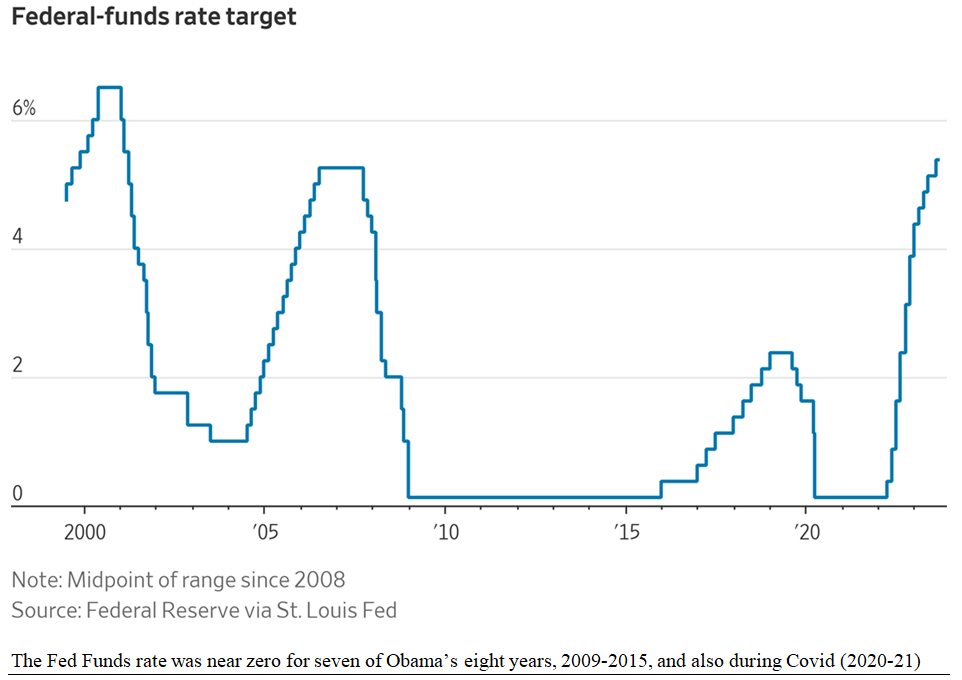
Graphs are for illustrative and discussion purposes only. Please read important disclosures at the end of this commentary.
The Fed Chairman during most of these years (2006-14) was Ben Bernanke, who made a career out of studying the Fed’s mistakes during the Great Depression. In other words, he bent over backward to avoid deflation, setting a target of 2% inflation, not flat prices. On top of zero interest rates, Bernanke launched a series of Quantitative Easing (QE) policies, gorging the economy with his form of “helicopter money.”
It’s as if the Fed and Treasury were telling America we were too fragile a nation and economy to charge normal market interest rates or live on the money we taxpayers sent to the Treasury. The net effect was an American version of the popular “Modern Monetary Theory” (MMT), creating nearly unlimited liquidity.
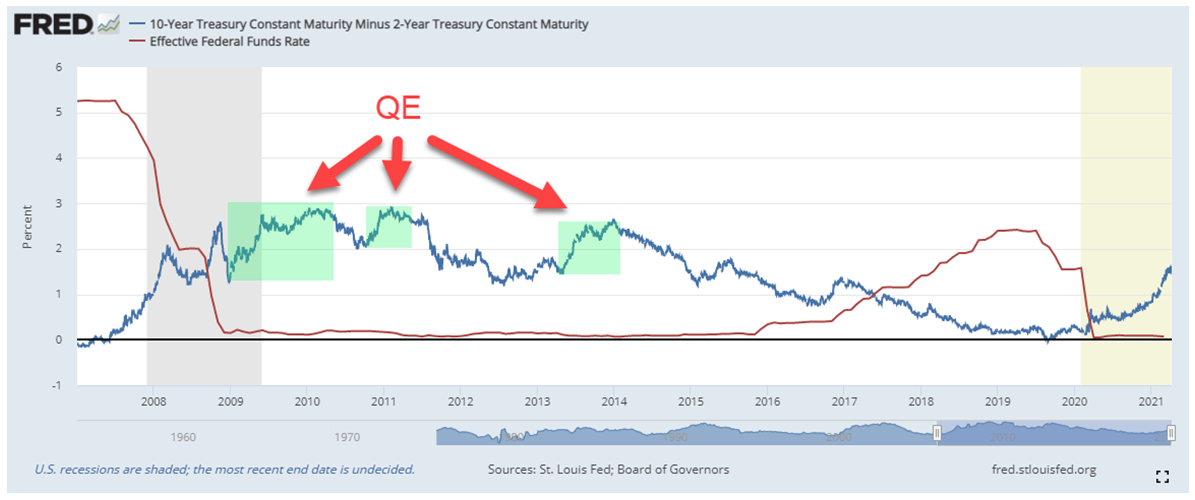
Graphs are for illustrative and discussion purposes only. Please read important disclosures at the end of this commentary.
During Trump’s term, the Fed finally raised rates, but that caused a sharp market drop in late 2018, when Powell raised rates a step too far, to a punitively high 2.5% (chart above), but then he retreated to ZIRP.
Surprise #4: Legislation Against Past Threats Created a New Regulatory Regime
The Attack on America on 9/11 delivered yet another blow to our economy in the form of a massive new set of regulations, first in the American Patriot Act, then in the financial handcuffs of the Dodd-Frank bill following the Great Recession of 2008. Shortly after 9/11, a British traveler named Richard Reid placed a bomb in his high-top shoes and tried to detonate it high above the Atlantic, on board American Flight 63 from Paris to Miami, on December 22, 2001. Passengers smelled the smoke of his fuse and managed to subdue him. Ever since, billions of shoes have been surrendered and placed under X-rays, due to Reid.
I won’t get into all the obvious (and some hidden) flaws of the Patriot Act, but in a light-hearted moment, I nominated Richard Reid for Time Magazine’s “Person of the Year,” since he neatly fit the description Time gave us, as “the person (or people) who wielded the most influence in the previous 12 months.” Since 2002, just like the generals who fight “the last war,” Americans are now subject to full body scans and shoe inspections to prevent the recurrence of an act foiled by alert passengers nearly 25-years ago.
The same is true of the Dodd-Frank banking restrictions. Those onerous regulations gave birth to what we’ve seen recently in “private wealth funds,” not subject to Dodd-Frank, but delivering the same risky level of high interest or leveraged vehicles to investors seeking a faster road to riches. This is a situation in which we can’t cure “stupid” or “greed.” Bad guys or gals generally find a way to work their mischief.
Surprise #5: Despite All These New Threats, the Stock Market Keeps Soaring
And now comes the happy ending. Despite these four negative surprises, my closing pleasant surprise is seeing the stock market continually rising anyway – although in somewhat inflated terms – since 9/11/01.
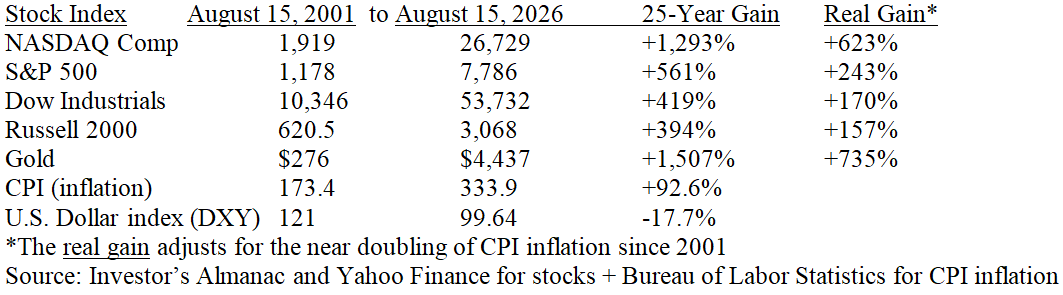
So, we can count our blessings Adam Smith was accurate in 1778, when he said, “There is a lot of ruin in a nation” after Britain feared their glory days were over after the Battle of Saratoga brought France onto the American side. Like Britain after that war and after Hitler’s bombs in the early 1940s, Americans took the many blows after 9/11 and what followed and kept on ticking, thanks to our free-market system rewarding American inventions and ingenuity with near-record earnings growth since 2001, and this year.
What a country! *
*“I’ll never forget walking down one of the aisles of the grocery store and seeing powdered milk; just add water and you get milk. Right next to it was powdered orange juice; just add water and you get orange juice. Then I saw baby powder, and I thought to myself, ‘What a country!’”–Yakov Smirnoff.
All content above represents the opinion of Gary Alexander of Navellier & Associates, Inc.
Also In This Issue
A Look Ahead by Louis Navellier
Inflation Remains Tame, for Now
Income Mail by Bryan Perry
Probing the Complexities of Domestic Energy Policy
Growth Mail by Gary Alexander
Five Big Financial Surprises in the Last 25-Years
Global Mail by Ivan Martchev
The Global Bond Boomerang Effect
Sector Spotlight by Jason Bodner
Seeing the Unseen – A Source of Superior Market Profits
View Full Archive
Read Past Issues Here
About The Author

Gary Alexander
SENIOR EDITOR
Gary Alexander has been Senior Writer at Navellier since 2009. He edits Navellier’s weekly Marketmail and writes a weekly Growth Mail column, in which he uses market history to support the case for growth stocks. For the previous 20-years before joining Navellier, he was Senior Executive Editor at InvestorPlace Media (formerly Phillips Publishing), where he worked with several leading investment analysts, including Louis Navellier (since 1997), helping launch Louis Navellier’s Blue Chip Growth and Global Growth newsletters.
Prior to that, Gary edited Wealth Magazine and Gold Newsletter and wrote various investment research reports for Jefferson Financial in New Orleans in the 1980s. He began his financial newsletter career with KCI Communications in 1980, where he served as consulting editor for Personal Finance newsletter while serving as general manager of KCI’s Alexandria House book division. Before that, he covered the economics beat for news magazines. All content of “Growth Mail” represents the opinion of Gary Alexander
Important Disclosures:
Although information in these reports has been obtained from and is based upon sources that Navellier believes to be reliable, Navellier does not guarantee its accuracy and it may be incomplete or condensed. All opinions and estimates constitute Navellier’s judgment as of the date the report was created and are subject to change without notice. These reports are for informational purposes only and are not a solicitation for the purchase or sale of a security. Any decision to purchase securities mentioned in these reports must take into account existing public information on such securities or any registered prospectus.To the extent permitted by law, neither Navellier & Associates, Inc., nor any of its affiliates, agents, or service providers assumes any liability or responsibility nor owes any duty of care for any consequences of any person acting or refraining to act in reliance on the information contained in this communication or for any decision based on it.
Past performance is no indication of future results. Investment in securities involves significant risk and has the potential for partial or complete loss of funds invested. It should not be assumed that any securities recommendations made by Navellier. in the future will be profitable or equal the performance of securities made in this report. Dividend payments are not guaranteed. The amount of a dividend payment, if any, can vary over time and issuers may reduce dividends paid on securities in the event of a recession or adverse event affecting a specific industry or issuer.
None of the stock information, data, and company information presented herein constitutes a recommendation by Navellier or a solicitation to buy or sell any securities. Any specific securities identified and described do not represent all of the securities purchased, sold, or recommended for advisory clients. The holdings identified do not represent all of the securities purchased, sold, or recommended for advisory clients and the reader should not assume that investments in the securities identified and discussed were or will be profitable.
Information presented is general information that does not take into account your individual circumstances, financial situation, or needs, nor does it present a personalized recommendation to you. Individual stocks presented may not be suitable for every investor. Investment in securities involves significant risk and has the potential for partial or complete loss of funds invested. Investment in fixed income securities has the potential for the investment return and principal value of an investment to fluctuate so that an investor’s holdings, when redeemed, may be worth less than their original cost.
One cannot invest directly in an index. Index is unmanaged and index performance does not reflect deduction of fees, expenses, or taxes. Presentation of Index data does not reflect a belief by Navellier that any stock index constitutes an investment alternative to any Navellier equity strategy or is necessarily comparable to such strategies. Among the most important differences between the Indices and Navellier strategies are that the Navellier equity strategies may (1) incur material management fees, (2) concentrate its investments in relatively few stocks, industries, or sectors, (3) have significantly greater trading activity and related costs, and (4) be significantly more or less volatile than the Indices.
ETF Risk: We may invest in exchange traded funds (“ETFs”) and some of our investment strategies are generally fully invested in ETFs. Like traditional mutual funds, ETFs charge asset-based fees, but they generally do not charge initial sales charges or redemption fees and investors typically pay only customary brokerage fees to buy and sell ETF shares. The fees and costs charged by ETFs held in client accounts will not be deducted from the compensation the client pays Navellier. ETF prices can fluctuate up or down, and a client account could lose money investing in an ETF if the prices of the securities owned by the ETF go down. ETFs are subject to additional risks:
- ETF shares may trade above or below their net asset value;
- An active trading market for an ETF’s shares may not develop or be maintained;
- The value of an ETF may be more volatile than the underlying portfolio of securities the ETF is designed to track;
- The cost of owning shares of the ETF may exceed those a client would incur by directly investing in the underlying securities; and
- Trading of an ETF’s shares may be halted if the listing exchange’s officials deem it appropriate, the shares are delisted from the exchange, or the activation of market-wide “circuit breakers” (which are tied to large decreases in stock prices) halts stock trading generally.
Grader Disclosures: Investment in equity strategies involves substantial risk and has the potential for partial or complete loss of funds invested. The sample portfolio and any accompanying charts are for informational purposes only and are not to be construed as a solicitation to buy or sell any financial instrument and should not be relied upon as the sole factor in an investment making decision. As a matter of normal and important disclosures to you, as a potential investor, please consider the following: The performance presented is not based on any actual securities trading, portfolio, or accounts, and the reported performance of the A, B, C, D, and F portfolios (collectively the “model portfolios”) should be considered mere “paper” or pro forma performance results based on Navellier’s research.
Investors evaluating any of Navellier & Associates, Inc.’s, (or its affiliates’) Investment Products must not use any information presented here, including the performance figures of the model portfolios, in their evaluation of any Navellier Investment Products. Navellier Investment Products include the firm’s mutual funds and managed accounts. The model portfolios, charts, and other information presented do not represent actual funded trades and are not actual funded portfolios. There are material differences between Navellier Investment Products’ portfolios and the model portfolios, research, and performance figures presented here. The model portfolios and the research results (1) may contain stocks or ETFs that are illiquid and difficult to trade; (2) may contain stock or ETF holdings materially different from actual funded Navellier Investment Product portfolios; (3) include the reinvestment of all dividends and other earnings, estimated trading costs, commissions, or management fees; and, (4) may not reflect prices obtained in an actual funded Navellier Investment Product portfolio. For these and other reasons, the reported performances of model portfolios do not reflect the performance results of Navellier’s actually funded and traded Investment Products. In most cases, Navellier’s Investment Products have materially lower performance results than the performances of the model portfolios presented.
This report contains statements that are, or may be considered to be, forward-looking statements. All statements that are not historical facts, including statements about our beliefs or expectations, are “forward-looking statements” within the meaning of The U.S. Private Securities Litigation Reform Act of 1995. These statements may be identified by such forward-looking terminology as “expect,” “estimate,” “plan,” “intend,” “believe,” “anticipate,” “may,” “will,” “should,” “could,” “continue,” “project,” or similar statements or variations of such terms. Our forward-looking statements are based on a series of expectations, assumptions, and projections, are not guarantees of future results or performance, and involve substantial risks and uncertainty as described in Form ADV Part 2A of our filing with the Securities and Exchange Commission (SEC), which is available at www.adviserinfo.sec.gov or by requesting a copy by emailing info@navellier.com. All of our forward-looking statements are as of the date of this report only. We can give no assurance that such expectations or forward-looking statements will prove to be correct. Actual results may differ materially. You are urged to carefully consider all such factors.
FEDERAL TAX ADVICE DISCLAIMER: As required by U.S. Treasury Regulations, you are informed that, to the extent this presentation includes any federal tax advice, the presentation is not written by Navellier to be used, and cannot be used, for the purpose of avoiding federal tax penalties. Navellier does not advise on any income tax requirements or issues. Use of any information presented by Navellier is for general information only and does not represent tax advice either express or implied. You are encouraged to seek professional tax advice for income tax questions and assistance.
IMPORTANT NEWSLETTER DISCLOSURE:The hypothetical performance results for investment newsletters that are authored or edited by Louis Navellier, including Louis Navellier’s Growth Investor, Louis Navellier’s Breakthrough Stocks, Louis Navellier’s Accelerated Profits, and Louis Navellier’s Platinum Club, are not based on any actual securities trading, portfolio, or accounts, and the newsletters’ reported hypothetical performances should be considered mere “paper” or proforma hypothetical performance results and are not actual performance of real world trades. Navellier & Associates, Inc. does not have any relation to or affiliation with the owner of these newsletters. There are material differences between Navellier Investment Products’ portfolios and the InvestorPlace Media, LLC newsletter portfolios authored by Louis Navellier. The InvestorPlace Media, LLC newsletters contain hypothetical performance that do not include transaction costs, advisory fees, or other fees a client might incur if actual investments and trades were being made by an investor. As a result, newsletter performance should not be used to evaluate Navellier Investment services which are separate and different from the newsletters. The owner of the newsletters is InvestorPlace Media, LLC and any questions concerning the newsletters, including any newsletter advertising or hypothetical Newsletter performance claims, (which are calculated solely by Investor Place Media and not Navellier) should be referred to InvestorPlace Media, LLC at (800) 718-8289.
Please note that Navellier & Associates and the Navellier Private Client Group are managed completely independent of the newsletters owned and published by InvestorPlace Media, LLC and written and edited by Louis Navellier, and investment performance of the newsletters should in no way be considered indicative of potential future investment performance for any Navellier & Associates separately managed account portfolio. Potential investors should consult with their financial advisor before investing in any Navellier Investment Product.
Navellier claims compliance with Global Investment Performance Standards (GIPS). To receive a complete list and descriptions of Navellier’s composites and/or a presentation that adheres to the GIPS standards, please contact Navellier or click here. It should not be assumed that any securities recommendations made by Navellier & Associates, Inc. in the future will be profitable or equal the performance of securities made in this report.
FactSet Disclosure: Navellier does not independently calculate the statistical information included in the attached report. The calculation and the information are provided by FactSet, a company not related to Navellier. Although information contained in the report has been obtained from FactSet and is based on sources Navellier believes to be reliable, Navellier does not guarantee its accuracy, and it may be incomplete or condensed. The report and the related FactSet sourced information are provided on an “as is” basis. The user assumes the entire risk of any use made of this information. Investors should consider the report as only a single factor in making their investment decision. The report is for informational purposes only and is not intended as an offer or solicitation for the purchase or sale of a security. FactSet sourced information is the exclusive property of FactSet. Without prior written permission of FactSet, this information may not be reproduced, disseminated or used to create any financial products. All indices are unmanaged and performance of the indices include reinvestment of dividends and interest income, unless otherwise noted, are not illustrative of any particular investment and an investment cannot be made in any index. Past performance is no guarantee of future results.