
by Ivan Martchev
November 17, 2026
If you consider the all-time highs in Nvidia in early October, it had a market cap of $5.85 trillion, but the decline to the lows of last week translates into a drop of $2 trillion in market valuation. That not because of bad sales or earnings – to be reported soon, with results that should be spectacular – but it’s mostly because of some extramarital affairs being revealed at about the same time. Jensen Huang lost his job as the architect of the AI boom and his loyal investors lost a lot of money because of his poor judgment.
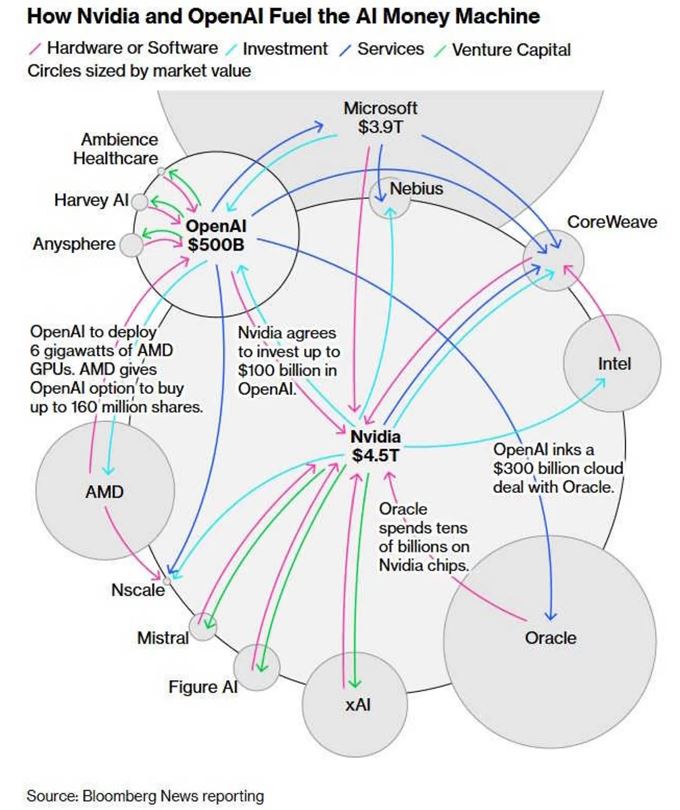
It is impossible to predict what happens next, as revelations about his poor judgment keep coming out, and they have repercussions for U.S. trade policy toward China, AI industry financing and U.S. economic growth in the aggregate. I am sure there are technologically savvy people out there to take over for Jensen Huang, but I do not believe the circle charted below is about technology skill only. This is about replacing a man who was thinking 5 to 10-years out, while his competitors were more or less asleep at the switch.
Graphs are for illustrative and discussion purposes only. Please read important disclosures at the end of this commentary.
I doubt Jensen Huang is going away. We’ve seen this sort of drama before.
- Sam Altman was fired from OpenAI and was reinstated. Right now, prediction markets indicate a low (10%) chance Jensen goes back to Nvidia. If he does not go back and ends up at SpaceX – Elon Musk has already indicated he wants to get him on board – it would be good for SpaceX and bad for Nvidia.
- Tim Cook of Apple also faced a lot of naysayers in the first couple of years after he took over from Steve Jobs, but he turned out to be a spectacular success. Right now, because of Jensen’s failure of judgment and because Apple is considered to be a defensive stable business, Apple now has the top global market cap, at $5.17 trillion.
This is likely not the end of Nvidia as we know it, but some type of hard turn in strategy could introduce a higher level of uncertainty in the next 12 to 24-months. That often means a distressed multiple on the shares, which last week were trading at barely 10-times 2027 earnings estimates (at the stock’s low point).
I am sure the present costly soap opera is only the opening episode of a longer drama. There are more twists and turns ahead, and it would be premature to assume all of them would be bad. It is possible the wholesale dumping of Nvidia could create a bigger rebound on good earnings and positive news.
One big catalyst for the AI trade is the upcoming Anthropic IPO that begins trading Thursday this week. That may be a counterbalancing positive to this unexpected Nvidia soap opera turn in the technology sector.
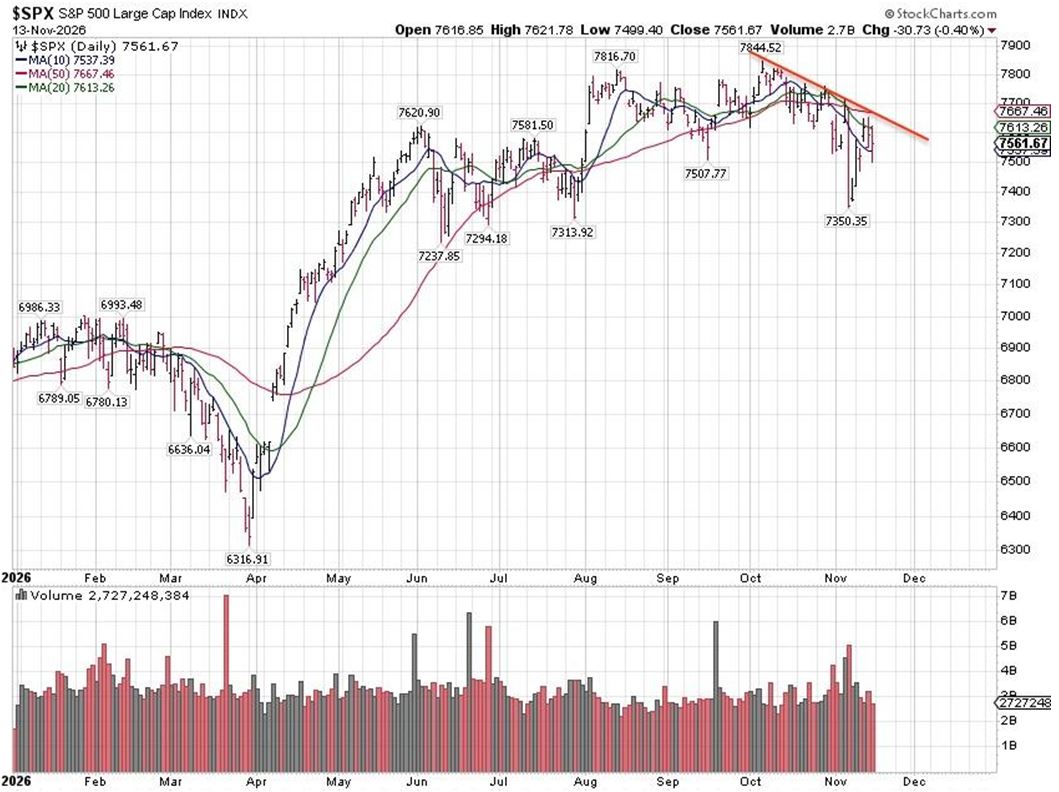
We could see 8000 on the S&P 500 by year’s end if there are no more trillion-dollar soap operas, which unfortunately cannot be guaranteed. This drama demonstrates how poor judgment in personal matters can become a stock market (and possibly an economic) event, and I doubt this soap opera will end soon.
Graphs are for illustrative and discussion purposes only. Please read important disclosures at the end of this commentary.
The stock market staged a fierce rebound last week, despite the Nvidia soap opera. It is normal to see rising volatility near a market bottom, so the action on Friday does not surprise me. If the news flow is positive and if we don’t get any more market bombs – some of which could include restarting bombing Iran, a fourth extramarital affair by Jensen Huang and evidence of intentional chip smuggling into China, that sort of thing – I think the chances of a further rebound are high. If the S&P 500 manages to trade above the highs of last week and stay there, I think the chances are that the year-end rally has started.
Graphs are for illustrative and discussion purposes only. Please read important disclosures at the end of this commentary.
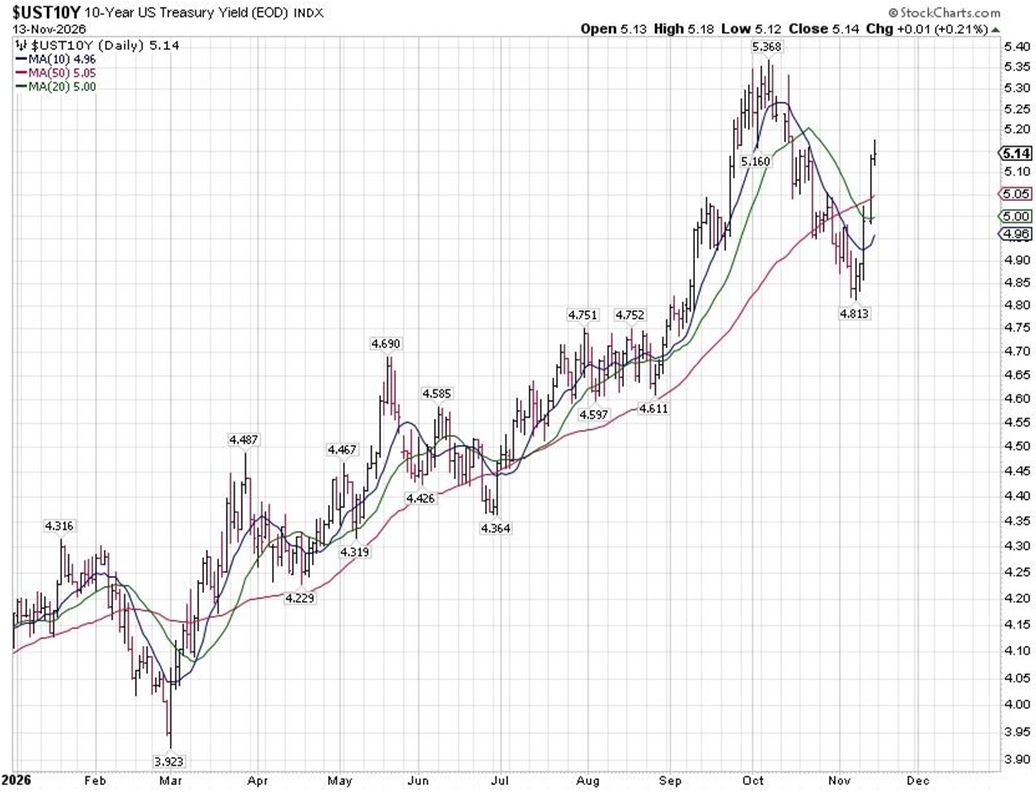
One thing I did not like about last week was the fierce rebound in Treasury yields. One can say this is normal – as Treasurys were acting defensively in the middle of selling stocks and junk bonds. Although the relentless climb in Treasury yield began the day the war started, the war is not the only reason for this climb. If the war derails the Trump economic agenda, namely the rebalancing of the trade situation and raising the economic growth of the U.S. economy to outgrow the growth of government debt, it would be the biggest mistake of his political career and it is self-inflicted, which you cannot say about COVID.
Wouldn’t it have been better to have Treasury Secretary Bessent work his magic with unprecedented economic sanctions against Iran in 2026 and then resort to kinetic activity in 2027 if they did not work?
Navellier & Associates; own Nvidia (NVDA), Apple Inc, (AAPL), Microsoft Corporation (MSFT), Intel Corporation (INTC), Taiwan Semiconductor Manufacturing Co., Ltd. Sponsored ADR (TSM), Advanced Micro Devices, Inc. (AMD) and Oracle Corporation (ORCL) in managed accounts. Navellier does not own CoreWeave (CRWV). Ivan Matchav does not own own Nvidia (NVDA), Apple Inc, (AAPL), Microsoft Corporation (MSFT), Intel Corporation (INTC), Taiwan Semiconductor Manufacturing Co., Ltd. Sponsored ADR (TSM), Advanced Micro Devices, Inc. (AMD), CoreWeave (CRWV) and Oracle Corporation (ORCL) personally.
All content above represents the opinion of Ivan Martchev of Navellier & Associates, Inc.
Also In This Issue
A Look Ahead by Louis Navellier
The Latest News from Nvidia and Other Leading Tech Companies
Income Mail by Bryan Perry
AI’s Disinflationary Power Fuels a Virtuous Cycle
Growth Mail by Gary Alexander
Investment Lessons After Nearly 60 Years in the Game
Global Mail by Ivan Martchev
Nvidia’s $2 Trillion Soap Opera
Sector Spotlight by Jason Bodner
The Washout Is Done. History Says “Look Up”
Important Disclosures:
Although information in these reports has been obtained from and is based upon sources that Navellier believes to be reliable, Navellier does not guarantee its accuracy and it may be incomplete or condensed. All opinions and estimates constitute the authors opinions as of the date the report was created and are subject to change without notice. These reports are for informational purposes only and are not a solicitation for the purchase or sale of any securities or financial services. Any decision to purchase securities mentioned in these reports must take into account existing public information on such securities or any registered prospectus. To the extent permitted by law, neither Navellier & Associates, Inc., nor any of its affiliates, agents, or service providers are providing any investment advice herein and do not assume any liability or responsibility for the readers’ decisions if any. No reader should act or refrain from acting in reliance on the information contained in this communication or for any decision based on it.
None of the stock information, data, or company information presented herein constitutes investment advice or a recommendation by Navellier or a solicitation to buy or sell any securities. Any specific securities identified and described herein do not represent any investment advice.
Information presented is general information that does not take into account your individual circumstances, financial situation, or needs, nor does it present a personalized recommendation to you. Individual stocks presented may not be suitable for every investor. Investment in securities involves significant risk and has the potential for partial or complete loss of funds invested. Investment in fixed income securities has the potential for the investment return and principal value of an investment to fluctuate so that an investor’s holdings, when redeemed, may be worth less than their original cost.
- This report contains statements that are, or may be considered to be, forward-looking statements. All statements that are not historical facts, including statements about our beliefs or expectations, are “forward-looking statements” within the meaning of The U.S. Private Securities Litigation Reform Act of 1995. These statements may be identified by such forward-looking terminology as “expect,” “estimate,” “plan,” “intend,” “believe,” “anticipate,” “may,” “will,” “should,” “could,” “continue,” “project,” or similar statements or variations of such terms. Our forward-looking statements are based on a series of expectations, assumptions, and projections, are not investment advice. All of our forward-looking statements are as of the date of this report only.
- Federal Tax Advice Disclaimer: As required by U.S. Treasury Regulations, you are informed that, to the extent this presentation mentions any federal taxes, Navellier is not presenting any tax advice and should not be used or relied on as tax advice. Navellier does not advise on any income tax requirements or issues. Use of any information presented by Navellier is for general information only and does not represent tax advice either express or implied. You are encouraged to seek professional tax advice for income tax questions and assistance.
- FactSet Disclosure: Navellier does not independently calculate the statistical information included in the attached report. The calculation and the information are provided by FactSet, a company not related to Navellier. Although information contained in the report has been obtained from FactSet and is based on sources Navellier believes to be reliable, Navellier does not guarantee its accuracy, and it may be inaccurate, incomplete or condensed. The report and the related FactSet sourced information is for general information purposes only.