
by Bryan Perry
November 17, 2026
After 10 unforgettable years, this final edition marks the end of our publication’s run and my time alongside my four extraordinary fellow editors. Thank you for reading, for your loyalty, and for making the past decade the privilege of a lifetime, so let me close with what I see as a positive surprise coming.
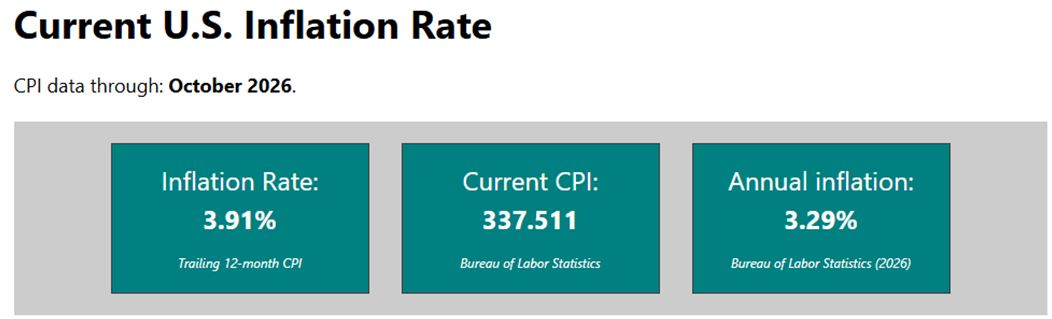
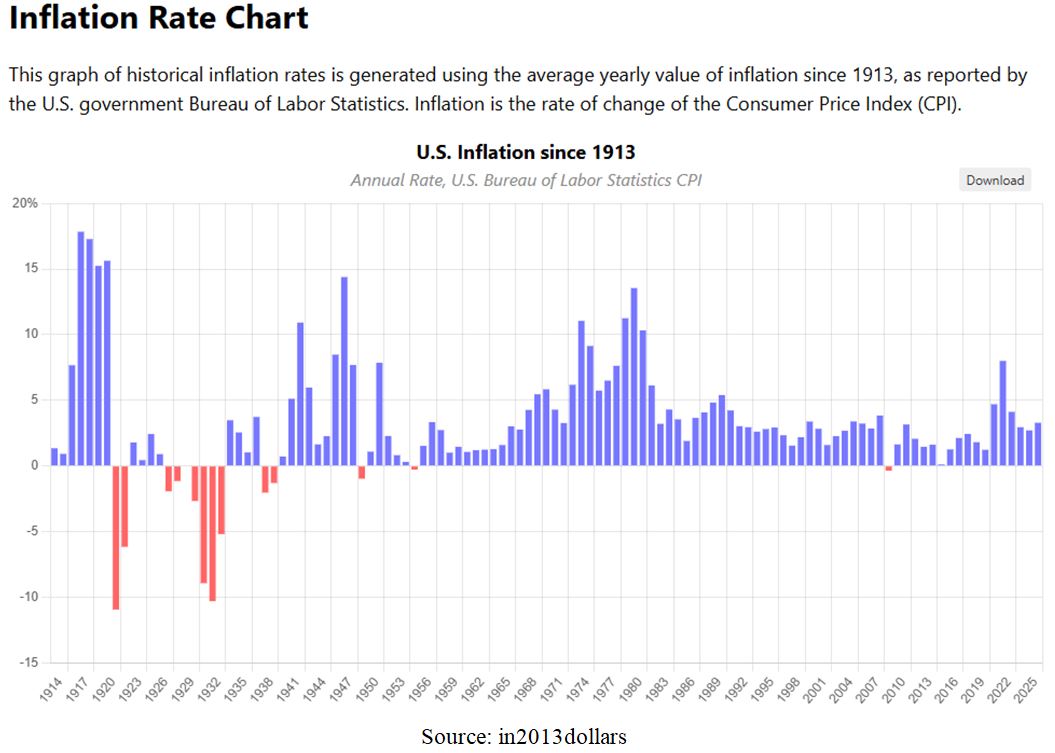
Last week, both the Consumer Price Index (CPI) and Producer Price Index (PPI) came in above forecast with non-energy components showing sticky price increases. At the same time, the reaction by the Treasury market wasn’t as negative as the narrative framed the news of higher-than-expected inflation.
Graphs are for illustrative and discussion purposes only. Please read important disclosures at the end of this commentary.
This is likely due to the fact the bond market is forward looking, which, in my view, means there is an incredible disinflationary catalyst at work – called artificial intelligence – and its productivity gains are still in the early days. According to FactSet’s tracking, 331 S&P 500 companies (67% of the 493 firms with conference calls) cited AI during their calls, marking the third consecutive quarter above 65%.
J.P. Morgan found nearly two-thirds of large firms deployed AI agents, but just 1 in 10 (10%, or 50 companies) scaled them across the entire business – a hockey stick chart of AI deployment in the making.
Throughout economic history, the rarest and most coveted macroeconomic environment is a time of low-inflationary growth, a time when output expands rapidly while price pressures subside. During such periods, central banks have room to keep monetary policy accommodative. As a result, real consumer purchasing power rises and corporate earnings compound without being eroded by rising input costs.
This mixture is like a “Goldilocks” growth formula on steroids.
While much of the public debate focuses on AI’s capital-intensive buildout of data centers and power grids, the deeper macroeconomic reality is AI operating as a potent disinflationary force across both the short and long term, a dynamic that is solidly bullish for corporate profit margins and equity valuations.
In the short term, AI’s disinflationary impact begins with the immediate compression of unit labor costs and operational friction. Over the past several years, tight labor markets and rising wages in service-heavy economies kept core inflation sticky. Generative AI and autonomous software agents directly address this bottleneck by enabling businesses to decouple revenue growth from headcount expansion.
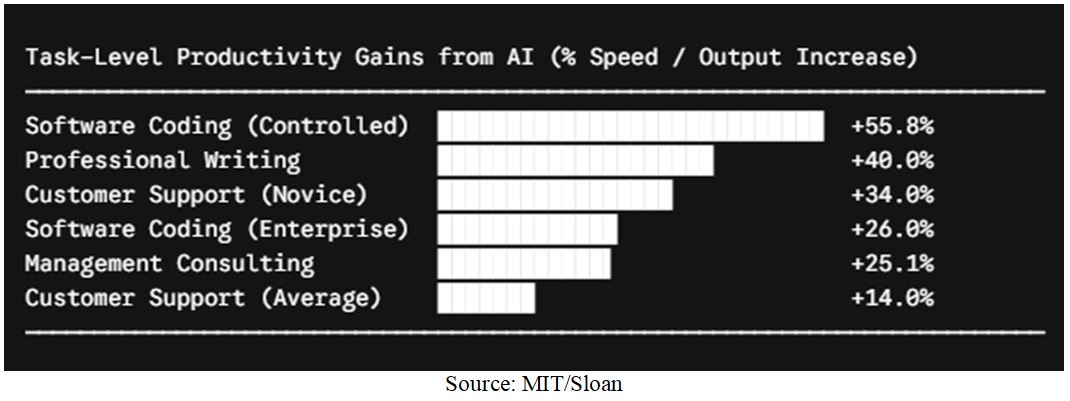
Even as companies invest heavily in compute infrastructure, early enterprise adopters are already reporting measurable productivity gains, due in part to customer service inquiries being resolved at a fraction of historical costs, with software engineering cycles compressed from months to weeks, and back-office functions in legal, accounting, and logistics becoming automated at scale.
Graphs are for illustrative and discussion purposes only. Please read important disclosures at the end of this commentary.
It is widely recognized that AI substantially increases more output per worker hour: Unit labor costs fall, allowing margins to expand without passing higher prices on to consumers. Furthermore, AI-driven supply chain optimization and dynamic inventory management are actively reducing waste and fulfillment delays, smoothing out the micro-level bottlenecks that frequently spark localized price spikes.
Over the long term, AI shifts from an incremental efficiency tool to a positive supply shock across the broader economy. As AI models become more efficient and inference costs plummet year after year, intelligence becomes an abundant, low-cost utility. Beyond white-collar services, the integration of AI into scientific research and physical industries promises to lower costs in sectors plagued by inflation.
In healthcare and pharmaceuticals, AI-accelerated molecular discovery and clinical trial optimization can sharply compress the multi-billion-dollar cost of bringing new therapies to market. In manufacturing, energy, and agriculture, AI-guided robotics and predictive maintenance increase asset utilization and reduce raw material waste. By expanding the economy’s productive capacity faster than aggregate demand, AI acts as a structural anchor keeping long-run inflation subdued.
For corporate profits, this disinflationary productivity boom translates directly into historic operating leverage. In a typical inflationary environment, rising revenues are an illusion where top-line growth is matched or exceeded by rising wages, raw materials, and borrowing costs, leaving profit margins stagnant. Conversely, in an AI-driven disinflationary expansion, companies capture the spread between steady demand and falling marginal costs. Because software, algorithms, and automated workflows scale with minimal incremental expense, every additional dollar of revenue carries a significantly higher contribution margin. There is already early evidence of this divergence, where corporate earnings growth outpaces top-line revenue growth as labor costs as a share of output decline.
These margin gains are not confined to mega-cap technology providers. While semiconductor and cloud infrastructure firms capture the initial wave of capital expenditure, the true multi-year earnings windfall accrues to traditional enterprises such as banks, retailers, healthcare providers, and industrial manufacturers that deploy AI to strip out administrative bloat and monetize proprietary data.
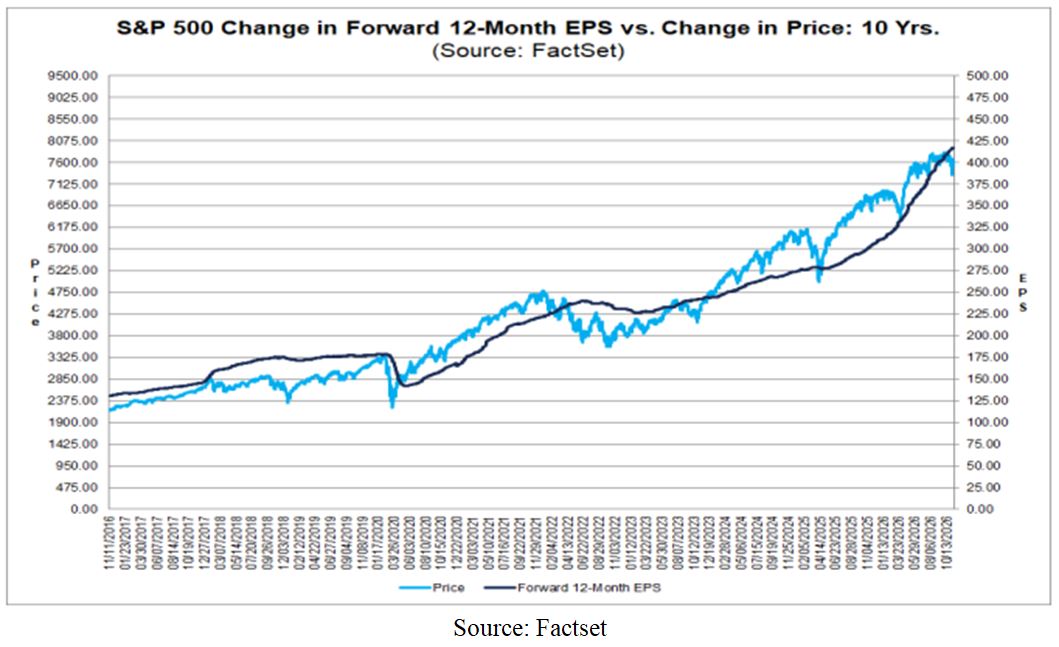
Finally, the marriage of AI-led disinflation and expanding corporate margins creates an ideal valuation environment for the stock market. Equity prices are fundamentally a function of two variables: future earnings growth and the discount rate applied to those earnings. When inflation is persistent, as has been the case in 2026, bond yields rise, forcing central banks to tighten liquidity and compressing the price-to-earnings multiples investors are willing to pay for stocks. The current P/E for the S&P of 17.5x puts it comfortably below both its 5-year average (19.8x) and 10-year average (19.1x).
Graphs are for illustrative and discussion purposes only. Please read important disclosures at the end of this commentary.
By dampening inflationary pressures over time, AI relieves pressure on long-term interest rates and gives the Federal Reserve greater flexibility to support economic expansion. Lower inflation volatility reduces the equity risk premium, supporting higher valuation multiples at a time when earnings are rising.
Skeptics often warn that massive AI capital expenditures (or energy constraints) could spark near-term price pressures, overlooking the crucial distinction between temporary investment friction and permanent productivity gains. Building factories always requires upfront capital and resources, yet the ultimate purpose of industrial investment is to produce goods more cheaply and abundantly.
AI follows the exact same playbook. By cutting the cost of doing business in the short term and then multiplying economic output over the long haul, artificial intelligence creates a powerful disinflationary tailwind, driving durable earnings growth and sustained stock market gains for investors.
P.S. Since this is my last column here, you can now contact me at bryanperry@mintassetmanagment.com
All content above represents the opinion of Bryan Perry of Navellier & Associates, Inc.
Also In This Issue
A Look Ahead by Louis Navellier
The Latest News from Nvidia and Other Leading Tech Companies
Income Mail by Bryan Perry
AI’s Disinflationary Power Fuels a Virtuous Cycle
Growth Mail by Gary Alexander
Investment Lessons After Nearly 60 Years in the Game
Global Mail by Ivan Martchev
Nvidia’s $2 Trillion Soap Opera
Sector Spotlight by Jason Bodner
The Washout Is Done. History Says “Look Up”
Important Disclosures:
Although information in these reports has been obtained from and is based upon sources that Navellier believes to be reliable, Navellier does not guarantee its accuracy and it may be incomplete or condensed. All opinions and estimates constitute the authors opinions as of the date the report was created and are subject to change without notice. These reports are for informational purposes only and are not a solicitation for the purchase or sale of any securities or financial services. Any decision to purchase securities mentioned in these reports must take into account existing public information on such securities or any registered prospectus. To the extent permitted by law, neither Navellier & Associates, Inc., nor any of its affiliates, agents, or service providers are providing any investment advice herein and do not assume any liability or responsibility for the readers’ decisions if any. No reader should act or refrain from acting in reliance on the information contained in this communication or for any decision based on it.
None of the stock information, data, or company information presented herein constitutes investment advice or a recommendation by Navellier or a solicitation to buy or sell any securities. Any specific securities identified and described herein do not represent any investment advice.
Information presented is general information that does not take into account your individual circumstances, financial situation, or needs, nor does it present a personalized recommendation to you. Individual stocks presented may not be suitable for every investor. Investment in securities involves significant risk and has the potential for partial or complete loss of funds invested. Investment in fixed income securities has the potential for the investment return and principal value of an investment to fluctuate so that an investor’s holdings, when redeemed, may be worth less than their original cost.
- This report contains statements that are, or may be considered to be, forward-looking statements. All statements that are not historical facts, including statements about our beliefs or expectations, are “forward-looking statements” within the meaning of The U.S. Private Securities Litigation Reform Act of 1995. These statements may be identified by such forward-looking terminology as “expect,” “estimate,” “plan,” “intend,” “believe,” “anticipate,” “may,” “will,” “should,” “could,” “continue,” “project,” or similar statements or variations of such terms. Our forward-looking statements are based on a series of expectations, assumptions, and projections, are not investment advice. All of our forward-looking statements are as of the date of this report only.
- Federal Tax Advice Disclaimer: As required by U.S. Treasury Regulations, you are informed that, to the extent this presentation mentions any federal taxes, Navellier is not presenting any tax advice and should not be used or relied on as tax advice. Navellier does not advise on any income tax requirements or issues. Use of any information presented by Navellier is for general information only and does not represent tax advice either express or implied. You are encouraged to seek professional tax advice for income tax questions and assistance.
- FactSet Disclosure: Navellier does not independently calculate the statistical information included in the attached report. The calculation and the information are provided by FactSet, a company not related to Navellier. Although information contained in the report has been obtained from FactSet and is based on sources Navellier believes to be reliable, Navellier does not guarantee its accuracy, and it may be inaccurate, incomplete or condensed. The report and the related FactSet sourced information is for general information purposes only.