
by Bryan Perry
November 3, 2026
Market and sector volatility can either cause elevated stress or seriously beneficial income to one’s portfolio. Over the course of the past six months, the majority of the S&P’s 11 sectors have endured fairly extreme levels of volatility. This past week, the technology sector was the poster child of what is termed “excessive implied volatility,” which (translated) means share price deterioration – but not always.
This “implied volatility” is the options market’s term for a forward-looking estimate of how wildly an underlying asset’s price will fluctuate over a specific time period. Rather than tracking historical price movement, implied volatility is backed out of current option market prices using mathematical formulas like the Black-Scholes model. In plain terms, it measures aggregate uncertainty. For instance, when traders expect impending catalysts, earnings surprises or macro turmoil, they will bid up option contracts as portfolio insurance, driving implied volatility and option premiums higher.
In markets navigating a volatile streak, taking full advantage of implied volatility means selling option premiums back to the marketplace and capturing outsized option premium-related income. For covered-call strategies, implied volatility acts as the primary revenue engine. When a fund sells call options against the shares it owns, the cash premium it pockets rises proportionally with the implied volatility.
In lower-volatility environments, option selling produces modest single-digit yields that rarely compensate for capping upside gains, while elevated implied volatility inflates the option seller’s premium income, allowing covered-call ETFs to distribute sustainable double-digit annualized yields.
The current market environment represents a structural “sweet spot” for covered-call income ETFs: Broad indices are characterized by rich equity valuations and range-bound, sideways friction rather than big bull rallies, while ongoing macro and geopolitical crosscurrents keep implied volatility persistently elevated. Because standard equity dividend yields remain near historical lows, investors face an income drought.
In a choppy market, pure equities generate sluggish capital gains but covered-call funds capture fat up-front option premiums that outperform static buy-and-hold strategies without suffering from the capped-upside drag that occurs during parabolic market melt-ups.
Applying this methodology works best in a sector that is technically overbought. The energy sector fits this profile and strategy to a tee. Be it the integrated major oil companies or the exploration and production companies, the top holdings in the State Street Energy Select Sector SPDR ETF (XLE) account for 78% of total assets. Shares of XLE have rallied 55% over the past three-months.
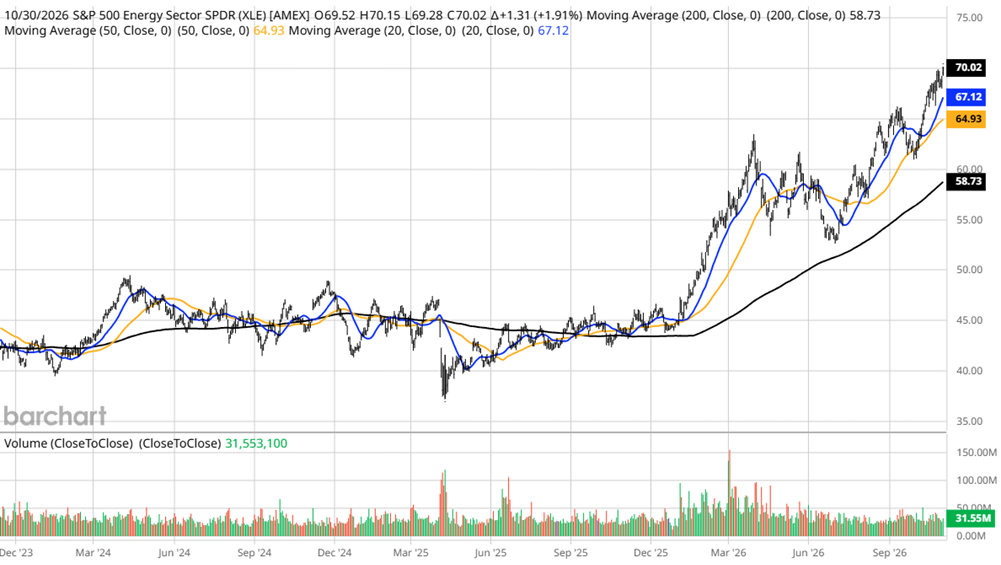
Graphs are for illustrative and discussion purposes only. Please read important disclosures at the end of this commentary.
With WTI crude trading at around $104 a barrel as of last Friday, the following chart shows that WTI is at the high end of its long-term historic range, with option premiums having expanded meaningfully in the last few months. Hence, it stands to reason that staying long the sector while banking historic call premium makes good portfolio sense, whether done individually or with ETFs or closed-end funds.
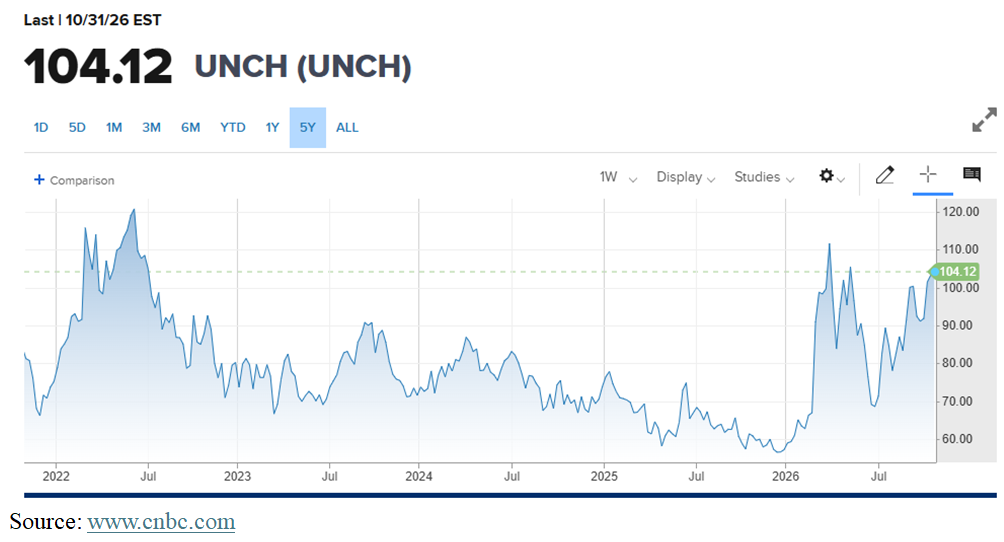
Graphs are for illustrative and discussion purposes only. Please read important disclosures at the end of this commentary.
Applying this strategy to other sectors that have rallied due to defensive characteristics but lacking in fundamentals (i.e., consumer staples, REITs, utilities) requires more technical confirmation. Increased input costs, higher financing thresholds, and regulatory hurdles are headwinds to these three sectors that saw sharply bullish market rotation as funds flowed out of portfolios overweighted in technology.
Chasing these sectors following a knee-jerk spike invites fresh risk, whereas staying long leading energy producers and refiners, where global supply levels are low and visibility of all-out future production, is about as bright as can be makes for a core sector holding and terrific inflation hedge.
By the end of September, global oil inventories remained substantially below pre-war levels, while onshore stocks had fallen to their lowest levels since at least 2016. The continued depletion of these reserves is reducing the market’s ability to absorb additional supply disruptions. Without a rapid resolution to the ongoing conflicts in the Middle East, global oil markets could face further turbulence in the coming months, particularly as available inventory buffers continue to shrink. Despite improved crude flows through the Strait of Hormuz, supply risks remain elevated and shipping costs continue to weigh on the market. As of this week, the conflict with Iran and its proxy states looks to extend out indefinitely.
Selling individual call options on the integrated oil companies, the oil tanker shipping companies, the refiners, and oil service companies can provide some of the most attractive income the option market is offering during these highly charged geopolitical times. So, why not consider cashing in on this volatility and strike while the option iron is hot. At some point, volatility will retreat and so will lofty yields.
For income investors seeking to capture rich call option premiums in a simple plug-and-play investment, the State Street Energy Select Sector SPDR Premium Income ETF (XLEI) is worth consideration. The strategy is to buy shares of State Street Energy Select Sector SPDR ETF (XLE) and sell just out of the money monthly calls. Below is a table of the past 12-months’ distributions, with rolling yields over 17%.
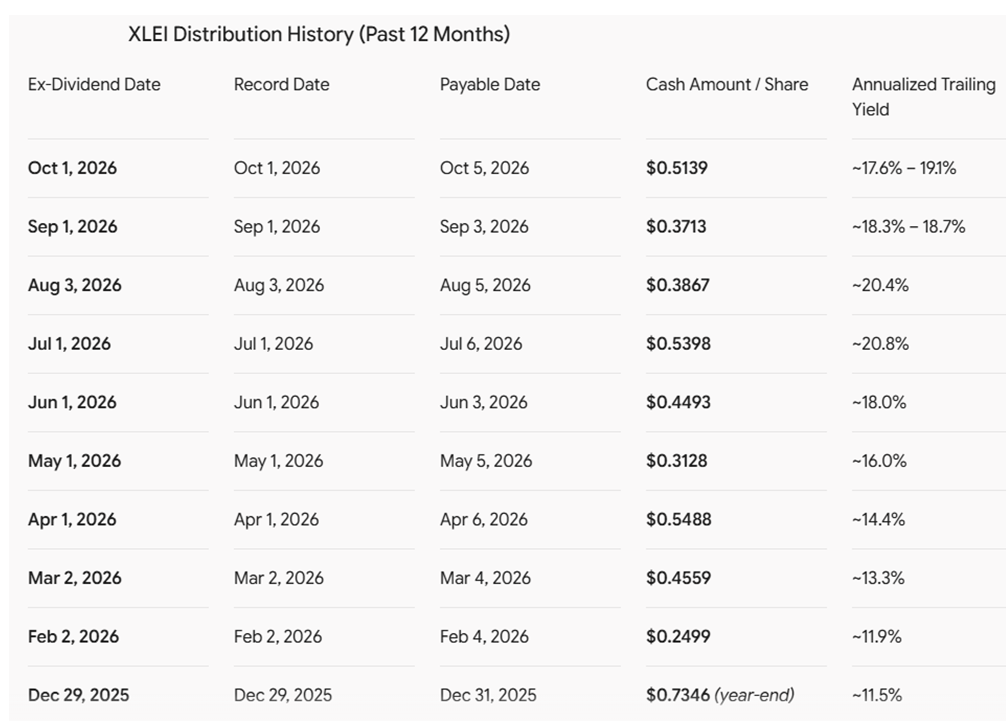
Graphs are for illustrative and discussion purposes only. Please read important disclosures at the end of this commentary.
There are other sectors with covered call strategies that also offer outsized yields where investors need to perform their due diligence. But when option income funds related to energy are paying out huge yields during periods of extreme volatility where the underlying fundamentals look to extend out for several months if not quarters, then doing some homework on whether to commit capital is indeed warranted.
All content above represents the opinion of Bryan Perry of Navellier & Associates, Inc.
Also In This Issue
A Look Ahead by Louis Navellier
Expect a Fractured G-20 Meeting in Florida Next Month
Income Mail by Bryan Perry
Using Energy Options to Take “Implied Market Volatility” to the Bank
Growth Mail by Gary Alexander
Today May Be the Best Day to Invest in the Post-Election Surge
Global Mail by Ivan Martchev
A Stock Market Bottom is Likely Within Reach
Sector Spotlight by Jason Bodner
Doubting the Future is Popular – But Not Very Profitable
Important Disclosures:
Although information in these reports has been obtained from and is based upon sources that Navellier believes to be reliable, Navellier does not guarantee its accuracy and it may be incomplete or condensed. All opinions and estimates constitute the authors opinions as of the date the report was created and are subject to change without notice. These reports are for informational purposes only and are not a solicitation for the purchase or sale of any securities or financial services. Any decision to purchase securities mentioned in these reports must take into account existing public information on such securities or any registered prospectus. To the extent permitted by law, neither Navellier & Associates, Inc., nor any of its affiliates, agents, or service providers are providing any investment advice herein and do not assume any liability or responsibility for the readers’ decisions if any. No reader should act or refrain from acting in reliance on the information contained in this communication or for any decision based on it.
None of the stock information, data, or company information presented herein constitutes investment advice or a recommendation by Navellier or a solicitation to buy or sell any securities. Any specific securities identified and described herein do not represent any investment advice.
Information presented is general information that does not take into account your individual circumstances, financial situation, or needs, nor does it present a personalized recommendation to you. Individual stocks presented may not be suitable for every investor. Investment in securities involves significant risk and has the potential for partial or complete loss of funds invested. Investment in fixed income securities has the potential for the investment return and principal value of an investment to fluctuate so that an investor’s holdings, when redeemed, may be worth less than their original cost.
- This report contains statements that are, or may be considered to be, forward-looking statements. All statements that are not historical facts, including statements about our beliefs or expectations, are “forward-looking statements” within the meaning of The U.S. Private Securities Litigation Reform Act of 1995. These statements may be identified by such forward-looking terminology as “expect,” “estimate,” “plan,” “intend,” “believe,” “anticipate,” “may,” “will,” “should,” “could,” “continue,” “project,” or similar statements or variations of such terms. Our forward-looking statements are based on a series of expectations, assumptions, and projections, are not investment advice. All of our forward-looking statements are as of the date of this report only.
- Federal Tax Advice Disclaimer: As required by U.S. Treasury Regulations, you are informed that, to the extent this presentation mentions any federal taxes, Navellier is not presenting any tax advice and should not be used or relied on as tax advice. Navellier does not advise on any income tax requirements or issues. Use of any information presented by Navellier is for general information only and does not represent tax advice either express or implied. You are encouraged to seek professional tax advice for income tax questions and assistance.
- FactSet Disclosure: Navellier does not independently calculate the statistical information included in the attached report. The calculation and the information are provided by FactSet, a company not related to Navellier. Although information contained in the report has been obtained from FactSet and is based on sources Navellier believes to be reliable, Navellier does not guarantee its accuracy, and it may be inaccurate, incomplete or condensed. The report and the related FactSet sourced information is for general information purposes only.