
by Bryan Perry
October 27, 2026
The recent pullback in the benchmark 10-year Treasury from 5.35% to 5.00% has been a welcome development, but it remains tenuous with WTI crude back up to nearly $104 per barrel, plus inflation readings above forecasted levels, and rumblings of further rate hikes after the midterm elections.
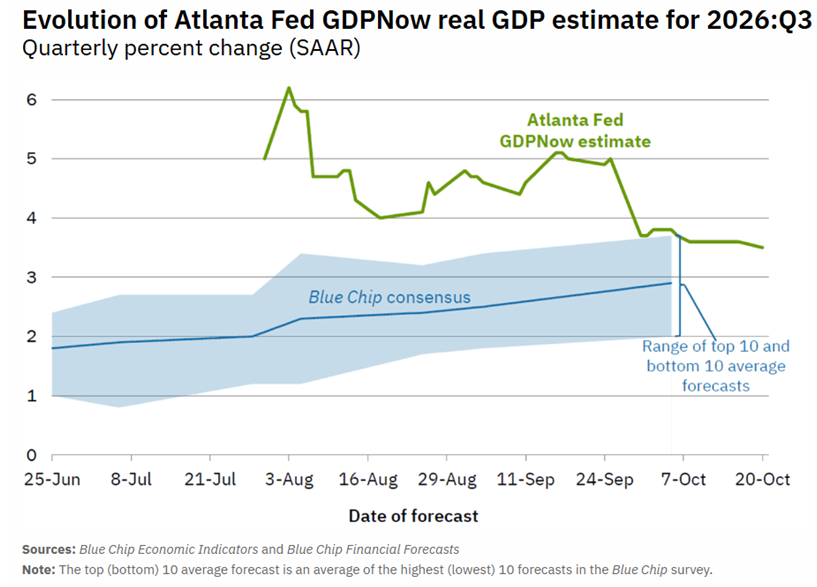
Dissecting the current landscape for bond investing involves looking at the most recent economic data and revisions to get some insight for the near term. Starting with the outlook for economic growth, the Atlanta Fed has lowered its estimate for the third-quarter GDP to 3.5% from 5.0% in just the past month.
Graphs are for illustrative and discussion purposes only. Please read important disclosures at the end of this commentary.
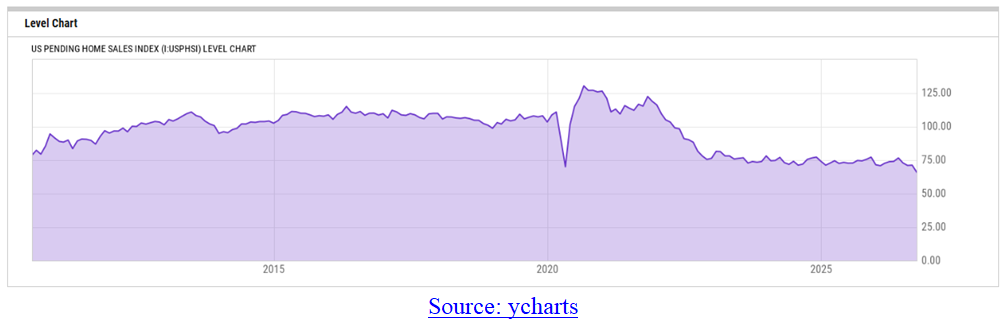
This is a sharp reduction, reflecting a weak housing market experiencing severe weakness rather than a price collapse. Sales volume has stalled due to an affordability squeeze, while home values remain largely propped up by a structural supply shortage. Existing home sales are tracking at levels unseen since 2010.
Graphs are for illustrative and discussion purposes only. Please read important disclosures at the end of this commentary.
Housing turnover has broken down. When home sales freeze at 3.9 million units, people basically aren’t moving. That eliminates the spending wave typically triggered by a move – like furniture, appliances, kitchen remodels, carpeting, and moving services – all impacted when the housing market seizes up.
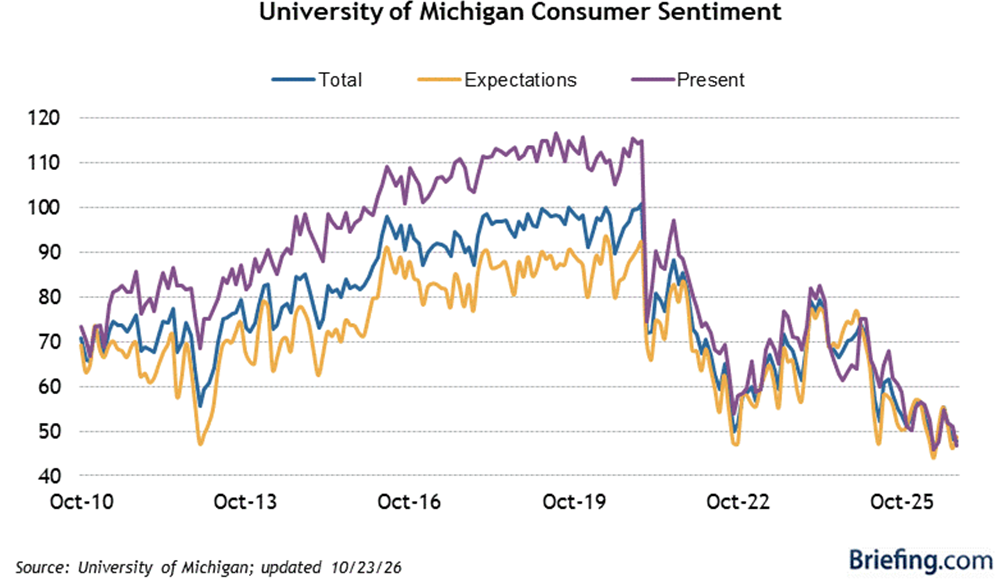
Consumer sentiment is also in the red. The final University of Michigan Consumer Survey for October revealed that American consumer sentiment remains mired near historic lows, at 48.0, roughly 10% below year-ago levels, representing one of the lowest readings in the survey’s 70-year history.
Graphs are for illustrative and discussion purposes only. Please read important disclosures at the end of this commentary.
The primary drag on sentiment came from the Current Economic Conditions sub-index, which slid 8.3% month-over-month to 46.7, driven largely by an 18% plunge in buying conditions for large durable goods and vehicles, as high borrowing costs and price tags continue to strain household purchasing power.
The survey as a whole highlights an exhausted consumer navigating high interest rates, elevated everyday expenses and creeping inflation, which complicates the path ahead for Federal Reserve policymakers.
So, with economists forecasting a slowing of economic activity, the housing market stuck in first gear as mortgage rates trade between 6.75% and 7.4%, and the consumer concerned about their buying power, it stands to reason some elements of demand destruction are already underway. That means the Fed has every reason to sit out a further rate hike at this week’s FOMC meeting, and not just for political reasons.
The bond market is sending a signal that even if S&P 500 earnings remain robust, the consumer-driven U.S. economy is starting to downshift. Whether the holiday shopping season changes this is a jump ball, but gas and travel costs are high, so discretionary spending on big ticket items is likely to remain soft.
Under this scenario, and assuming the 10-year yield holds around 5.0%, many investors are asking where the best opportunities in the bond market are right now. Within the Treasury market, intermediate-term Treasuries (with 5–7-year maturities) offer 4.8% to 5.0%; investment grade corporates with 3-7-year maturities pay 5.8% to 6.3% yields, and 10-year AAA/AA tax free municipal bonds are paying 4%-4.2%.
The best opportunities emerge by balancing yield capture, reinvestment risk, and credit protection across the curve. The 5-to-7-year portion of the Treasury yield curve delivers 4.8% to 5.0%. This represents the “duration sweet spot,” and is attracting strong fund flows of late.
According to the CME FedWatch Tool, the probability of a Fed Funds rate hike at the December 9 FOMC meeting stands at 67.5% now, down from 75.5% a week ago. If the data noted above keeps trending lower during the month of November, the Fed will likely keep rates steady. If oil prices recede, then there is a chance for a shift in monetary policy to ease rates to stimulate a cautious consumer and housing market. Stay tuned. The next five-weeks will likely crystalize the trend for interest rates.
All content above represents the opinion of Bryan Perry of Navellier & Associates, Inc.
Also In This Issue
A Look Ahead by Louis Navellier
A Closer Look at Last Week’s Earnings Leaders
Income Mail by Bryan Perry
Taking Stock of the Bond Market
Growth Mail by Gary Alexander
America Wins the “World Cup” (and Super Bowl) of Economic Growth
Global Mail by Ivan Martchev
There are Too Many Cross Currents for a Firm Bottom
Sector Spotlight by Jason Bodner
Leaves Don’t Fall – They’re Killed
Important Disclosures:
Although information in these reports has been obtained from and is based upon sources that Navellier believes to be reliable, Navellier does not guarantee its accuracy and it may be incomplete or condensed. All opinions and estimates constitute the authors opinions as of the date the report was created and are subject to change without notice. These reports are for informational purposes only and are not a solicitation for the purchase or sale of any securities or financial services. Any decision to purchase securities mentioned in these reports must take into account existing public information on such securities or any registered prospectus. To the extent permitted by law, neither Navellier & Associates, Inc., nor any of its affiliates, agents, or service providers are providing any investment advice herein and do not assume any liability or responsibility for the readers’ decisions if any. No reader should act or refrain from acting in reliance on the information contained in this communication or for any decision based on it.
None of the stock information, data, or company information presented herein constitutes investment advice or a recommendation by Navellier or a solicitation to buy or sell any securities. Any specific securities identified and described herein do not represent any investment advice.
Information presented is general information that does not take into account your individual circumstances, financial situation, or needs, nor does it present a personalized recommendation to you. Individual stocks presented may not be suitable for every investor. Investment in securities involves significant risk and has the potential for partial or complete loss of funds invested. Investment in fixed income securities has the potential for the investment return and principal value of an investment to fluctuate so that an investor’s holdings, when redeemed, may be worth less than their original cost.
- This report contains statements that are, or may be considered to be, forward-looking statements. All statements that are not historical facts, including statements about our beliefs or expectations, are “forward-looking statements” within the meaning of The U.S. Private Securities Litigation Reform Act of 1995. These statements may be identified by such forward-looking terminology as “expect,” “estimate,” “plan,” “intend,” “believe,” “anticipate,” “may,” “will,” “should,” “could,” “continue,” “project,” or similar statements or variations of such terms. Our forward-looking statements are based on a series of expectations, assumptions, and projections, are not investment advice. All of our forward-looking statements are as of the date of this report only.
- Federal Tax Advice Disclaimer: As required by U.S. Treasury Regulations, you are informed that, to the extent this presentation mentions any federal taxes, Navellier is not presenting any tax advice and should not be used or relied on as tax advice. Navellier does not advise on any income tax requirements or issues. Use of any information presented by Navellier is for general information only and does not represent tax advice either express or implied. You are encouraged to seek professional tax advice for income tax questions and assistance.
- FactSet Disclosure: Navellier does not independently calculate the statistical information included in the attached report. The calculation and the information are provided by FactSet, a company not related to Navellier. Although information contained in the report has been obtained from FactSet and is based on sources Navellier believes to be reliable, Navellier does not guarantee its accuracy, and it may be inaccurate, incomplete or condensed. The report and the related FactSet sourced information is for general information purposes only.