
by Ivan Martchev
October 27, 2026
The indications given by the Trump administration last week are for renewed kinetic activity in Iran, possibly commencing after the November 3rd election. Historically, elections have been clearing events, where investors mostly focus on good earnings and “run with the ball,” so to speak, but I have to wonder what type of clearing event this election would be if the price of oil – especially the European Brent benchmark – is already past the highs seen at the opening stages of the war (see chart below).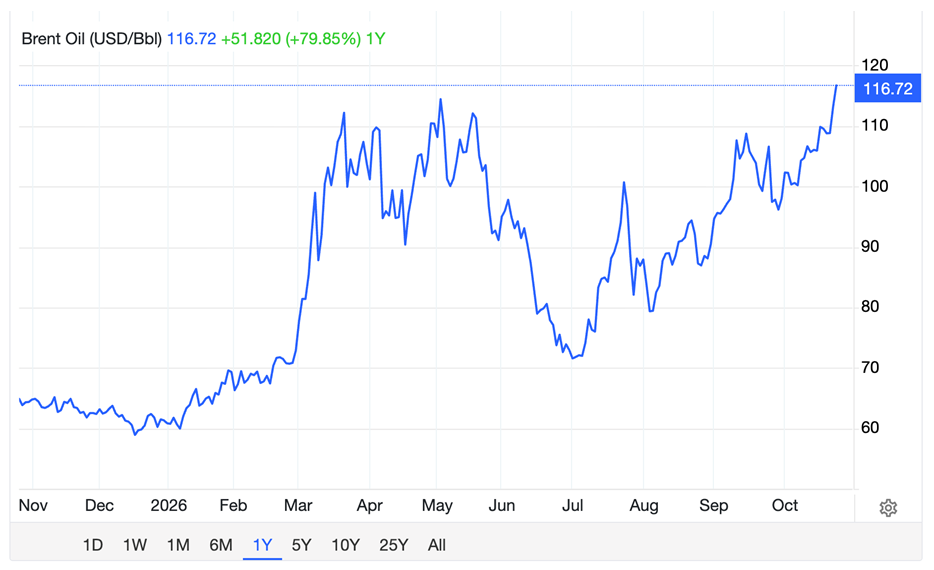
Graphs are for illustrative and discussion purposes only. Please read important disclosures at the end of this commentary.
WTI Cushing, the U.S. benchmark, is close behind, closing last week at $103.27 per barrel. The fact that WTI Cushing has not taken out the highs from March is highly misleading. Delivering oil in the U.S. is not the same as delivering oil in Asia and other places. The surge in shipping and insurance costs requires adding at least $30 to the cost of a barrel of oil when shipping to faraway destinations, even if they are not in the line of fire. If they are in the line of fire, the shipping and insurance costs are even worse. The price of distillates like diesel have already made all-time highs, while the other war in Ukraine is also a huge factor, despite a token Russian diesel deal with the U.S. that did nothing other than generate headlines.
We don’t know how long this renewed warfare with Iran will last, but we can hope it is less than the opening stages of the war. The Iran war has also done a number on the EU natural gas market where the Rotterdam benchmark contract closed at 93.860 EUR/MWh last Friday.
To Americans, that price may sound like a lot of gibberish, but to a European industrial customer it is an absolute nightmare. When converting to the U.S. system you get a price of $30.81/MMBtu, where the U.S. front-month contract closed on Friday at $2.64 because of warm weather.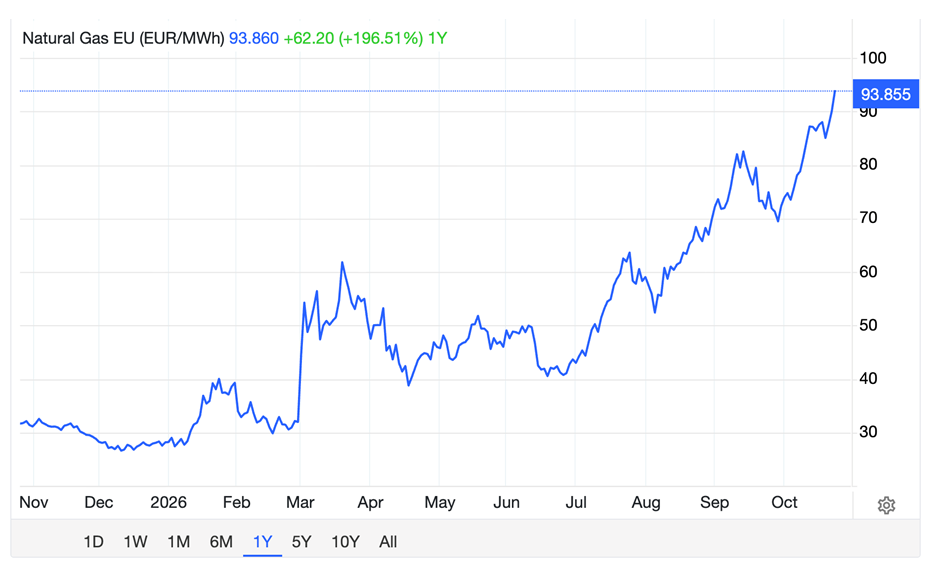
Graphs are for illustrative and discussion purposes only. Please read important disclosures at the end of this commentary.
The Iran war affects flows of spot LNG globally. There is already damage to LNG infrastructure in Qatar, and I have to wonder how much more damage there will be if the war enters a second kinetic phase after the election. More damaged infrastructure may mean higher prices for longer if it can’t be quickly fixed.
While the U.S. stock market may be able to look past an energy price spike, if the second-stage of the Iran war is short, it will have a much harder time looking past troubles in the U.S. junk bond market, which multiplied in the past week. Simply put, if the junk bond market keeps selling off, stocks cannot rally.
The Dilemma of Accounting for CoreWeave and “Neocloud bonds”
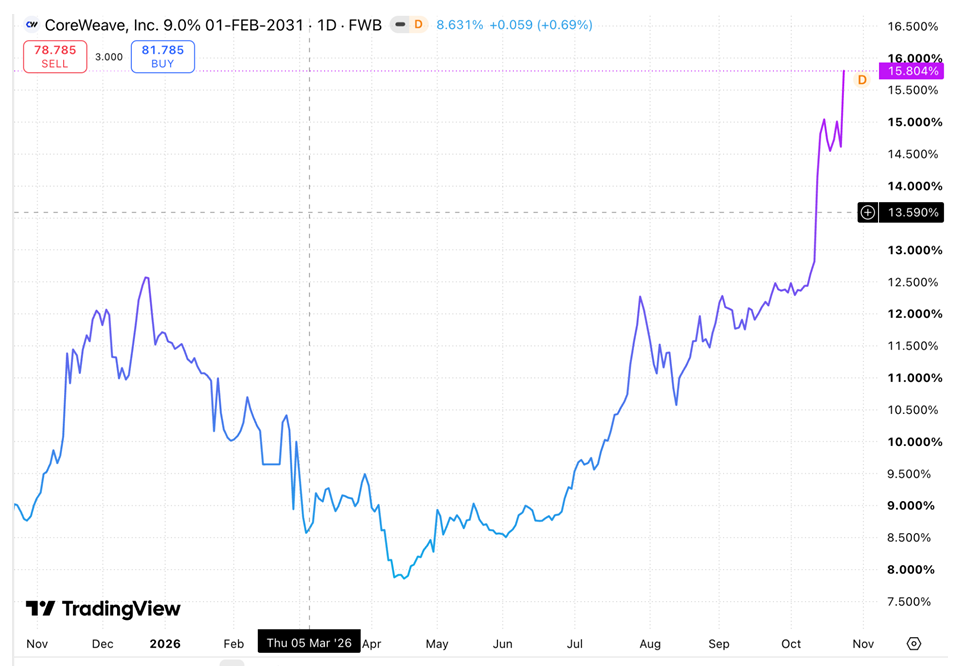
Much has been said about the trouble in neocloud bonds, where CoreWeave is on everyone’s radar, but bonds across this new industry look more or less the same. A neocloud is a cloud infrastructure company for primarily AI activity, requiring a lot of GPUs (read expensive) to run. Bigger hyperscaler clouds have more diverse abilities and can run other types of enterprise software. Since neoclouds are a new industry requiring massive capex to get to scale, they must borrow a lot of money. The junk bond market is saying the level of borrowing required will require much higher interest rates, which may render their business models uncompetitive as yields on some CoreWeave bonds have more or less doubled in six-months.
Graphs are for illustrative and discussion purposes only. Please read important disclosures at the end of this commentary.
Famed semiconductor executive Jensen Huang gave a TV interview from Berlin last week, where he was a keynote speaker at an AI conference. His key points were these: “The demand for the neoclouds is off the charts. Their capabilities are extraordinary. So, what is missing in the middle is the working capital to fuel that growth, to fund that growth. And because there is so much demand across so many sectors of AI there is a scarcity of capital. The demand of the capital is much greater than the availability of the capital…That’s gonna get solved. That’s gonna get solved because fundamentally the most important things are the values that these companies are providing. The demand for it is so strong.”
I don’t have a problem with AI. I think we will do wonderful things with productivity and economic growth over the long term. What I do have a problem with is Jensen Huang’s definition of working capital, because I think he is using the wrong terminology. So, I asked Gemini, Google’s popular AI chatbot, to define ‘working capital ‘and here is what I got with a link to a bank website: “Working capital is the money a business has available to fund its day-to-day operations and pay its short-term bills.”
I don’t think what CoreWeave or the neoclouds need is working capital. They need to borrow massive amounts of money to buy GPUs and data center infrastructure and services to grow their businesses. This is not working capital. This is a debt form of long-term financing, which just doubled in price if one were to use the yield on CoreWeave bonds over the past six-months. Having gone to business school, I can tell you they taught the difference between debt and equity financing is non-existent if the business model is sound. I believe they still teach this nonsense. It is nonsense because debt and equity have very different roles in the capital structure. Economic activity is cyclical, making mandatory debt payments a problem, where one can skip a dividend (if there is one) or not pay a dividend in the interest of long-term growth.
Right now, the bond market does not want to see any more neocloud debt. One has to wonder will the stock market be receptive to a neocloud secondary offering of equity financing? I think the answer is firmly, No, although there hasn’t been any neocloud stupid enough to try it yet.
Graphs are for illustrative and discussion purposes only. Please read important disclosures at the end of this commentary.
There will be a lot of earnings reports released this week and next, which may provide an upside catalyst for the stock market, most likely after the election. I think the kinetic activity in Iran may be shorter than the first phase, so some investors may use the commencement of renewed hostilities as a buy signal. As there is trouble in the junkiest of junk bonds and neocloud bonds in particular, every rebound needs to be treated with suspicion until the junk bond market calms down.
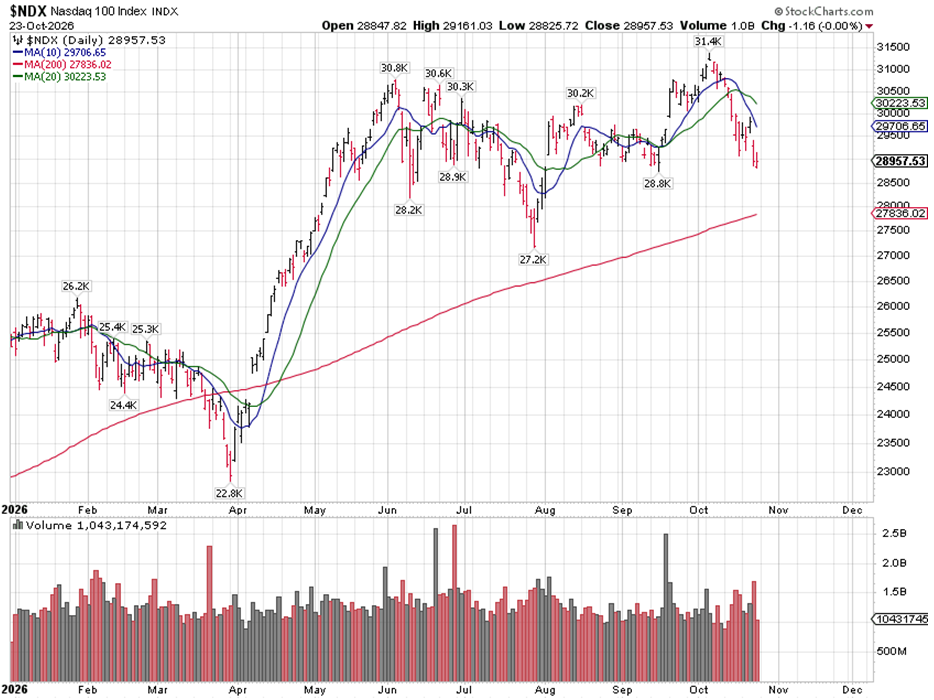
I think the NASDAQ 100 Index, where the drama is concentrated, as it is the epicenter of the “AI trade”, is probably headed to the vicinity of its 200-day moving average, near 27,800. The bulls are likely to make a stand in the range of 27,200 (last summer’s low) and 27,800. If it weren’t for the Iran war, it would have been easier to find a firmer bottom in the present environment with solid earnings growth.
The way the stock market works in a situation with many cross currents, the more uncertainty is removed the more likely it is to rally on good earnings news, which may happen near the beginning of Iran Phase 2.
Navellier and Associates; do not own CoreWeave (CRWV) in managed accounts. Ivan Martchev does not own CoreWeave (CRWV) personally.
All content above represents the opinion of Ivan Martchev of Navellier & Associates, Inc.
Also In This Issue
A Look Ahead by Louis Navellier
A Closer Look at Last Week’s Earnings Leaders
Income Mail by Bryan Perry
Taking Stock of the Bond Market
Growth Mail by Gary Alexander
America Wins the “World Cup” (and Super Bowl) of Economic Growth
Global Mail by Ivan Martchev
There are Too Many Cross Currents for a Firm Bottom
Sector Spotlight by Jason Bodner
Leaves Don’t Fall – They’re Killed
Important Disclosures:
Although information in these reports has been obtained from and is based upon sources that Navellier believes to be reliable, Navellier does not guarantee its accuracy and it may be incomplete or condensed. All opinions and estimates constitute the authors opinions as of the date the report was created and are subject to change without notice. These reports are for informational purposes only and are not a solicitation for the purchase or sale of any securities or financial services. Any decision to purchase securities mentioned in these reports must take into account existing public information on such securities or any registered prospectus. To the extent permitted by law, neither Navellier & Associates, Inc., nor any of its affiliates, agents, or service providers are providing any investment advice herein and do not assume any liability or responsibility for the readers’ decisions if any. No reader should act or refrain from acting in reliance on the information contained in this communication or for any decision based on it.
None of the stock information, data, or company information presented herein constitutes investment advice or a recommendation by Navellier or a solicitation to buy or sell any securities. Any specific securities identified and described herein do not represent any investment advice.
Information presented is general information that does not take into account your individual circumstances, financial situation, or needs, nor does it present a personalized recommendation to you. Individual stocks presented may not be suitable for every investor. Investment in securities involves significant risk and has the potential for partial or complete loss of funds invested. Investment in fixed income securities has the potential for the investment return and principal value of an investment to fluctuate so that an investor’s holdings, when redeemed, may be worth less than their original cost.
- This report contains statements that are, or may be considered to be, forward-looking statements. All statements that are not historical facts, including statements about our beliefs or expectations, are “forward-looking statements” within the meaning of The U.S. Private Securities Litigation Reform Act of 1995. These statements may be identified by such forward-looking terminology as “expect,” “estimate,” “plan,” “intend,” “believe,” “anticipate,” “may,” “will,” “should,” “could,” “continue,” “project,” or similar statements or variations of such terms. Our forward-looking statements are based on a series of expectations, assumptions, and projections, are not investment advice. All of our forward-looking statements are as of the date of this report only.
- Federal Tax Advice Disclaimer: As required by U.S. Treasury Regulations, you are informed that, to the extent this presentation mentions any federal taxes, Navellier is not presenting any tax advice and should not be used or relied on as tax advice. Navellier does not advise on any income tax requirements or issues. Use of any information presented by Navellier is for general information only and does not represent tax advice either express or implied. You are encouraged to seek professional tax advice for income tax questions and assistance.
- FactSet Disclosure: Navellier does not independently calculate the statistical information included in the attached report. The calculation and the information are provided by FactSet, a company not related to Navellier. Although information contained in the report has been obtained from FactSet and is based on sources Navellier believes to be reliable, Navellier does not guarantee its accuracy, and it may be inaccurate, incomplete or condensed. The report and the related FactSet sourced information is for general information purposes only.