
by Gary Alexander
October 27, 2026
On Sunday, the Pittsburgh Steelers and New Orleans Saints played an NFL mid-season game in the suburbs of Paris, France. The hapless Saints lost again, but I’m glad that American football match ended somewhat more peacefully than Europe’s own football Super Bowl match last May 30, when Paris St. Germain – France’s top soccer squad – beat Britain’s Arsenal to win the EUFA Champions League. Soon after that game ended (in Budapest), rioters set fires all around Paris, with one death and over 400 injured.
In the last five weeks, similar riots and fires spread throughout France, as rioters ransacked shops in Marseille and set fire to the historic Limoges town hall, which survived the Nazis but not today’s rioters.

French protestors, dominated by their impoverished and un-assimilated immigrants, are mostly demanding more social services and better schools, but France already has the highest level of public spending and tax burdens in the Euro-zone. In 2025, French government spending accounted for 57.3% of GDP, but that’s apparently not enough for the rioting crowds in the Banlieue of Paris and other major French cities. (Note: French suburbs are called “Banlieue,” but since the 1970s the term has taken on an added meaning, usually referring to economically disadvantaged suburbs with un-assimilated immigrant concentrations).
With French elections coming next April, conservative candidate Marine Le Pen has gained favor, while the furthest-left candidate, Jean-Luc Melenchon, has doubled down on demanding more handouts. Mr. Melenchon is currently in a tie with two other candidates on the left. These three may join forces to try to defeat the likely victory of Ms. Le Pen of the National Rally right – or there may be a run-off next May.
France isn’t the only EU nation facing this funding dilemma. The economic performance of most EU nations has been dismal since 2010, starting with the financial crisis in the PIGS nations (Portugal, Italy, Greece and Spain). Since about 2008, Europe has seen virtually zero economic or productivity growth.
Marine Le Pen is openly hostile to the EU hierarchy, especially after an EU court convicted her on what seem like a bogus (politically motivated) charge. Next door to France, Germany’s Afd Party is even more openly hostile to the EU, so it is likely that the two largest countries in the EU, Germany and France, will soon be led by anti-EU parties, leading me to suspect the euro will keep dropping to the dollar.
Some recent articles from Bloomberg brought the cause of this dilemma into a sharper focus:
- First, The Wall Street Journal covered France’s appetite for “Magic Money” (i.e., more services despite a lower tax base), based on Modern Monetary Theory (MMT), which has armed a debt bomb.
- MarketWatch amplified this point in an article entitled: “French bonds are suffering through their worst decade since 1803 – and investors are bracing for more pain.” One telling clue in the article: In 2008, France’s debt-to-GDP ratio was about the same as Germany’s and well below Italy’s ratio, but now French debt is far above Germany’s debt and is closing in on Italy’s high debt-to-GDP ratio.
- Bloomberg posted a similar article, entitled: “France Turmoil Threatens to Drag ECB Into Bond Market Showdown,” exploring the prospect of a government collapse and how the European Central Bank (ECB) may have to step in to buy French bonds or even cancel some debt. This threat sent French bond yields soaring. As a result, the euro appears to be headed to parity with the U.S. dollar.
Addressing the beef that the French need better schools, they have a point, but The Business Standard reports that French educators’ pensions “account for 32% of French education ministry spending.”
France’s public debt has surged to 120% of GDP, with the 2026 deficit projected to reach 5.4% of GDP, almost twice the EU’s 3% limit. And France is not alone. Spain has also seen riots, and Spain’s retail sales dropped 0.9% in the same month Germany saw a 3.4% plunge in retail sales. Also, German efficiency is flagging as their trains no longer run on time. Similar national failures are spreading throughout Europe.
Meanwhile, the U.S. is Running Laps Around the European Union
Try as they might, the European Union cannot emulate the United States. We speak one language, with the world’s longest-standing Constitution. Our states “grew up together,” with one brutal Civil War over 160-years ago, but European nations speak different languages, had different currencies until 1999 and fought endless wars against each other over the last 500-years, with one “100-Year War” lasting 116-years.
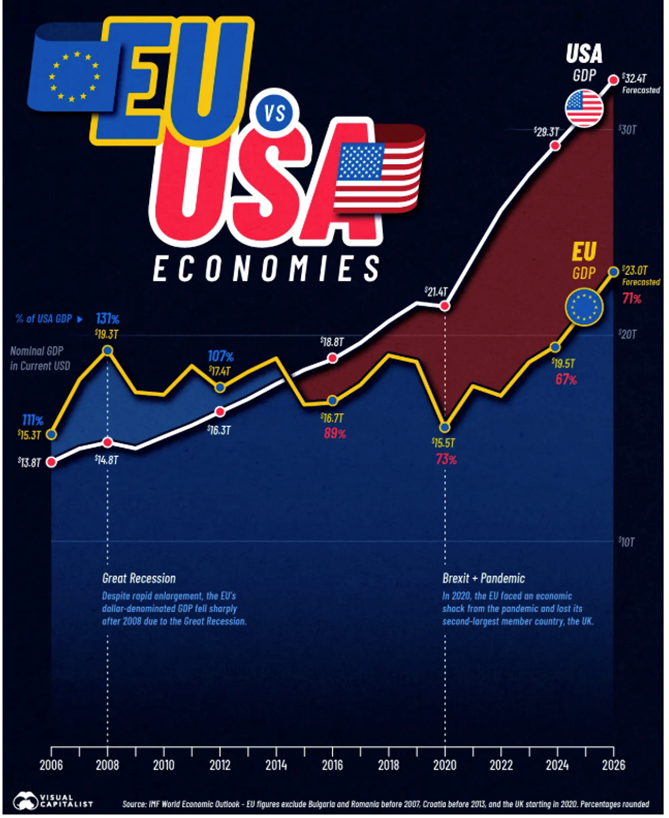
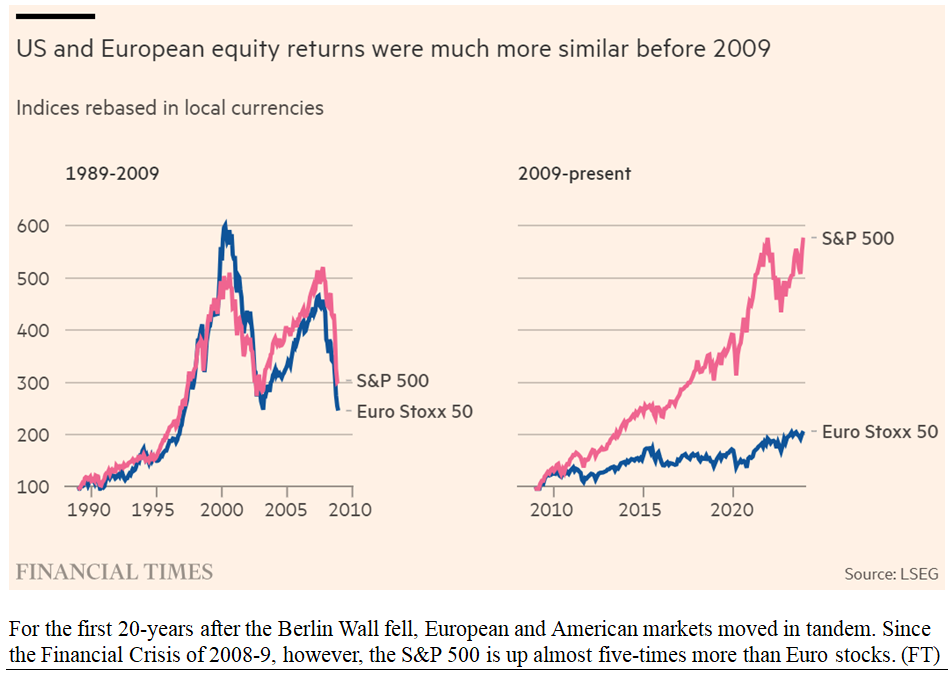
Europe mostly matched U.S. growth and market profits from 1989 to 2009, but then the U.S. pulled ahead rapidly, as Europe entered a death spiral and the U.S. economy took off, as charted below:
Graphs are for illustrative and discussion purposes only. Please read important disclosures at the end of this commentary.
Turning to the stock market, there are now 15-companies with market capitalization over $1 trillion, and 12 of them are domiciled in the United States, with two headquartered in the Asian nations near China, and the other being the Saudi state oil monopoly. Zero in Europe! As a result, U.S. markets have blossomed in the last 15-years, while Europe shrank dramatically in its wealth creation capacity.
Graphs are for illustrative and discussion purposes only. Please read important disclosures at the end of this commentary.
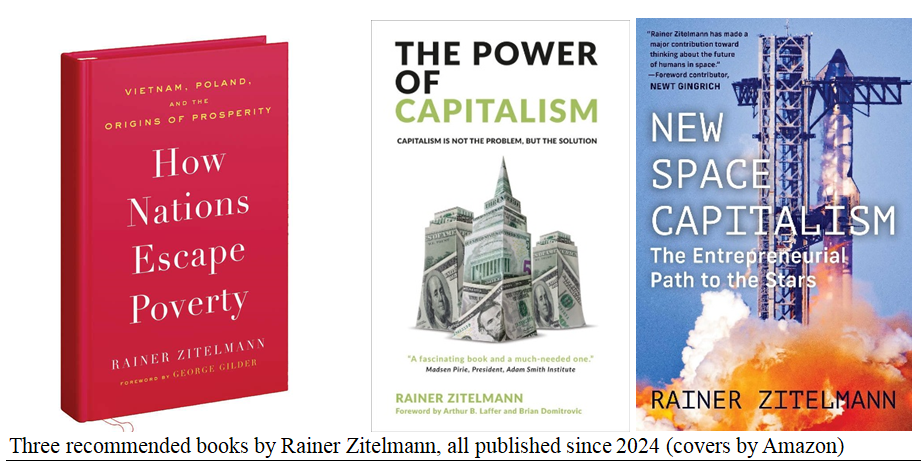
With so many mega-stocks created and domiciled in America – or in the technology exporting firms in Taiwan and South Korea – the fruits of capitalism are dominated by American entrepreneurs, not socialist nations in Europe, so let me introduce you to the books and films of Rainer Zitelmann, in his studies of nations.
Dr. Zitelmann travels the world and polls citizens about their attitudes toward free markets or capitalism. Some of his results are in these films, which I have reviewed for Anthem (Freedom Fest) film festival.
- Vietnam – Beating Poverty with Market Economy by Dr. Rainer Zitelmann
- Rainer Zitelmann film about Poland
- Rainer Zitelmann film about Sweden
These are all available on YouTube and run an average 30 to 35-minutes each, so take a short world tour of these amazing political and economic reforms in formerly socialist nations – two of them in Europe!
Or, if you prefer getting information in print (which I prefer), here are Dr. Zitelmann’s latest offerings:
Finally, let’s bring this talk of economic Super Bowls and World Cups home to our 50 United States:
With U.S. elections coming next Tuesday, we’re seeing a microcosm of the warring economic theories of Europe, with some of our 50-states wanting to emulate Europe. For instance, California is threatening to tax wealth, not just income, but taxing the market-based price of one’s assets can only send those asset prices down for everyone – as those assets must be sold to pay the wealth tax. But thankfully, America is a competing laboratory of economic competition, and our healthiest states are business-friendly states.
We also vote with our feet, with a massive emigration from California to more tax-friendly states, so the economic and demographic economic “playoffs” continue. We’ll see the results of this competition next Tuesday. I won’t predict the outcome other than to say most of the established polls will be wildly wrong, and we can celebrate some form of split powers (Democrats controlling the House) as the market loves gridlock, the division of powers inherent in our Constitution, since it limits the political mischief there.
All content above represents the opinion of Gary Alexander of Navellier & Associates, Inc.
Also In This Issue
A Look Ahead by Louis Navellier
A Closer Look at Last Week’s Earnings Leaders
Income Mail by Bryan Perry
Taking Stock of the Bond Market
Growth Mail by Gary Alexander
America Wins the “World Cup” (and Super Bowl) of Economic Growth
Global Mail by Ivan Martchev
There are Too Many Cross Currents for a Firm Bottom
Sector Spotlight by Jason Bodner
Leaves Don’t Fall – They’re Killed
Important Disclosures:
Although information in these reports has been obtained from and is based upon sources that Navellier believes to be reliable, Navellier does not guarantee its accuracy and it may be incomplete or condensed. All opinions and estimates constitute the authors opinions as of the date the report was created and are subject to change without notice. These reports are for informational purposes only and are not a solicitation for the purchase or sale of any securities or financial services. Any decision to purchase securities mentioned in these reports must take into account existing public information on such securities or any registered prospectus. To the extent permitted by law, neither Navellier & Associates, Inc., nor any of its affiliates, agents, or service providers are providing any investment advice herein and do not assume any liability or responsibility for the readers’ decisions if any. No reader should act or refrain from acting in reliance on the information contained in this communication or for any decision based on it.
None of the stock information, data, or company information presented herein constitutes investment advice or a recommendation by Navellier or a solicitation to buy or sell any securities. Any specific securities identified and described herein do not represent any investment advice.
Information presented is general information that does not take into account your individual circumstances, financial situation, or needs, nor does it present a personalized recommendation to you. Individual stocks presented may not be suitable for every investor. Investment in securities involves significant risk and has the potential for partial or complete loss of funds invested. Investment in fixed income securities has the potential for the investment return and principal value of an investment to fluctuate so that an investor’s holdings, when redeemed, may be worth less than their original cost.
- This report contains statements that are, or may be considered to be, forward-looking statements. All statements that are not historical facts, including statements about our beliefs or expectations, are “forward-looking statements” within the meaning of The U.S. Private Securities Litigation Reform Act of 1995. These statements may be identified by such forward-looking terminology as “expect,” “estimate,” “plan,” “intend,” “believe,” “anticipate,” “may,” “will,” “should,” “could,” “continue,” “project,” or similar statements or variations of such terms. Our forward-looking statements are based on a series of expectations, assumptions, and projections, are not investment advice. All of our forward-looking statements are as of the date of this report only.
- Federal Tax Advice Disclaimer: As required by U.S. Treasury Regulations, you are informed that, to the extent this presentation mentions any federal taxes, Navellier is not presenting any tax advice and should not be used or relied on as tax advice. Navellier does not advise on any income tax requirements or issues. Use of any information presented by Navellier is for general information only and does not represent tax advice either express or implied. You are encouraged to seek professional tax advice for income tax questions and assistance.
- FactSet Disclosure: Navellier does not independently calculate the statistical information included in the attached report. The calculation and the information are provided by FactSet, a company not related to Navellier. Although information contained in the report has been obtained from FactSet and is based on sources Navellier believes to be reliable, Navellier does not guarantee its accuracy, and it may be inaccurate, incomplete or condensed. The report and the related FactSet sourced information is for general information purposes only.