
by Bryan Perry
October 20, 2026
The recent, aggressive sell-off of artificial intelligence (AI) stocks was spurred by fears of elevated interest rates, debt-heavy balance sheets among niche neocloud providers and growing economic anxiety.
In their rush to price in this array of macro risks, public markets are ignoring a fundamental operational reality: AI compute demand is severely outpacing the available supply, and the multi-year capital expenditure buildout is not only necessary but destined to yield incredible long-term returns.
Market drawdowns, like we saw last week, often signal an impending drop in end-user demand. With AI, however, the opposite is the case. Across frontier research labs, hyperscalers and enterprise software companies, the appetite for high-performance compute continues to accelerate with every enhancement.
The bottleneck isn’t customer interest; it is supply-driven. Data center footprint delays, electrical grid interconnection queues, memory IC allocations and high-bandwidth fiber interconnect shortages are creating structural backlogs. Because 30% to 50% of the currently planned data center capacity is slipping into future years, due to physical power and infrastructure constraints, component and hardware demand is not disappearing, it is simply being stretched out over a longer, highly visible multi-year timeline.
Every GPU coming off the line is pre-allocated months or years in advance, but despite this, a central pillar of the recent bearish narrative is that Big Techbology’s extensive capex budgets are unsustainable. Skeptics argue that spending upwards of $600 billion globally on AI data infrastructure will dilate near-term profit margins without an immediate dollar-for-dollar payback, but this argument misinterprets the nature of technology platform shifts. Investors are witnessing the re-architecting of global computing infrastructure from general-purpose CPUs to accelerated GPUs and specialized neural accelerators.
Unlike the dot-com bubble of the late 1990s, fueled by unprofitable startups rapidly burning cash and building debt loads, the vast majority of AI capex is backed by four dominant cash-rich hyperscalers, which account for over 70% to 75% of global corporate AI infrastructure capex and are now generating tens of billions in free cash flow – each quarter – from their core businesses.
Goldman Sachs projected U.S. hyperscaler AI-related capital expenditures reaching roughly $1.2 trillion in 2027, with cumulative AI infrastructure spending approximately $7.6 trillion from 2026 to 2031.
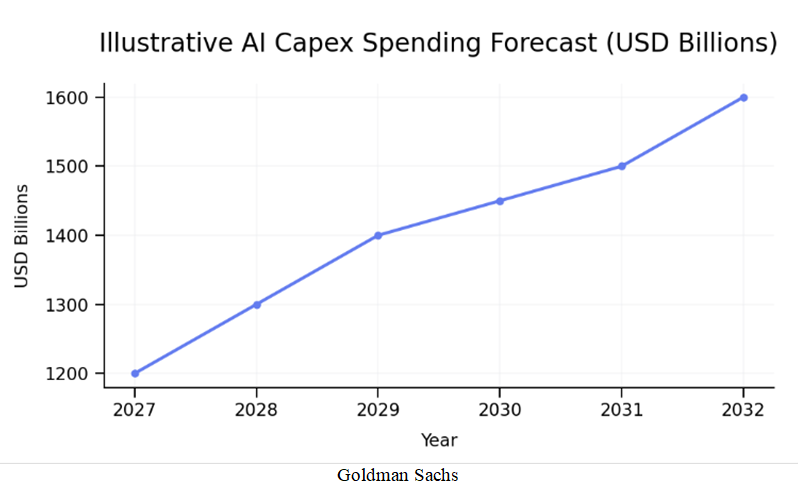
Graphs are for illustrative and discussion purposes only. Please read important disclosures at the end of this commentary.
For a hyperscaler, over-investing in AI infrastructure means carrying excess compute assets that can eventually be repurposed for inference or standard cloud workloads. The cost of under-investing is catastrophic. Under-investing, however, means a corporate giant risks total platform obsolescence.
The primary catalyst for the market’s recent jitters was sell-offs in high-leverage neocloud providers and debt-backed infrastructure players, leading traders to panic over rising borrowing costs and financing stress. However, conflating specialized, debt-heavy asset-backed vehicles with the broader AI ecosystem is a structural error: Highly levered specialized cloud providers represent a thin slice of total AI compute deployment. If a debt-financed provider faces debt refinancing pressure, their hardware assets do not vanish, but will be acquired or leased by capital-rich hyperscalers eager for immediate capacity.
As frontier models move from pure training to widespread enterprise deployment, token inference demand grows exponentially. This generates recurring, predictable cash flows that de-risk infrastructure debt over time. AI compute assets are operating at near-capacity from the moment power is turned on.
When equity markets experience sharp sell-offs, the narrative shifts quickly from optimism to existential dread. But market prices fluctuate far faster than physical infrastructure can be built, or real-world compute demand can be satisfied. And this is currently occurring within the investing landscape.
Financing cycles break when assets sit unused. The bottom line is that the underlying fundamentals of the AI expansion remain solid and will be validated during the current earnings season. Compute supply is severely constrained, capital expenditures are backed by some of the strongest corporate balance sheets in history, and financing concerns are localized to a small subset of leveraged players.
Based on how quickly markets react to changing narratives, the bullish AI camp argues that the disconnect between market prices and reality is at an inflection point that will be resolved during the Q3 reporting period – a “show time” for the AI trade to deliver what the market demands – prosperity.
All content above represents the opinion of Bryan Perry of Navellier & Associates, Inc.
Also In This Issue
A Look Ahead by Louis Navellier
Earnings Highlights from Week #1 of Third-Quarter Results
Income Mail by Bryan Perry
It’s “Show Time” for The AI Trade
Growth Mail by Gary Alexander
Anatomy of a Scary (but Meaningless) Market Collapse 39-Years Ago Today
Global Mail by Ivan Martchev
When Junk Bonds Get Junkier
Sector Spotlight by Jason Bodner
This Market is Frozen, Not Dead
Important Disclosures:
Although information in these reports has been obtained from and is based upon sources that Navellier believes to be reliable, Navellier does not guarantee its accuracy and it may be incomplete or condensed. All opinions and estimates constitute the authors opinions as of the date the report was created and are subject to change without notice. These reports are for informational purposes only and are not a solicitation for the purchase or sale of any securities or financial services. Any decision to purchase securities mentioned in these reports must take into account existing public information on such securities or any registered prospectus. To the extent permitted by law, neither Navellier & Associates, Inc., nor any of its affiliates, agents, or service providers are providing any investment advice herein and do not assume any liability or responsibility for the readers’ decisions if any. No reader should act or refrain from acting in reliance on the information contained in this communication or for any decision based on it.
None of the stock information, data, or company information presented herein constitutes investment advice or a recommendation by Navellier or a solicitation to buy or sell any securities. Any specific securities identified and described herein do not represent any investment advice.
Information presented is general information that does not take into account your individual circumstances, financial situation, or needs, nor does it present a personalized recommendation to you. Individual stocks presented may not be suitable for every investor. Investment in securities involves significant risk and has the potential for partial or complete loss of funds invested. Investment in fixed income securities has the potential for the investment return and principal value of an investment to fluctuate so that an investor’s holdings, when redeemed, may be worth less than their original cost.
- This report contains statements that are, or may be considered to be, forward-looking statements. All statements that are not historical facts, including statements about our beliefs or expectations, are “forward-looking statements” within the meaning of The U.S. Private Securities Litigation Reform Act of 1995. These statements may be identified by such forward-looking terminology as “expect,” “estimate,” “plan,” “intend,” “believe,” “anticipate,” “may,” “will,” “should,” “could,” “continue,” “project,” or similar statements or variations of such terms. Our forward-looking statements are based on a series of expectations, assumptions, and projections, are not investment advice. All of our forward-looking statements are as of the date of this report only.
- Federal Tax Advice Disclaimer: As required by U.S. Treasury Regulations, you are informed that, to the extent this presentation mentions any federal taxes, Navellier is not presenting any tax advice and should not be used or relied on as tax advice. Navellier does not advise on any income tax requirements or issues. Use of any information presented by Navellier is for general information only and does not represent tax advice either express or implied. You are encouraged to seek professional tax advice for income tax questions and assistance.
- FactSet Disclosure: Navellier does not independently calculate the statistical information included in the attached report. The calculation and the information are provided by FactSet, a company not related to Navellier. Although information contained in the report has been obtained from FactSet and is based on sources Navellier believes to be reliable, Navellier does not guarantee its accuracy, and it may be inaccurate, incomplete or condensed. The report and the related FactSet sourced information is for general information purposes only.