
by Ivan Martchev
September 9, 2026
There isn’t anything new about President Trump complaining about interest rates being too high. He used to constantly harass former Chair Jerome Powell and call him names. I would not call myself a big fan of Jerome Powell, but if the Fed were not independent, they would not be able to correct their mistakes.
Now, here comes the new Fed Chair, Kevin Warsh, handpicked by Treasury Secretary Scott Bessent. Both Bessent and Warsh have previously worked closely with famed money manager Stanley Durckenmiller, who sharply criticized Bessent’s actions to calm down the Treasury bond market (see The Wall Street Journal “Let the Bond Market Speak”). Bessent’s intervention came just two-months before the November midterm elections. Furthermore, Vice President JD Vance flat out said on Thursday last week that the administration’s position is the Fed should lower rates. On Friday, President Trump himself chimed in:
True Economic Greatness for our Country that it deserves, because every time we do well, the stupid people want to immediately stop this Great Upward Momentum. GROWTH DOES NOT CAUSE INFLATION! I knew this morning as soon as I looked at these fantastic Job Numbers that the Market would go down when it should be going UP like a Rocketship. We should be doing GDP of 15% and 20%, not 2, 3, and 4%, and America should become Far Greater Financially than it is right now. Our Debt would be paid off, and all of these other things would happen. Remember, every point in the Interest Rate costs the U.S. 650 Billion Dollars a year. We should pay the Lowest Interest Rates in the World because we make everything run, and give otherwise failed countries Great Economic Wealth! Thank you for your attention to this matter.”
If that’s not political pressure on the Fed just before the September FOMC meeting, I don’t know what is.
Treasury market yields are moving up fast, reaching 4.82% in overnight trading last week on the 10-year yield. We also have PPI and CPI numbers coming this week, and an FOMC statement on September 16.
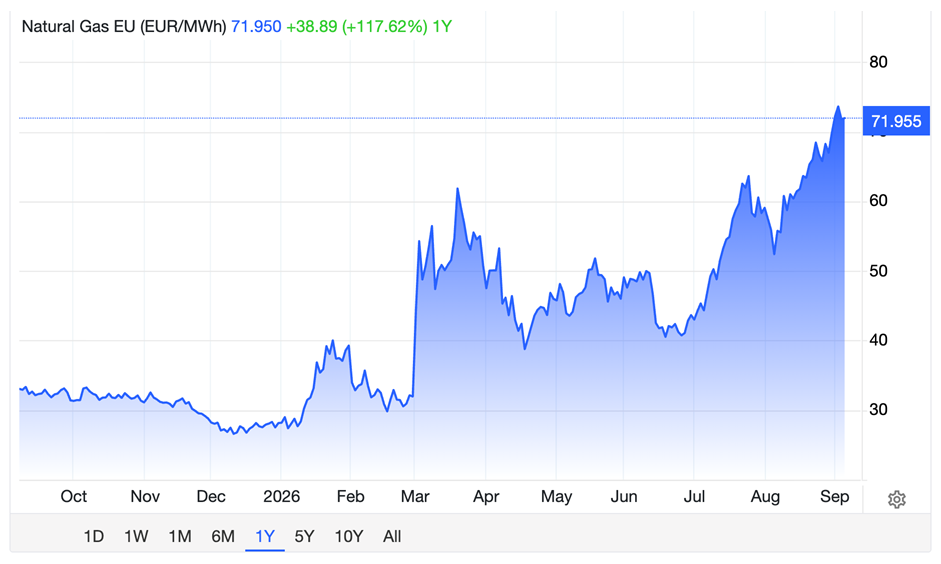
The rise in government bond yields is a global phenomenon, not necessarily driven by U.S. economic fundamentals alone. Even though Scott Bessent can intervene in the U.S. Treasury market, he does not have the money to do so in Germany, France, the UK or Japan. Global diesel fuel prices are at all-time highs (related to the war in Ukraine and Iran) and the EU natural gas market is in severe distress because LNG is not flowing through the Strait of Hormuz. Unless the Iran war ends expeditiously, which does not seem likely as of this writing, it is hard to see how this situation will improve.
Graphs are for illustrative and discussion purposes only. Please read important disclosures at the end of this commentary.
If you convert the EU natural gas benchmark contract to the U.S. system, natural gas is trading right now at $23.20/mmBTU, while the U.S. benchmark price closed last week at $2.98/mmBTU. This situation is likely to get worse, as inventories are well below the five-year average – by about 17% at last count. Earlier this summer, that number reached 23%, and it is unlikely to improve dramatically in short order.
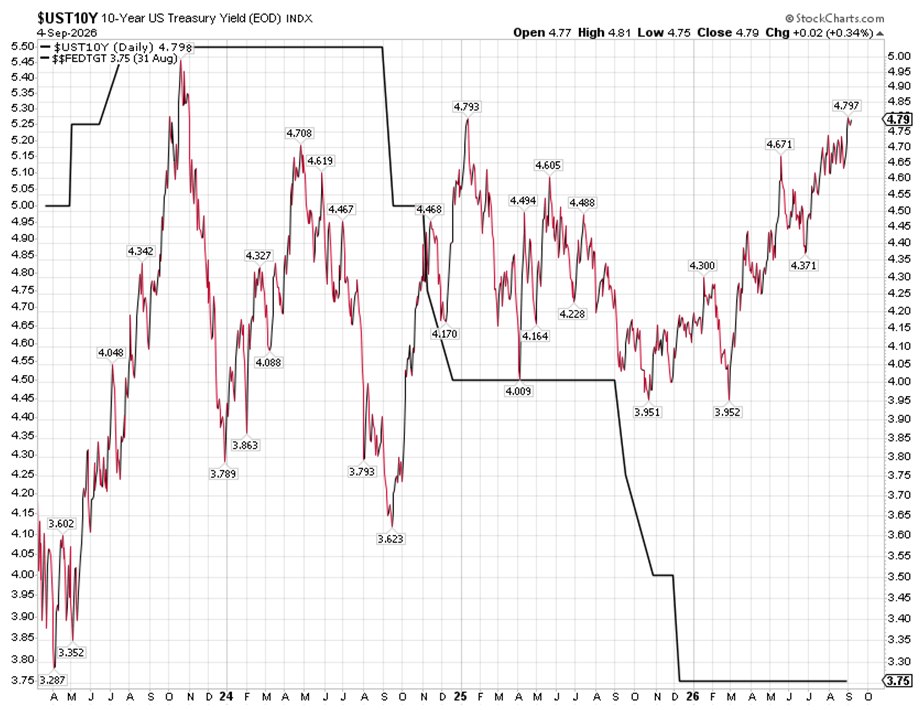
I don’t have a problem with the Fed waiting until after the election to move on the Fed funds rate, but I don’t know if the Treasury market will wait for the Fed. The 2-year Treasury yield now suggests the Fed is late by about two-rate hikes, and the last thing bond investors want to hear is the Fed lowering rates.
Graphs are for illustrative and discussion purposes only. Please read important disclosures at the end of this commentary.
The Powell Fed famously lowered rates in 2024 and the U.S. Treasury yield spiked by about the same amount he lowered them (see the above chart). The Treasury market can and will move against the Fed if the Fed is doing what it is not supposed to be doing. Powell sold his cuts at the time as a response to the Fed’s employment mandate, but he did make his move right before the 2024 elections
If the Fed were to lower the Fed funds rate on September 16 – even though I do not believe there is any reasonable chance they will do that – I think we’ll see same exact dynamic from Powell’s mistake in 2024, and the 10-year yield would rise further, producing the opposite effect the Trump administration is looking for. I don’t think the stock market would like to see the 10-year yield at 5%, and it would like the situation even less at 5.25%, which is what is likely to happen if the Fed were to lower interest rates now, at a time of overall elevated inflation, and when the global trend is not moving in the right direction.
In the middle of the war with Iran, which seemed to be getting worse over the weekend, with tit-for-tat strikes on both sides, the U.S. market has held up fairly well, with the S&P up a glorious six-points (under 0.1%) last week. The biggest move came after Fed President Waller’s statement he is OK with holding the Fed fund rate where it is if inflation keeps on cooling, but the move in Treasury bonds is not only about inflation. It is about two-wars, energy prices and all the hard-to-control deficits globally.
For the sake of argument, if the Ukraine and Iran wars were to end expeditiously – as unlikely as it may sound at this very moment – the stock market would explode higher, as both Treasury yields and energy prices will decline noticeably. We have very high Q2 earnings growth of 52.4%, while estimates called for just +23.2% as late as June 30! This is one of the biggest surprises in recent history, on top of almost 29% EPS growth in Q1. Declining bond yields tend to push stocks higher, but rising yields can be a headwind.
The main issue now is to seek ways to end both wars before the November midterm elections, as unlikely as that seems. The outcome carries gargantuan implications for stocks, bonds, and commodity prices.
All content above represents the opinion of Ivan Martchev of Navellier & Associates, Inc.
Also In This Issue
A Look Ahead by Louis Navellier
Friday’s Jobs Report and Other Indicators Look Strong
Income Mail by Bryan Perry
The Opponents of Data Centers Just Don’t Get It
Growth Mail by Gary Alexander
What Happened to America’s Work Ethic?
Global Mail by Ivan Martchev
The President is on a Collision Course with the Fed
Sector Spotlight by Jason Bodner
Applying Leverage to the Upcoming Elections
View Full Archive
Read Past Issues Here

Ivan Martchev
INVESTMENT STRATEGIST
Ivan Martchev is an investment strategist with Navellier. Previously, Ivan served as editorial director at InvestorPlace Media. Ivan was editor of Louis Rukeyser’s Mutual Funds and associate editor of Personal Finance. Ivan is also co-author of The Silk Road to Riches (Financial Times Press). The book provided analysis of geopolitical issues and investment strategy in natural resources and emerging markets with an emphasis on Asia. The book also correctly predicted the collapse in the U.S. real estate market, the rise of precious metals, and the resulting increased investor interest in emerging markets. Ivan’s commentaries have been published by MSNBC, The Motley Fool, MarketWatch, and others. All content of “Global Mail” represents the opinion of Ivan Martchev
Important Disclosures:
Although information in these reports has been obtained from and is based upon sources that Navellier believes to be reliable, Navellier does not guarantee its accuracy and it may be incomplete or condensed. All opinions and estimates constitute Navellier’s judgment as of the date the report was created and are subject to change without notice. These reports are for informational purposes only and are not a solicitation for the purchase or sale of a security. Any decision to purchase securities mentioned in these reports must take into account existing public information on such securities or any registered prospectus.To the extent permitted by law, neither Navellier & Associates, Inc., nor any of its affiliates, agents, or service providers assumes any liability or responsibility nor owes any duty of care for any consequences of any person acting or refraining to act in reliance on the information contained in this communication or for any decision based on it.
Past performance is no indication of future results. Investment in securities involves significant risk and has the potential for partial or complete loss of funds invested. It should not be assumed that any securities recommendations made by Navellier. in the future will be profitable or equal the performance of securities made in this report. Dividend payments are not guaranteed. The amount of a dividend payment, if any, can vary over time and issuers may reduce dividends paid on securities in the event of a recession or adverse event affecting a specific industry or issuer.
None of the stock information, data, and company information presented herein constitutes a recommendation by Navellier or a solicitation to buy or sell any securities. Any specific securities identified and described do not represent all of the securities purchased, sold, or recommended for advisory clients. The holdings identified do not represent all of the securities purchased, sold, or recommended for advisory clients and the reader should not assume that investments in the securities identified and discussed were or will be profitable.
Information presented is general information that does not take into account your individual circumstances, financial situation, or needs, nor does it present a personalized recommendation to you. Individual stocks presented may not be suitable for every investor. Investment in securities involves significant risk and has the potential for partial or complete loss of funds invested. Investment in fixed income securities has the potential for the investment return and principal value of an investment to fluctuate so that an investor’s holdings, when redeemed, may be worth less than their original cost.
One cannot invest directly in an index. Index is unmanaged and index performance does not reflect deduction of fees, expenses, or taxes. Presentation of Index data does not reflect a belief by Navellier that any stock index constitutes an investment alternative to any Navellier equity strategy or is necessarily comparable to such strategies. Among the most important differences between the Indices and Navellier strategies are that the Navellier equity strategies may (1) incur material management fees, (2) concentrate its investments in relatively few stocks, industries, or sectors, (3) have significantly greater trading activity and related costs, and (4) be significantly more or less volatile than the Indices.
ETF Risk: We may invest in exchange traded funds (“ETFs”) and some of our investment strategies are generally fully invested in ETFs. Like traditional mutual funds, ETFs charge asset-based fees, but they generally do not charge initial sales charges or redemption fees and investors typically pay only customary brokerage fees to buy and sell ETF shares. The fees and costs charged by ETFs held in client accounts will not be deducted from the compensation the client pays Navellier. ETF prices can fluctuate up or down, and a client account could lose money investing in an ETF if the prices of the securities owned by the ETF go down. ETFs are subject to additional risks:
- ETF shares may trade above or below their net asset value;
- An active trading market for an ETF’s shares may not develop or be maintained;
- The value of an ETF may be more volatile than the underlying portfolio of securities the ETF is designed to track;
- The cost of owning shares of the ETF may exceed those a client would incur by directly investing in the underlying securities; and
- Trading of an ETF’s shares may be halted if the listing exchange’s officials deem it appropriate, the shares are delisted from the exchange, or the activation of market-wide “circuit breakers” (which are tied to large decreases in stock prices) halts stock trading generally.
Grader Disclosures: Investment in equity strategies involves substantial risk and has the potential for partial or complete loss of funds invested. The sample portfolio and any accompanying charts are for informational purposes only and are not to be construed as a solicitation to buy or sell any financial instrument and should not be relied upon as the sole factor in an investment making decision. As a matter of normal and important disclosures to you, as a potential investor, please consider the following: The performance presented is not based on any actual securities trading, portfolio, or accounts, and the reported performance of the A, B, C, D, and F portfolios (collectively the “model portfolios”) should be considered mere “paper” or pro forma performance results based on Navellier’s research.
Investors evaluating any of Navellier & Associates, Inc.’s, (or its affiliates’) Investment Products must not use any information presented here, including the performance figures of the model portfolios, in their evaluation of any Navellier Investment Products. Navellier Investment Products include the firm’s mutual funds and managed accounts. The model portfolios, charts, and other information presented do not represent actual funded trades and are not actual funded portfolios. There are material differences between Navellier Investment Products’ portfolios and the model portfolios, research, and performance figures presented here. The model portfolios and the research results (1) may contain stocks or ETFs that are illiquid and difficult to trade; (2) may contain stock or ETF holdings materially different from actual funded Navellier Investment Product portfolios; (3) include the reinvestment of all dividends and other earnings, estimated trading costs, commissions, or management fees; and, (4) may not reflect prices obtained in an actual funded Navellier Investment Product portfolio. For these and other reasons, the reported performances of model portfolios do not reflect the performance results of Navellier’s actually funded and traded Investment Products. In most cases, Navellier’s Investment Products have materially lower performance results than the performances of the model portfolios presented.
This report contains statements that are, or may be considered to be, forward-looking statements. All statements that are not historical facts, including statements about our beliefs or expectations, are “forward-looking statements” within the meaning of The U.S. Private Securities Litigation Reform Act of 1995. These statements may be identified by such forward-looking terminology as “expect,” “estimate,” “plan,” “intend,” “believe,” “anticipate,” “may,” “will,” “should,” “could,” “continue,” “project,” or similar statements or variations of such terms. Our forward-looking statements are based on a series of expectations, assumptions, and projections, are not guarantees of future results or performance, and involve substantial risks and uncertainty as described in Form ADV Part 2A of our filing with the Securities and Exchange Commission (SEC), which is available at www.adviserinfo.sec.gov or by requesting a copy by emailing info@navellier.com. All of our forward-looking statements are as of the date of this report only. We can give no assurance that such expectations or forward-looking statements will prove to be correct. Actual results may differ materially. You are urged to carefully consider all such factors.
FEDERAL TAX ADVICE DISCLAIMER: As required by U.S. Treasury Regulations, you are informed that, to the extent this presentation includes any federal tax advice, the presentation is not written by Navellier to be used, and cannot be used, for the purpose of avoiding federal tax penalties. Navellier does not advise on any income tax requirements or issues. Use of any information presented by Navellier is for general information only and does not represent tax advice either express or implied. You are encouraged to seek professional tax advice for income tax questions and assistance.
IMPORTANT NEWSLETTER DISCLOSURE:The hypothetical performance results for investment newsletters that are authored or edited by Louis Navellier, including Louis Navellier’s Growth Investor, Louis Navellier’s Breakthrough Stocks, Louis Navellier’s Accelerated Profits, and Louis Navellier’s Platinum Club, are not based on any actual securities trading, portfolio, or accounts, and the newsletters’ reported hypothetical performances should be considered mere “paper” or proforma hypothetical performance results and are not actual performance of real world trades. Navellier & Associates, Inc. does not have any relation to or affiliation with the owner of these newsletters. There are material differences between Navellier Investment Products’ portfolios and the InvestorPlace Media, LLC newsletter portfolios authored by Louis Navellier. The InvestorPlace Media, LLC newsletters contain hypothetical performance that do not include transaction costs, advisory fees, or other fees a client might incur if actual investments and trades were being made by an investor. As a result, newsletter performance should not be used to evaluate Navellier Investment services which are separate and different from the newsletters. The owner of the newsletters is InvestorPlace Media, LLC and any questions concerning the newsletters, including any newsletter advertising or hypothetical Newsletter performance claims, (which are calculated solely by Investor Place Media and not Navellier) should be referred to InvestorPlace Media, LLC at (800) 718-8289.
Please note that Navellier & Associates and the Navellier Private Client Group are managed completely independent of the newsletters owned and published by InvestorPlace Media, LLC and written and edited by Louis Navellier, and investment performance of the newsletters should in no way be considered indicative of potential future investment performance for any Navellier & Associates separately managed account portfolio. Potential investors should consult with their financial advisor before investing in any Navellier Investment Product.
Navellier claims compliance with Global Investment Performance Standards (GIPS). To receive a complete list and descriptions of Navellier’s composites and/or a presentation that adheres to the GIPS standards, please contact Navellier or click here. It should not be assumed that any securities recommendations made by Navellier & Associates, Inc. in the future will be profitable or equal the performance of securities made in this report.
FactSet Disclosure: Navellier does not independently calculate the statistical information included in the attached report. The calculation and the information are provided by FactSet, a company not related to Navellier. Although information contained in the report has been obtained from FactSet and is based on sources Navellier believes to be reliable, Navellier does not guarantee its accuracy, and it may be incomplete or condensed. The report and the related FactSet sourced information are provided on an “as is” basis. The user assumes the entire risk of any use made of this information. Investors should consider the report as only a single factor in making their investment decision. The report is for informational purposes only and is not intended as an offer or solicitation for the purchase or sale of a security. FactSet sourced information is the exclusive property of FactSet. Without prior written permission of FactSet, this information may not be reproduced, disseminated or used to create any financial products. All indices are unmanaged and performance of the indices include reinvestment of dividends and interest income, unless otherwise noted, are not illustrative of any particular investment and an investment cannot be made in any index. Past performance is no guarantee of future results.