
by Gary Alexander
August 25, 2026
The bond vigilantes are a real and well-recognized species of unelected but powerful critics of financial and monetary policies in major nations. These enforcers – called “vigilantes” by economist Ed Yardeni in 1984 – bid up Treasury yields when they see termites in the woodwork, like excessive monetary easing, runaway budget deficits, rising inflation, geopolitical threats, or a looming Fed (FOMC) change in policy.
The bond vigilantes made new headlines last week by pushing 30-year rates up to a near-20-year high, but perhaps we haven’t given enough ink to the ‘gold vigilantes,’ who perform the same service, using the world’s oldest and most respected currency – an ounce of pure gold. I started writing about this a month ago (July 28) in a Growth Mail column, “An Undeclared New Gold Standard Has Quietly Returned.” It was the first of five historical reviews designed to take our mind off meaningless market gyrations in August (vacation time) markets, which can scare us or delight us, but are mostly based on slender volume.
Since that column appeared, gold has risen from just over $4,000 per ounce to over $4,600 per ounce (+15%). Midway, on August 11, I covered gold again, marking the 55th anniversary of America going off the gold standard in 1971, and the 15th anniversary of gold’s record surge in August 2011 based on a debt ceiling debate and Treasury debt downgrade. After a 4-year dip (2011-15), gold quintupled in 10 years, rising from $1,075 in late 2015 to $5,400 in early 2026 – and now, gold has begun a huge new surge.
The gold vigilantes are mostly responding to America’s debt addiction. We just crossed the $40 trillion debt level, and the CBO predicts a Fiscal Year 2026 deficit of $2.1 trillion, despite a strongly growing economy. Another part of gold’s rise comes from this new, possibly prolonged Iran War, and since wars (and gold’s reaction to war) often accelerate in August, I’ll cite some examples from this week in history:
How Nations Tend to Fight Wars (with Gold) in Late August in History
- On August 24-25, 1814 (in the War of 1812), British forces sacked Washington DC, burned much of the White House and destroyed the Library of Congress: All 3,000 books were burned. Three days later, August 28, the British captured a large part of the East Coast, including most of the Chesapeake Bay, so major New York banks stopped all payment of specie (gold and silver).
- On August 28, 1862, the Rebel army launched a second Bull Run attack, the Second Battle of Manassas, 30 miles west of Washington, DC, where U.S. Treasury Secretary Salmon Chase ran out of funds to pay soldiers or conduct the war. His solution? Warm up the printing presses! On this date, he hired six people to create a Bureau of Engraving and Printing (BEP). Chase first elected to print “paper coins,” replacing silver, which had become scarce. He didn’t print dollar notes at first, but the BEP started printing Greenbacks in 1864, as the costly war dragged on.
- World War I began in August 1914, giving rise to Barbara Tuchman’s classic book, “The Guns of August.” Early in the month, Sir Edward Grey, British foreign secretary, said, “The lamps are going out all over Europe; we shall not see them lit again in our lifetime.” World War II justified in that prediction, but in the short-term stock markets were closed in American and Europe. The Bank of England suspended gold-for-sterling in the Currency & Bank Notes Act of August 6.
- On August 23, 1939, the Hitler-Stalin “nonaggression pact” cleared the way for Germany to launch World War II with their invasion of Poland on September 1. During that time, inflation (and the price of gold) were only kept in check by domestic price controls amid rationing:
- On August 28, 1941, FDR issued established the Office of Price Administration (OPA), which imposed rent controls and rationing. They initially targeted tires. Soon, the agency printed coupon books for sugar, coffee, meat, fats and oils. Americans took the “Homefront Pledge,” a promise to avoid all “black markets” in favor of OPA rations. The end of the war didn’t end the OPA. President Truman kept the agency going into 1946, but in 1947 OPA was phased out, with only rents, sugar, and rice still limited. The agency claimed victory, saying consumer prices only rose 31% (1941-45), half the 62% rise in World War I. Two future Presidents worked for the OPA, including Nixon and Reagan – plus economist Milton Friedman, who learned the folly of price controls, first-hand, but Mr. Nixon clearly didn’t learn much about the folly of price controls.
- On August 24, 1944, the Liberation of Paris came, fittingly, on the Patron Day of St. Louis. But a year later, on August 25, 1945: The Cold War began a week before VJ Day, when the Baptist missionary and U.S. army specialist John Birch was killed by Chinese Communists in China’s Anhui province. As the first official American death in the subsequent 45-year Cold War, Robert H. Welch, Jr., later named his anti-Communist John Birch Society in honor of this fallen martyr.
- On August 7, 1964, by a unanimous vote in the House of Representatives and a vote of 88-2 in the Senate, Congress passed the Gulf of Tonkin Resolution, giving President Lyndon Johnson authority to “take all necessary steps… to prevent further aggression” in Indochina. Imagine that – to launch a soon-unpopular war, and Congress complied, with only two dissenting votes out 535. The next year (1965) is when inflation and currency crunches began, leading to devaluation later.
- On August 3, 1990 (a Friday), the first Gulf War began. On Monday, August 6, the United Nations Security Council voted 13-0 (with two abstentions: Cuba & Yemen) for economic sanctions against Iraq. In another wartime surprise, on August 19, 1991, the Dow fell 3% in response to the last gasp of the 45-year Cold War, as eight senior “hard-liners” in the Soviet government staged a coup against Mikhail Gorbachev, whom they detained under house arrest.
In the last decade, gold has tended to rise most after the outbreak of wars, first a couple of Ukraine invasions by Russia, then the big move after the Iran-sponsored invasion of Israel in October 2023:
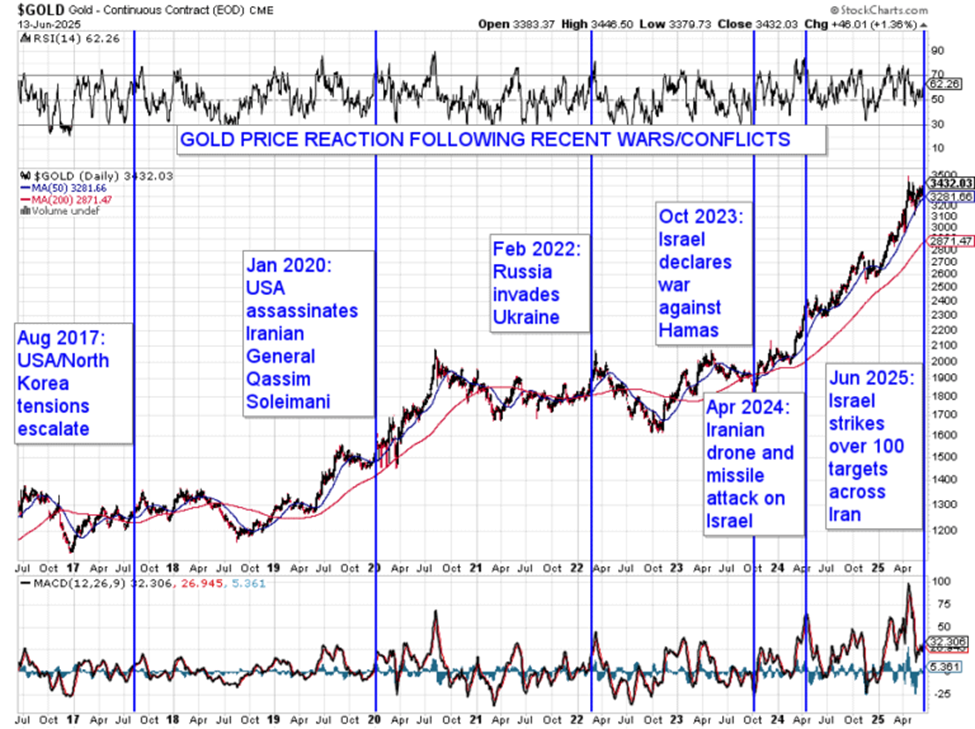
Graphs are for illustrative and discussion purposes only. Please read important disclosures at the end of this commentary.
Gold demand rose on each of these wartime events. At the same time, many nations rushed to supply more gold. On the supply side, last weekend marked the centennial of the 20th Century’s greatest source of gold. On August 22, 1926, gold was discovered in South Africa, where production peaked in 1970, the year before President Nixon ended the gold standard in America. In 1970 South Africa’s gold output peaked at over a million kilograms (1,000 metric tons), producing nearly one-third of global gold then.
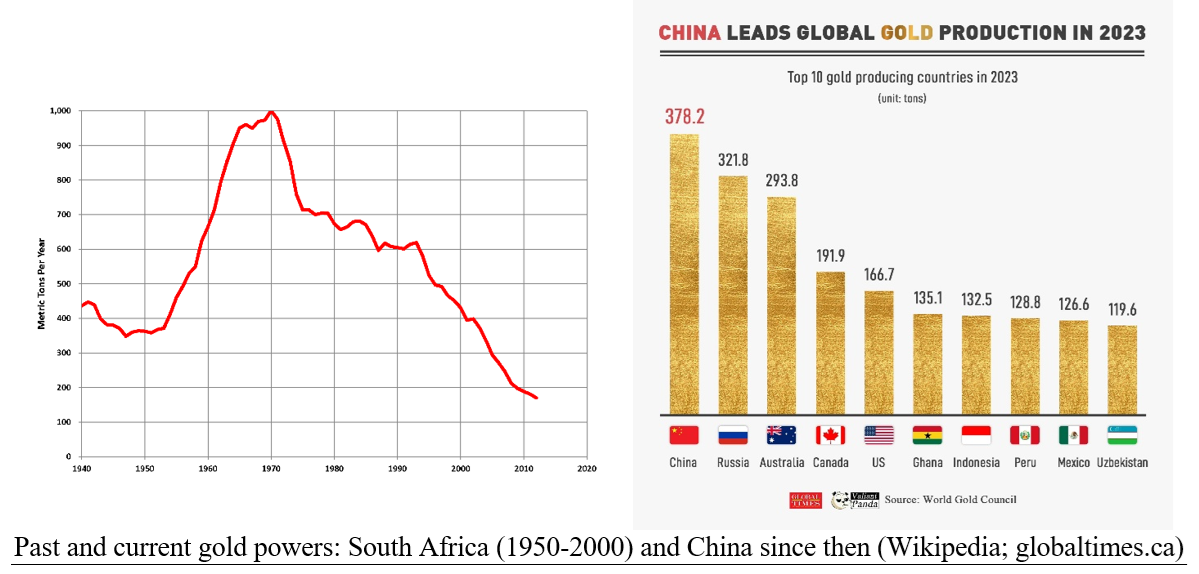 Graphs are for illustrative and discussion purposes only. Please read important disclosures at the end of this commentary.
Currently, China is the leading producer and consumer of gold, replacing their dollar hoard with gold, so in this new (unofficial) gold standard of massive central bank buying, China keeps its eyes on the prize.
Who would have thought China would become a mighty nation led by fanatical gold vigilantes?
All content above represents the opinion of Gary Alexander of Navellier & Associates, Inc.
Also In This Issue
A Look Ahead by Louis Navellier
Why Data Centers and Memory Stocks Remain Great Buys
Income Mail by Bryan Perry
The Current Blueprint for High Yield Income
Growth Mail by Gary Alexander
The “Gold Vigilantes” Went to War This August
Global Mail by Ivan Martchev
Secretary Bessent’s Act of Desperation
Sector Spotlight by Jason Bodner
Trust the Data, Not Your “Gut” Feelings
View Full Archive
Read Past Issues Here
About The Author

Gary Alexander
SENIOR EDITOR
Gary Alexander has been Senior Writer at Navellier since 2009. He edits Navellier’s weekly Marketmail and writes a weekly Growth Mail column, in which he uses market history to support the case for growth stocks. For the previous 20-years before joining Navellier, he was Senior Executive Editor at InvestorPlace Media (formerly Phillips Publishing), where he worked with several leading investment analysts, including Louis Navellier (since 1997), helping launch Louis Navellier’s Blue Chip Growth and Global Growth newsletters.
Prior to that, Gary edited Wealth Magazine and Gold Newsletter and wrote various investment research reports for Jefferson Financial in New Orleans in the 1980s. He began his financial newsletter career with KCI Communications in 1980, where he served as consulting editor for Personal Finance newsletter while serving as general manager of KCI’s Alexandria House book division. Before that, he covered the economics beat for news magazines. All content of “Growth Mail” represents the opinion of Gary Alexander
Important Disclosures:
Although information in these reports has been obtained from and is based upon sources that Navellier believes to be reliable, Navellier does not guarantee its accuracy and it may be incomplete or condensed. All opinions and estimates constitute Navellier’s judgment as of the date the report was created and are subject to change without notice. These reports are for informational purposes only and are not a solicitation for the purchase or sale of a security. Any decision to purchase securities mentioned in these reports must take into account existing public information on such securities or any registered prospectus.To the extent permitted by law, neither Navellier & Associates, Inc., nor any of its affiliates, agents, or service providers assumes any liability or responsibility nor owes any duty of care for any consequences of any person acting or refraining to act in reliance on the information contained in this communication or for any decision based on it.
Past performance is no indication of future results. Investment in securities involves significant risk and has the potential for partial or complete loss of funds invested. It should not be assumed that any securities recommendations made by Navellier. in the future will be profitable or equal the performance of securities made in this report. Dividend payments are not guaranteed. The amount of a dividend payment, if any, can vary over time and issuers may reduce dividends paid on securities in the event of a recession or adverse event affecting a specific industry or issuer.
None of the stock information, data, and company information presented herein constitutes a recommendation by Navellier or a solicitation to buy or sell any securities. Any specific securities identified and described do not represent all of the securities purchased, sold, or recommended for advisory clients. The holdings identified do not represent all of the securities purchased, sold, or recommended for advisory clients and the reader should not assume that investments in the securities identified and discussed were or will be profitable.
Information presented is general information that does not take into account your individual circumstances, financial situation, or needs, nor does it present a personalized recommendation to you. Individual stocks presented may not be suitable for every investor. Investment in securities involves significant risk and has the potential for partial or complete loss of funds invested. Investment in fixed income securities has the potential for the investment return and principal value of an investment to fluctuate so that an investor’s holdings, when redeemed, may be worth less than their original cost.
One cannot invest directly in an index. Index is unmanaged and index performance does not reflect deduction of fees, expenses, or taxes. Presentation of Index data does not reflect a belief by Navellier that any stock index constitutes an investment alternative to any Navellier equity strategy or is necessarily comparable to such strategies. Among the most important differences between the Indices and Navellier strategies are that the Navellier equity strategies may (1) incur material management fees, (2) concentrate its investments in relatively few stocks, industries, or sectors, (3) have significantly greater trading activity and related costs, and (4) be significantly more or less volatile than the Indices.
ETF Risk: We may invest in exchange traded funds (“ETFs”) and some of our investment strategies are generally fully invested in ETFs. Like traditional mutual funds, ETFs charge asset-based fees, but they generally do not charge initial sales charges or redemption fees and investors typically pay only customary brokerage fees to buy and sell ETF shares. The fees and costs charged by ETFs held in client accounts will not be deducted from the compensation the client pays Navellier. ETF prices can fluctuate up or down, and a client account could lose money investing in an ETF if the prices of the securities owned by the ETF go down. ETFs are subject to additional risks:
- ETF shares may trade above or below their net asset value;
- An active trading market for an ETF’s shares may not develop or be maintained;
- The value of an ETF may be more volatile than the underlying portfolio of securities the ETF is designed to track;
- The cost of owning shares of the ETF may exceed those a client would incur by directly investing in the underlying securities; and
- Trading of an ETF’s shares may be halted if the listing exchange’s officials deem it appropriate, the shares are delisted from the exchange, or the activation of market-wide “circuit breakers” (which are tied to large decreases in stock prices) halts stock trading generally.
Grader Disclosures: Investment in equity strategies involves substantial risk and has the potential for partial or complete loss of funds invested. The sample portfolio and any accompanying charts are for informational purposes only and are not to be construed as a solicitation to buy or sell any financial instrument and should not be relied upon as the sole factor in an investment making decision. As a matter of normal and important disclosures to you, as a potential investor, please consider the following: The performance presented is not based on any actual securities trading, portfolio, or accounts, and the reported performance of the A, B, C, D, and F portfolios (collectively the “model portfolios”) should be considered mere “paper” or pro forma performance results based on Navellier’s research.
Investors evaluating any of Navellier & Associates, Inc.’s, (or its affiliates’) Investment Products must not use any information presented here, including the performance figures of the model portfolios, in their evaluation of any Navellier Investment Products. Navellier Investment Products include the firm’s mutual funds and managed accounts. The model portfolios, charts, and other information presented do not represent actual funded trades and are not actual funded portfolios. There are material differences between Navellier Investment Products’ portfolios and the model portfolios, research, and performance figures presented here. The model portfolios and the research results (1) may contain stocks or ETFs that are illiquid and difficult to trade; (2) may contain stock or ETF holdings materially different from actual funded Navellier Investment Product portfolios; (3) include the reinvestment of all dividends and other earnings, estimated trading costs, commissions, or management fees; and, (4) may not reflect prices obtained in an actual funded Navellier Investment Product portfolio. For these and other reasons, the reported performances of model portfolios do not reflect the performance results of Navellier’s actually funded and traded Investment Products. In most cases, Navellier’s Investment Products have materially lower performance results than the performances of the model portfolios presented.
This report contains statements that are, or may be considered to be, forward-looking statements. All statements that are not historical facts, including statements about our beliefs or expectations, are “forward-looking statements” within the meaning of The U.S. Private Securities Litigation Reform Act of 1995. These statements may be identified by such forward-looking terminology as “expect,” “estimate,” “plan,” “intend,” “believe,” “anticipate,” “may,” “will,” “should,” “could,” “continue,” “project,” or similar statements or variations of such terms. Our forward-looking statements are based on a series of expectations, assumptions, and projections, are not guarantees of future results or performance, and involve substantial risks and uncertainty as described in Form ADV Part 2A of our filing with the Securities and Exchange Commission (SEC), which is available at www.adviserinfo.sec.gov or by requesting a copy by emailing info@navellier.com. All of our forward-looking statements are as of the date of this report only. We can give no assurance that such expectations or forward-looking statements will prove to be correct. Actual results may differ materially. You are urged to carefully consider all such factors.
FEDERAL TAX ADVICE DISCLAIMER: As required by U.S. Treasury Regulations, you are informed that, to the extent this presentation includes any federal tax advice, the presentation is not written by Navellier to be used, and cannot be used, for the purpose of avoiding federal tax penalties. Navellier does not advise on any income tax requirements or issues. Use of any information presented by Navellier is for general information only and does not represent tax advice either express or implied. You are encouraged to seek professional tax advice for income tax questions and assistance.
IMPORTANT NEWSLETTER DISCLOSURE:The hypothetical performance results for investment newsletters that are authored or edited by Louis Navellier, including Louis Navellier’s Growth Investor, Louis Navellier’s Breakthrough Stocks, Louis Navellier’s Accelerated Profits, and Louis Navellier’s Platinum Club, are not based on any actual securities trading, portfolio, or accounts, and the newsletters’ reported hypothetical performances should be considered mere “paper” or proforma hypothetical performance results and are not actual performance of real world trades. Navellier & Associates, Inc. does not have any relation to or affiliation with the owner of these newsletters. There are material differences between Navellier Investment Products’ portfolios and the InvestorPlace Media, LLC newsletter portfolios authored by Louis Navellier. The InvestorPlace Media, LLC newsletters contain hypothetical performance that do not include transaction costs, advisory fees, or other fees a client might incur if actual investments and trades were being made by an investor. As a result, newsletter performance should not be used to evaluate Navellier Investment services which are separate and different from the newsletters. The owner of the newsletters is InvestorPlace Media, LLC and any questions concerning the newsletters, including any newsletter advertising or hypothetical Newsletter performance claims, (which are calculated solely by Investor Place Media and not Navellier) should be referred to InvestorPlace Media, LLC at (800) 718-8289.
Please note that Navellier & Associates and the Navellier Private Client Group are managed completely independent of the newsletters owned and published by InvestorPlace Media, LLC and written and edited by Louis Navellier, and investment performance of the newsletters should in no way be considered indicative of potential future investment performance for any Navellier & Associates separately managed account portfolio. Potential investors should consult with their financial advisor before investing in any Navellier Investment Product.
Navellier claims compliance with Global Investment Performance Standards (GIPS). To receive a complete list and descriptions of Navellier’s composites and/or a presentation that adheres to the GIPS standards, please contact Navellier or click here. It should not be assumed that any securities recommendations made by Navellier & Associates, Inc. in the future will be profitable or equal the performance of securities made in this report.
FactSet Disclosure: Navellier does not independently calculate the statistical information included in the attached report. The calculation and the information are provided by FactSet, a company not related to Navellier. Although information contained in the report has been obtained from FactSet and is based on sources Navellier believes to be reliable, Navellier does not guarantee its accuracy, and it may be incomplete or condensed. The report and the related FactSet sourced information are provided on an “as is” basis. The user assumes the entire risk of any use made of this information. Investors should consider the report as only a single factor in making their investment decision. The report is for informational purposes only and is not intended as an offer or solicitation for the purchase or sale of a security. FactSet sourced information is the exclusive property of FactSet. Without prior written permission of FactSet, this information may not be reproduced, disseminated or used to create any financial products. All indices are unmanaged and performance of the indices include reinvestment of dividends and interest income, unless otherwise noted, are not illustrative of any particular investment and an investment cannot be made in any index. Past performance is no guarantee of future results.