
by Bryan Perry
September 29, 2026
The diplomatic dynamic between President Trump and Tehran remains trapped in a volatile cycle of fragile ceasefires, aggressive blockades and rejected proposals. Following months of military escalation and naval blockades surrounding the Strait of Hormuz, their diplomatic efforts have stalled once again.
The latest round of negotiations had Iranian President Masoud Pezeshkian and Foreign Minister Abbas Araghchi submitting an accelerated 7-day proposal to the White House envoy, Steve Witkoff. Iran’s offer essentially called for reopening the Strait of Hormuz under a designated transit route via Oman and then restart U.N. International Atomic Energy Agency inspections on its civil nuclear program.
As conditions for this offer, Iran demanded a complete lifting of the U.S. naval blockade on oil ports, reinstatement of oil export waivers, unfreezing of assets and an immediate end to regional strikes in Lebanon. President Trump rejected that proposal, refusing to tie U.S sanctions to regional operations in Lebanon and saying Tehran is operating out of economic desperation caused by the blockade. Trump also insists on irreversible nuclear concessions and zero oil-smuggling before granting economic relief, whereas Tehran seeks sanction relief and asset access before allowing inspectors into nuclear facilities. Iran seeks to maintain a customized maritime transit route governed bilaterally with Oman, which both Washington and our Allied Gulf partners argue grants Tehran excessive control over energy trade.
Tehran also insists any deal must freeze Israeli campaigns against Hezbollah in Lebanon, a condition the Trump administration refuses to enforce. As long as the Islamic Revolutionary Guard Corps (IRGC) has operational authority over defense, regional proxies and the nuclear apparatus, engaging with diplomats can seem like a futile exercise, but because the IRGC is classified as a foreign terrorist organization by Washington. U.S. officials cannot legally conduct open, direct bilateral negotiations with IRGC leaders.
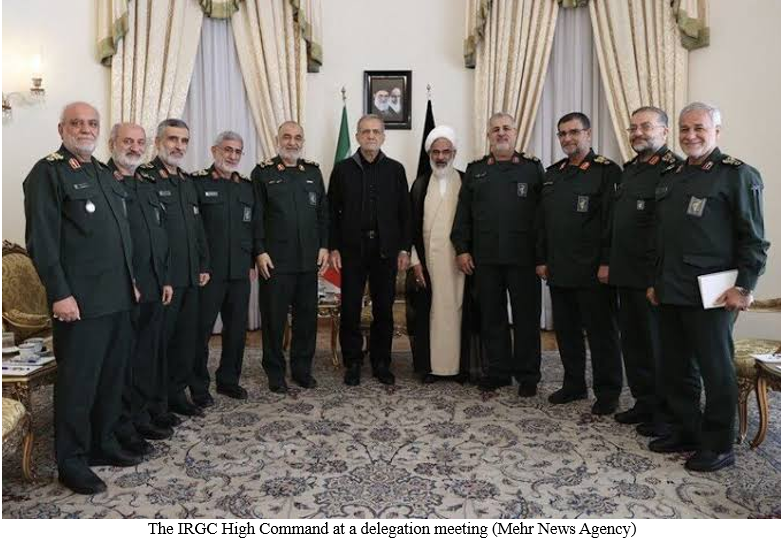
This is the main reason why a diplomatic solution is elusive, both now and in the foreseeable future. The refusal of the IRGC to make broad, structural concessions, even in the face of severe economic collapse and immense hardship for ordinary citizens, is driven by deeply embedded structural factors.
Understanding this dynamic requires analyzing the primary forces that shape the IRGC’s incentives. The IRGC was created in 1979, not as a traditional national military force, but as explicit guardians of Iran’s Islamic Revolution. Hostility toward American global influence, or anti-imperialism as they call it, is not a negotiable foreign policy stance for those leading the Guard; it is the fundamental core of its existence.
Accepting a broad deal requiring dismantling its ballistic missile program, cutting off regional non-state partners (in what we call the Axis of Resistance), or abandoning nuclear threshold status would amount to an ideological surrender, so dismantling these capabilities would seem to dismantle the revolution itself.
Counterintuitively, western sanctions and economic isolation do not weaken the IRGC’s institutional position. Instead, they strengthen it, relative to the civilian population. When regular international commerce is blocked, legal trade collapses. The IRGC’s extensive commercial apparatus, front companies, and logistics networks control illicit smuggling, shadow banking, and alternative oil sales.
Broad economic sanctions decimate Iran’s private sector and middle class while giving the Guard a near-monopoly on critical imports, construction, energy infrastructure and hard-currency routing. Economic hardship for ordinary citizens reduces private-sector independence, making the broader populace more reliant on state rations and subsidies, usually managed by regime-linked entities.
From a regime-survival standpoint, domestic dissent is managed through the state security apparatus rather than economic satisfaction. The IRGC and its volunteer paramilitary wing, the Basij, view public economic distress as a tactical security challenge rather than a mandate for diplomatic compromise.
Internal protests or public grievances over inflation, currency devaluation, and living standards are treated by the security state as national security threats engineered by foreign adversaries. As long as the command structure, intelligence services, and internal security units remain funded and loyal, the regime calculates it can suppress domestic unrest regardless of the economic cost.
Lastly, from the IRGC’s perspective, negotiating away irreversible physical assets like enriched uranium inventories or nuclear infrastructure in exchange for easily reversible U.S. policy changes would not be acceptable, as current U.S. commitments may not survive legislative shifts or presidential elections, so the Guard prefers asymmetric military deterrence in the form of ballistic missiles, armed proxies and nuclear threshold capabilities as a more reliable shield against foreign pressure than a signed diplomatic treaty.
Under these conditions, when dealing with an evil operator like the IRGC, whose identity, funding, and domestic control are tied to permanent confrontation, there are no quick fixes or comprehensive diplomatic solutions which Trump’s team are seeking. It would be an illusion to think grand diplomacy efforts will someday result in regional coexistence, where the IRGC cedes to any of its perceived threats.
A pragmatic strategy to cripple the IRGC and have any kind of potential of working should focus on containment, asymmetric deterrence, and long-term economic degradation. A realistic plan would include disrupting the shadow economy and revenue networks. An effective approach targets IRGC finances rather than applying broad economic bans that mostly harm civilians. The U.S. is already hard at work on this.
The plan should include targeting the shadow tanker fleet, front companies and ship-to-ship transfer hubs in Southeast Asia and the Middle East that fund the Quds Force. Cut off access to western clearing systems for foreign banks that facilitate IRGC currency conversions. Our U.S. Central Command (CENTCOM) has been highly active at this effort and yet describes it as geopolitical whack-a-mole.
Drone or missile strikes on shipping lanes are not isolated incidents, but direct, state-sanctioned actions by the IRGC, triggering direct strikes on IRGC intelligence centers, launch sites, or maritime assets. Expanding integrated air and missile defense networks alongside Gulf allies (Saudi Arabia, UAE, Qatar) to make missile make such drone attacks militarily ineffective. The U.S. is currently very active at this policy initiative. If the U.S. wants to decrease its military presence, our Gulf allies must gain strength.
Most importantly, the primary threat to the IRGC’s long-term survival comes from within Iran, its own population. Bypassing state internet blackouts, using satellite internet and circumvention tools to ensure Iranian citizens can organize and communicate, will be a key part to mobilizing the population. This can help expose the corrupt financial networks of senior IRGC commanders to demonstrate to the domestic public how state funds are diverted with the intent of fueling widespread dissent, and ultimately rebellion.
The goal of a pragmatic containment strategy is not to quickly eliminate the IRGC, which is impossible without a devastating regional war, but to cap its operational reach and substantially raise its cost of doing business. Because the IRGC is built to adapt to coercive pressure, containment isn’t a single mission with a clear end point. It is a continuous, high-friction approach that will take years to accomplish its purpose.
All content above represents the opinion of Bryan Perry of Navellier & Associates, Inc.
Also In This Issue
A Look Ahead by Louis Navellier
Prepare For Some “October Surprises”
Income Mail by Bryan Perry
Trump And Iran: “The Illusion of the Deal”
Growth Mail by Gary Alexander
What’s Wrong with Growth? (Not Much)
Global Mail by Ivan Martchev
What Do Parabolic Treasury Yields Tell Us?
Sector Spotlight by Jason Bodner
There Are Indexes, and There Are Markets
View Full Archive
Read Past Issues Here

Bryan Perry
SENIOR DIRECTOR
Bryan Perry is a Senior Director with Navellier Private Client Group, advising and facilitating high net worth investors in the pursuit of their financial goals.
Bryan’s financial services career spanning the past three decades includes over 20-years of wealth management experience with Wall Street firms that include Bear Stearns, Lehman Brothers and Paine Webber, working with both retail and institutional clients. Bryan earned a B.A. in Political Science from Virginia Polytechnic Institute & State University and currently holds a Series 65 license. All content of “Income Mail” represents the opinion of Bryan Perry
Important Disclosures:
Although information in these reports has been obtained from and is based upon sources that Navellier believes to be reliable, Navellier does not guarantee its accuracy and it may be incomplete or condensed. All opinions and estimates constitute the authors opinions as of the date the report was created and are subject to change without notice. These reports are for informational purposes only and are not a solicitation for the purchase or sale of any securities or financial services. Any decision to purchase securities mentioned in these reports must take into account existing public information on such securities or any registered prospectus. To the extent permitted by law, neither Navellier & Associates, Inc., nor any of its affiliates, agents, or service providers are providing any investment advice herein and do not assume any liability or responsibility for the readers’ decisions if any. No reader should act or refrain from acting in reliance on the information contained in this communication or for any decision based on it.
None of the stock information, data, or company information presented herein constitutes investment advice or a recommendation by Navellier or a solicitation to buy or sell any securities. Any specific securities identified and described herein do not represent any investment advice.
Information presented is general information that does not take into account your individual circumstances, financial situation, or needs, nor does it present a personalized recommendation to you. Individual stocks presented may not be suitable for every investor. Investment in securities involves significant risk and has the potential for partial or complete loss of funds invested. Investment in fixed income securities has the potential for the investment return and principal value of an investment to fluctuate so that an investor’s holdings, when redeemed, may be worth less than their original cost.
- This report contains statements that are, or may be considered to be, forward-looking statements. All statements that are not historical facts, including statements about our beliefs or expectations, are “forward-looking statements” within the meaning of The U.S. Private Securities Litigation Reform Act of 1995. These statements may be identified by such forward-looking terminology as “expect,” “estimate,” “plan,” “intend,” “believe,” “anticipate,” “may,” “will,” “should,” “could,” “continue,” “project,” or similar statements or variations of such terms. Our forward-looking statements are based on a series of expectations, assumptions, and projections, are not investment advice. All of our forward-looking statements are as of the date of this report only.
- Federal Tax Advice Disclaimer: As required by U.S. Treasury Regulations, you are informed that, to the extent this presentation mentions any federal taxes, Navellier is not presenting any tax advice and should not be used or relied on as tax advice. Navellier does not advise on any income tax requirements or issues. Use of any information presented by Navellier is for general information only and does not represent tax advice either express or implied. You are encouraged to seek professional tax advice for income tax questions and assistance.
- FactSet Disclosure: Navellier does not independently calculate the statistical information included in the attached report. The calculation and the information are provided by FactSet, a company not related to Navellier. Although information contained in the report has been obtained from FactSet and is based on sources Navellier believes to be reliable, Navellier does not guarantee its accuracy, and it may be inaccurate, incomplete or condensed. The report and the related FactSet sourced information is for general information purposes only.