
by Gary Alexander
October 6, 2026
Call me old-fashioned, but we still get the printed Wall Street Journal each day in the mail, and my wife is kind (and smart) enough to read it first and mark any articles I might like, or be able to use in this column. About 10 days ago, on Friday, September 25, when I got back from my weekly radio show, she let me know that “half of today’s Wall Street Journal seemed to be obsessed with AI…and it’s all so confusing.”
I could empathize with her, since all the pro-and-con arguments over the AI “threat” or “bonanza” are often conflicting and confusing, but I doubted her census count of 50% or more of the WSJ’s content that day, so I flipped through the headlines and found “only” five extensive articles on AI that Friday, mostly encouraging. Here are the titles, to give you the feel of the Journal’s optimism – on that Friday, anyway:
Wall Street Journal Headlines on AI (on Friday, September 25)
“Fear Not the AI Apocalypse”
“AI and the Growing Threat to Taiwan”
“The Amazing Things AI is Already Doing for Humanity”
“The AI Power Crunch Draws 3-D Printing Help”
“In the Age of AI, Cash is Still King”
But the next few editions (September 26-30), delivered nine more WSJ AI headlines, mostly downers:
“Regulators Have No Template for AI”
“Trump is in Denial About AI’s Danger”
“Will the AI Frenzy Add up to Anything?”
“The Doomers Who Shaped the AI Safety Freakout”
“When AI Tells a Story About Your Health, Is it True?”
“(Company) Scraps AI Model Over Safety Concerns”
“Top AI Scientists Are Urging Greater Oversight”
“Trump Defends Light-Touch AI Strategy”
“AI Spending Slows (Company’s) Profit Growth” *
*Note: I say “company” for the name of a traded security, but the company’s name is irrelevant.
Maybe the Journal likes to be upbeat on Fridays but scarier during other weekdays, but there’s a load of grief, worry and doomsday rhetoric in these articles, as there has been for most previous technology innovations.
Last Sunday night, October 4, CBS’s 60 Minutes opened with a scary story of AI “taking our jobs,” asking, “Is any job safe?” They called it, “The Great Job Apocalypse.” Some sane voices said we’re not abolishing jobs but changing the nature of work, but bad news sells better, so the “AI Dystopia” theme dominated.
Technological innovations have always scared us, starting 200-years ago, with new canals and railroads:
- In 1825, when the Erie Canal opened, local farmers and merchants lost business on their preferred routes, and their services became less profitable, causing job losses – followed by greater job gains.
- In 1829, when railroads gained traction, Vice President Martin van Buren allegedly warned of their dangers, writing, “Railroad carriages are pulled at the enormous speed of 15-miles per hour . . . the Almighty certainly never intended that people should travel at such breakneck speeds.”
Whether VP van Buren said that is in question, but many fell for similar warnings about faster transport. When airplanes emerged, skeptics responded, “If God wanted us to fly, he would have given us wings.”
I’m reading a few fascinating books in this regard. First, I re-read Scottish journalist Charles Mackay’s three-volume “Extraordinary Popular Delusions and the Madness of Crowds” (1842). His first volume covered crazy investment schemes, like the Dutch Tulip Mania of 1637, the Mississippi Scheme and South Sea Bubble in France and England, 1720-21 and a slew of failed doomsday prophecies. Volume II covered the Crusades and Witch Mania, but Volume 3 sounds like today’s news, focusing on technologies, from Alchemy to the crazy Magnetizers, then Mesmerism and a variety of veiled magic via machinery.
The next exhaustive historical survey I read covered America and its army of clever inventors. In “They Built America,” authors Harold Evans, Gail Buckland and David Lefer profiled over 50 pioneers of real technologies that worked, from Fulton’s steamboats and Eli Whitney’s cotton gin to today’s tech wizards, including Bill Gates and Steve Jobs. These were all audacious men (and a few women) who persevered despite severe skepticism, duplicity, legal barriers and suspicious customers to create our modern world.
In the chapter on telegraphs, for instance, the authors showed how scientist Joseph Henry (later the head of the Smithsonian) invented electronic transmission but remained aloof from commerce, as a pure scientist, untouched by commercial dreams, so a painter visiting Paris had a brainstorm on the ocean liner returning home. Samuel F.B. Morse figured out a way to send messages by telegram.
The invention of photography was also a big threat – to the art world. At the time, the art world said the camera would make art obsolete, but Morse countered: “Art is to be wonderfully enriched by this discovery,” As a noted painter, Samuel Morse surprised the skeptics by supporting photography, invented by Frenchman Louis Daguerre and popularized by America’s Matthew Brady. And he was right. The reality of photos gave birth to more personal art via Vincent Van Gogh and the French Expressionists.
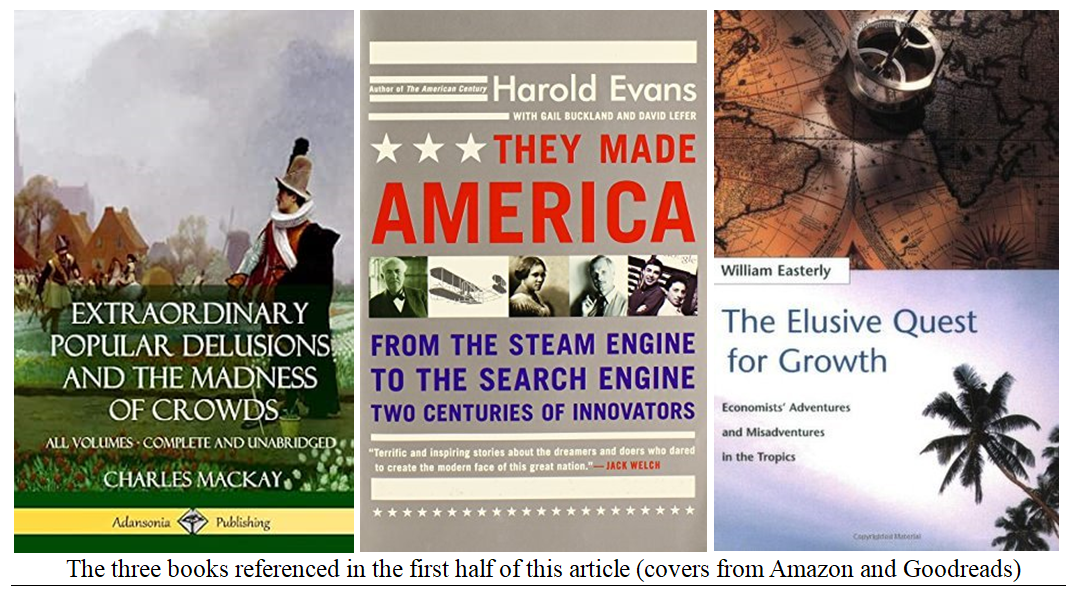
In “The Elusive Quest for Growth” (2001), William Easterley listed some of the same doomsday fears that greeted some of our recent technological innovations. Around Y2k, he noticed the following titles in his university and local libraries, similar to the doomsday books I posted here last week. (See Growth Mail: 9-29-26: What’s Wrong with Growth? (Not Much) – Navellier). Not all authors agree with me:
Sample Library Titles on Economic Growth in the 1990s (and my brief comment)
“Sustainable Development is Possible Only if We Forgo Growth” (so, shrinking wealth is desirable?)
“Economic Growth and Declining Social Welfare” (no, the poor are escaping poverty or getting rich).
“Developed to Death” (What “Deaths” do you mean, with longer life expectancy in most nations?)
“The Poverty of Affluence” (Hmmm! Does the author prefer the “Richness of Poverty”?)
“The Costs of Economic Growth” (in comparison to the deep depression and poverty of no growth?)
“The Growth Illusion: How Economic Growth Has Enriched the Few, Impoverished the Many, and Endangered the Planet” (written in 1992, just before China lifted a billion citizens out of poverty)
–Titles listed in “The Elusive Quest for Growth,” by William Easterly (2001)
Every new technology in the last century has been greeted with widespread fears of “lost jobs,” when in fact technology creates more jobs, but different jobs – work that did not exist before technology created those jobs. In 1942, economist Joseph Schmpeter called this process “creative destruction,” a dynamic in which growth “revolutionizes the economic structure from within, incessantly destroying the old one, incessantly creating a new one. The process of Creative Destruction is the essential fact about capitalism.”
New technology delivers greater growth, and cleaner growth, through boosting productivity. It’s not the technology itself, but how entrepreneurs find ways to use it. As Easterly noted, the Mayans and Aztecs had the wheel but used it only for children’s toys. India produced the first high-quality steel but didn’t use it. They sold steel to Islamic warriors, who fashioned swords to kill infidels. China beat us to all kinds of tech, including gunpowder (mostly used for fireworks), triple-masted ocean-going ships (hardly used) and wheels galore – paddle wheels, wheelbarrows, spinning wheels, waterwheels, but unused in industry.
America was quick to build out new technologies. Others may have made the first car or train engine or radio set or steel mill, but Americans adapted technologies rapidly for mass consumption at a fair price.
Some nations pioneer technology but fail to privatize those skills for commercial adaptation. Egypt obviously built the pyramids – a superior technology 4,000-years ago – but why is Egypt now among the poorest nations on earth, four millennia later? The Chinese reached peak productivity in the Ming Dynasty – 400 to 700-years ago – and then became one of the poorest nations on earth for three-centuries.
Technology is responsible for most of the differences across countries in per capita growth since 1960. As of Y2k, when “The Elusive Quest for Growth” was written, China offered the world “cheap labor,” but it wasn’t really cheap, since U.S. workers produced 20-times the output per worker of Chinese workers.
In conclusion, I’m an agnostic about the value of AI, but history hints at some comforting conclusions: (1) there will be friends and enemies of AI, mostly based on whether a person’s job, income or personal privacy are threatened; (2) the technology is in its infancy, so its champions will make some mistakes, at first, but then, (3) there will be mostly positive outcomes, with some clear downsides, revealed in time and governed mostly by the feedback of customers, not overbearing government regulations, mostly helping lawyers, and (4) like the internet, home computers and smart phones, we will likely enjoy our use of AI.
All content above represents the opinion of Gary Alexander of Navellier & Associates, Inc.
Also In This Issue
A Look Ahead by Louis Navellier
The Fourth Quarter is When Stocks Usually Shine the Brightest
Income Mail by Bryan Perry
The Bond Market Deserves a Sigh of Relief
Growth Mail by Gary Alexander
The Current AI Scare Resembles Past Techno-Terror Tales
Global Mail by Ivan Martchev
Sector Friction in the S&P 500 Widens
Sector Spotlight by Jason Bodner
Like the Seasons, Markets Often Wax and Wane on Schedule
View Full Archive
Read Past Issues Here
About The Author

Gary Alexander
SENIOR EDITOR
Gary Alexander has been Senior Writer at Navellier since 2009. He edits Navellier’s weekly Marketmail and writes a weekly Growth Mail column, in which he uses market history to support the case for growth stocks. For the previous 20-years before joining Navellier, he was Senior Executive Editor at InvestorPlace Media (formerly Phillips Publishing), where he worked with several leading investment analysts, including Louis Navellier (since 1997), helping launch Louis Navellier’s Blue Chip Growth and Global Growth newsletters.
Prior to that, Gary edited Wealth Magazine and Gold Newsletter and wrote various investment research reports for Jefferson Financial in New Orleans in the 1980s. He began his financial newsletter career with KCI Communications in 1980, where he served as consulting editor for Personal Finance newsletter while serving as general manager of KCI’s Alexandria House book division. Before that, he covered the economics beat for news magazines. All content of “Growth Mail” represents the opinion of Gary Alexander
Important Disclosures:
Although information in these reports has been obtained from and is based upon sources that Navellier believes to be reliable, Navellier does not guarantee its accuracy and it may be incomplete or condensed. All opinions and estimates constitute the authors opinions as of the date the report was created and are subject to change without notice. These reports are for informational purposes only and are not a solicitation for the purchase or sale of any securities or financial services. Any decision to purchase securities mentioned in these reports must take into account existing public information on such securities or any registered prospectus. To the extent permitted by law, neither Navellier & Associates, Inc., nor any of its affiliates, agents, or service providers are providing any investment advice herein and do not assume any liability or responsibility for the readers’ decisions if any. No reader should act or refrain from acting in reliance on the information contained in this communication or for any decision based on it.
None of the stock information, data, or company information presented herein constitutes investment advice or a recommendation by Navellier or a solicitation to buy or sell any securities. Any specific securities identified and described herein do not represent any investment advice.
Information presented is general information that does not take into account your individual circumstances, financial situation, or needs, nor does it present a personalized recommendation to you. Individual stocks presented may not be suitable for every investor. Investment in securities involves significant risk and has the potential for partial or complete loss of funds invested. Investment in fixed income securities has the potential for the investment return and principal value of an investment to fluctuate so that an investor’s holdings, when redeemed, may be worth less than their original cost.
- This report contains statements that are, or may be considered to be, forward-looking statements. All statements that are not historical facts, including statements about our beliefs or expectations, are “forward-looking statements” within the meaning of The U.S. Private Securities Litigation Reform Act of 1995. These statements may be identified by such forward-looking terminology as “expect,” “estimate,” “plan,” “intend,” “believe,” “anticipate,” “may,” “will,” “should,” “could,” “continue,” “project,” or similar statements or variations of such terms. Our forward-looking statements are based on a series of expectations, assumptions, and projections, are not investment advice. All of our forward-looking statements are as of the date of this report only.
- Federal Tax Advice Disclaimer: As required by U.S. Treasury Regulations, you are informed that, to the extent this presentation mentions any federal taxes, Navellier is not presenting any tax advice and should not be used or relied on as tax advice. Navellier does not advise on any income tax requirements or issues. Use of any information presented by Navellier is for general information only and does not represent tax advice either express or implied. You are encouraged to seek professional tax advice for income tax questions and assistance.
- FactSet Disclosure: Navellier does not independently calculate the statistical information included in the attached report. The calculation and the information are provided by FactSet, a company not related to Navellier. Although information contained in the report has been obtained from FactSet and is based on sources Navellier believes to be reliable, Navellier does not guarantee its accuracy, and it may be inaccurate, incomplete or condensed. The report and the related FactSet sourced information is for general information purposes only.