
by Bryan Perry
November 10, 2026
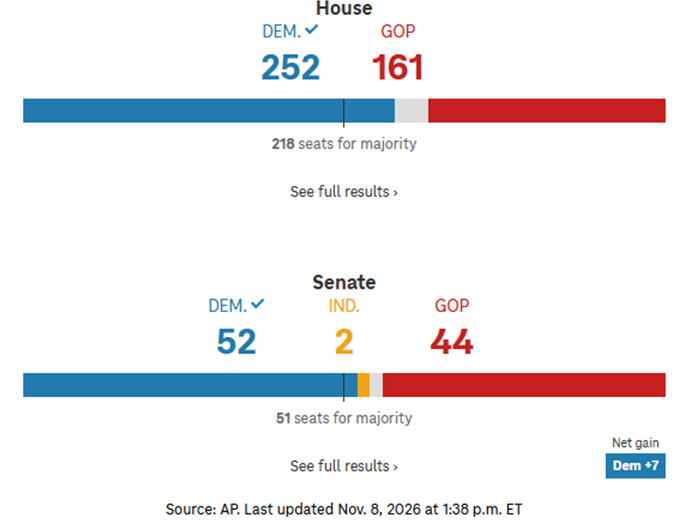
Divided government reshapes capital markets by muting sweeping partisan legislation while spotlighting areas where both sides must deliver. With a new blue wave flipping Congressional control, the executive and legislative branches face stark policy divergences, yet there is general consensus on national security, critical economic imperatives, domestic industrial demands, surging energy needs and reducing deficits.
2026 Election Results
Graphs are for illustrative and discussion purposes only. Please read important disclosures at the end of this commentary.
Looking forward, several primary bipartisan investment themes offer some durable policy tailwinds:
On energy needs, the collision of AI data-center buildouts, domestic manufacturing, and vehicle electrification has created an acute electricity bottleneck. Both parties recognize failure to expand generation and transmission. This threatens national competitiveness and raises consumer and business utility bills. Republicans prioritize traditional baseload generation, natural gas pipelines, and nuclear power, while Democrats push inter-regional transmission lines, grid-scale storage, and renewable integration.
The resulting compromise between these two approaches centers on comprehensive permitting reform, streamlining environmental policy permit reviews, establishing strict deadlines for agency approvals, and modernizing cost-allocation frameworks for multi-state transmission lines.

Investment opportunities within this all-important theme include buying stocks in regulated electric utilities executing capital expenditure programs for grid hardening and transformer capacity, plus specialized engineering and construction firms handling high-voltage transmission lines and substation upgrades. We can also add advanced nuclear operators, small modular reactor (SMR) developers, and fuel cycle providers, which each should enjoy broad cross-party support.
Maintaining federal incentives for domestic semiconductor fabrication, packaging, and critical mineral processing are key. Both sides support continued rollout of CHIPS Act milestones, defense-related industrial expansion and strategic reserves of rare earth elements. Stocks of domestic semiconductor foundries, toolmakers, and advanced packaging suppliers are well positioned, as are North American mining, refining, and recycling companies focused on lithium, cobalt, rare earth elements, and copper.

Industrial automation, robotics, and facility instrumentation providers enabling domestic factories to compete on unit labor costs would also be a hugely important secular and revolutionary cycle to keep American-made goods globally competitive and of the highest quality, but here is where it gets tricky.
On national security, the rivalry with China remains the strongest bipartisan consensus in Washington. While rhetoric differs, Democrats often frame the issue around unionized clean tech, while Republicans focus on tariffs and strategic decoupling, but both agree critical technologies cannot remain offshore.
Defense budgets will face fiscal scrutiny under a divided budget environment, but historically, top-line defense outlays consistently enjoy bipartisan support. However, the composition of that spending is rotating rapidly away from legacy hardware toward asymmetric, software-driven capabilities.
The U.S. Space Force program should continue to thrive. Both parties support countering Indo-Pacific and Eastern European threats through rapid fielding of autonomous systems, electronic warfare, hardened satellite communications, and naval recapitalization. Stocks of companies specializing in un-crewed aerial and maritime drones, counter-Unmanned Aerial Systems platforms, and AI-enabled battle management system will continue to draw investors, as well as stocks of commercial space launch providers, secure low-Earth-orbit (LEO) satellite constellations, and space domain awareness systems.

Healthcare spending was a primary focus of voters as it represents one of the largest drains on both family budgets and federal entitlements. Rather than pursuing sweeping systemic overhauls like single-payer healthcare or widespread ACA rollbacks, Congress will likely target market intermediaries. Bipartisan frustration with Pharmacy Benefit Managers (PBMs) and opaque drug pricing practices has reached a tipping point. Lawmakers from both parties favor delinking PBM compensation from drug list prices, banning spread pricing, and accelerating the commercial uptake of biosimilars and generics.
Generic drug and biosimilar manufacturers should gain market share as rebate walls erode. Retail pharmacy networks transitioning toward transparent, cost-plus dispensing models are also a bipartisan priority. And leading stocks of digital healthcare platforms that provide transparent cash-pay pricing and direct-to-consumer prescription fulfillment should also outperform.
Lastly, the Infrastructure Investment and Jobs Act (IIJA) provided multi-year authorizations that will disburse capital into 2027. Under a split government, these authorized state-level grants remain insulated from claw backs because funds deploy heavily into both red rural blue urban centers. Upgrading aging water treatment facilities, replacing lead pipes, expanding wastewater reclamation in the drought-stressed West and maintaining inland waterways, ports and rail corridors will be crucial infrastructure upgrades.
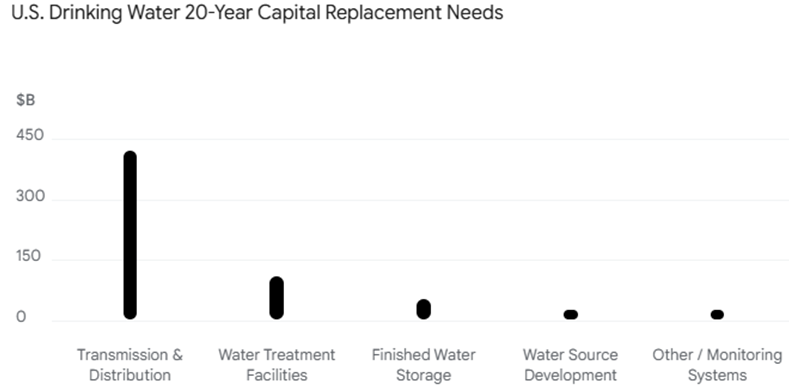
The U.S. Environmental Protection Agency (EPA) and American Society of Civil Engineers (ASCE) document extensive structural decay across America’s drinking water network. The EPA’s Drinking Water Infrastructure Needs Survey and Assessment identifies $625 billion in 20-year capital requirements to repair, replace, and modernize deteriorating public drinking water systems:
Graphs are for illustrative and discussion purposes only. Please read important disclosures at the end of this commentary.
Stocks of companies that compete in water infrastructure, including pump, pipe and filtration manufacturers, alongside water treatment chemical producers stand to thrive in what is a rapidly aging national water grid. Heavy building materials providers (aggregates, asphalt, ready-mix concrete) with localized pricing power near major federally assisted civil projects are poised to benefit greatly. They, and freight rail infrastructure maintenance contractors and marine logistics operators, should also reap a windfall from federal, state, and local capital investment.
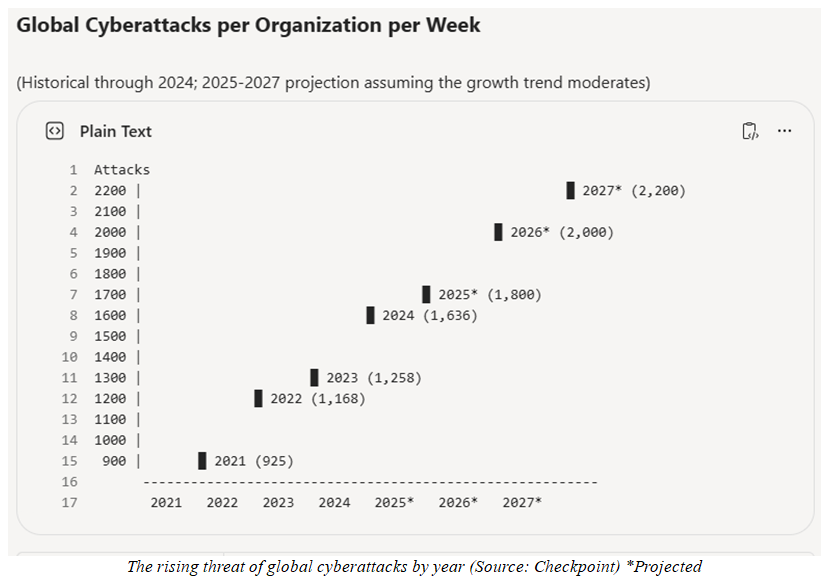
Heading into 2027, the most defensive growth profiles belong to companies aligned with non-discretionary federal imperatives, namely, keeping the power grid stable, securing strategic supply lines, and upgrading core physical infrastructure. Spanning across all these themes are government IT and cyber defense contractors safeguarding federal infrastructure and defense industrial base supply chains that stand to reap big financial rewards from all these investment themes.
Graphs are for illustrative and discussion purposes only. Please read important disclosures at the end of this commentary.
These cyberattacks will be the first and last line of defense of government, corporate, and consumer protection with a rapidly evolving and dangerous AI-driven dark web. A cybersecurity ETF or two might be the best way to cast a net over the sector as some companies are highly specialized.
With market trading seemingly in complete disarray – with every stock rising or falling on its own – now is a good time to do some top-down analysis. Identify themes with common ground on both sides of the aisle, select the most attractive subsectors on the receiving end of proactive legislation, and zero in on stocks under heavy accumulation by professional fund flows that are doing the same due diligence.
All content above represents the opinion of Bryan Perry of Navellier & Associates, Inc.
Also In This Issue
A Look Ahead by Louis Navellier
Great Earnings Will Keep Fueling Market (and Economic) Growth
Income Mail by Bryan Perry
Bipartisan Investment Themes For 2027
Growth Mail by Gary Alexander
Food for Thought (and Action) on Veteran’s Day
Global Mail by Ivan Martchev
On Market Moves and Political Repercussions
Sector Spotlight by Jason Bodner
How to Ride the Market’s Rare but Powerful Rogue Waves
Important Disclosures:
Although information in these reports has been obtained from and is based upon sources that Navellier believes to be reliable, Navellier does not guarantee its accuracy and it may be incomplete or condensed. All opinions and estimates constitute the authors opinions as of the date the report was created and are subject to change without notice. These reports are for informational purposes only and are not a solicitation for the purchase or sale of any securities or financial services. Any decision to purchase securities mentioned in these reports must take into account existing public information on such securities or any registered prospectus. To the extent permitted by law, neither Navellier & Associates, Inc., nor any of its affiliates, agents, or service providers are providing any investment advice herein and do not assume any liability or responsibility for the readers’ decisions if any. No reader should act or refrain from acting in reliance on the information contained in this communication or for any decision based on it.
None of the stock information, data, or company information presented herein constitutes investment advice or a recommendation by Navellier or a solicitation to buy or sell any securities. Any specific securities identified and described herein do not represent any investment advice.
Information presented is general information that does not take into account your individual circumstances, financial situation, or needs, nor does it present a personalized recommendation to you. Individual stocks presented may not be suitable for every investor. Investment in securities involves significant risk and has the potential for partial or complete loss of funds invested. Investment in fixed income securities has the potential for the investment return and principal value of an investment to fluctuate so that an investor’s holdings, when redeemed, may be worth less than their original cost.
- This report contains statements that are, or may be considered to be, forward-looking statements. All statements that are not historical facts, including statements about our beliefs or expectations, are “forward-looking statements” within the meaning of The U.S. Private Securities Litigation Reform Act of 1995. These statements may be identified by such forward-looking terminology as “expect,” “estimate,” “plan,” “intend,” “believe,” “anticipate,” “may,” “will,” “should,” “could,” “continue,” “project,” or similar statements or variations of such terms. Our forward-looking statements are based on a series of expectations, assumptions, and projections, are not investment advice. All of our forward-looking statements are as of the date of this report only.
- Federal Tax Advice Disclaimer: As required by U.S. Treasury Regulations, you are informed that, to the extent this presentation mentions any federal taxes, Navellier is not presenting any tax advice and should not be used or relied on as tax advice. Navellier does not advise on any income tax requirements or issues. Use of any information presented by Navellier is for general information only and does not represent tax advice either express or implied. You are encouraged to seek professional tax advice for income tax questions and assistance.
- FactSet Disclosure: Navellier does not independently calculate the statistical information included in the attached report. The calculation and the information are provided by FactSet, a company not related to Navellier. Although information contained in the report has been obtained from FactSet and is based on sources Navellier believes to be reliable, Navellier does not guarantee its accuracy, and it may be inaccurate, incomplete or condensed. The report and the related FactSet sourced information is for general information purposes only.