
by Gary Alexander
September 1, 2026
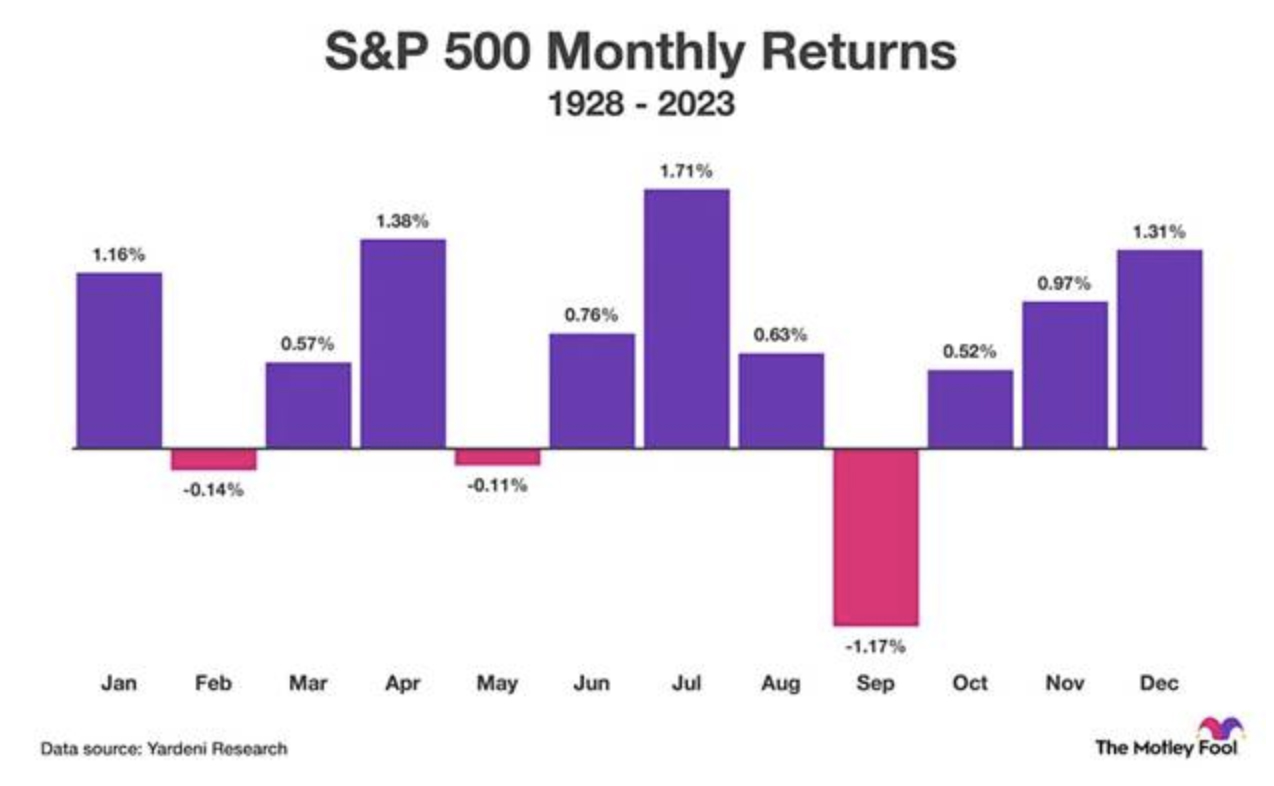
Today marks the first day of a dreaded month in market history. For a century, since 1928, September has been the worst month by far, and the only month with a net negative track record, retreating 1% on average.
Graphs are for illustrative and discussion purposes only. Please read important disclosures at the end of this commentary.
But wait. What about lately? In September 2025, the S&P 500 was up 3.53%, and the year before it was up 2%. August is also supposed to be a weak month, but this year we saw 2% gains in the Dow, +3% in the S&P 500 and +4% in NASDAQ (through last Friday). A familiar disclaimer comes to mind: “The past is no guarantee of the future,” and I would add, “a more common outcome is a ‘reversion to the mean.’”
I’m still a big fan of the 4-year Presidential cycle providing strong clues about the market’s direction, since that cycle is based on human nature in the real world, but I’m no fan of most other calendar clues, especially silly stuff like the Super Bowl Index, January Effect, hemlines, or Triple Crown winners. My basic beef is that creating a past trend from the rearview mirror is a study in coincidences or retro-fitting, not logical analysis. Those who bet on the past repeating itself forget that each new situation is truly new.
A coin flip coming up heads 10-times in a row doesn’t imply the next flip will be heads, or that “tails are due.” The next flip will always be a 50-50 wager, no matter what happened in the past 10 or 50 flips.
Some of the brainiest minds in our business can’t seem to figure that out. From the Nobel-winning team behind Long-Term Capital Management (LTCM) in 1998 to the more recent celebrated Wunderkinds, like Sam Bankman-Fried (FTX) or Leopold Aschenbrenner (Situational Awareness), trading on high leverage based on past trading ranges is a fool’s errand, as those past trading bands beg to be broken!
The Heisenberg Uncertainty Principle says we cannot simultaneously measure certain pairs of physical properties with infinite precision. More specifically, it says the observer tends to change the outcome.
In this regard, I would present my own hypothesis here – which I test every year – the Alexander Beat the Crash Calendar Rush, in which investors scarred by past October scares tend to sell in September to avoid the next crash, making September the market’s worst month. And now that September is the worst month, investors tend to sell in August – and now in July. This year, in fact, June and July were marginally down.
Investors no longer “sell in May and go away,” since that theory hasn’t worked lately, but perhaps they sell in June (“a bit too Soon”) or in July (“but don’t ask Why”) to avoid sell-offs in August or September.
Binary Thinking (As In “Sell All Stocks”) Is Usually a Huge Blunder
Worse than selling (or not buying) based on calendar months is the mistake of selling all – or the vast majority – of your stocks based on outdated math or an army of Cassandras forecasting a coming crash.
I have some experience in this arena. Thirty years ago, in July 1996, I was editing four financial letters at a major publishing firm. Most of our professional analysts were bullish then, including my four, but one was a “binary” thinker. I won’t name that analyst, but let’s call him “Gene,” as in a Genie’s magic lamp.
In late July 1996, Gene issued a much heralded “sell signal.” In fact, Gene issued a total of eight-sell (and eight-buy) signals from 1980 to 2010. Most worked out fine, but 1996 didn’t, as the market soon soared.
Even if these sell signals are all correct, I wouldn’t necessarily follow any of them. Putting aside the headache of paying capital gains tax and guessing how or when to jump back in, you sell on weak bids.
I was on the front line of that 1996 sell signal, fielding hundreds of subscriber calls, faxes and even office visits every day after that sell signal. While my other three-editors were still bullish, I had to defend this one-bear. Whose side should I take? These are the real-world problems when making major sell signals.
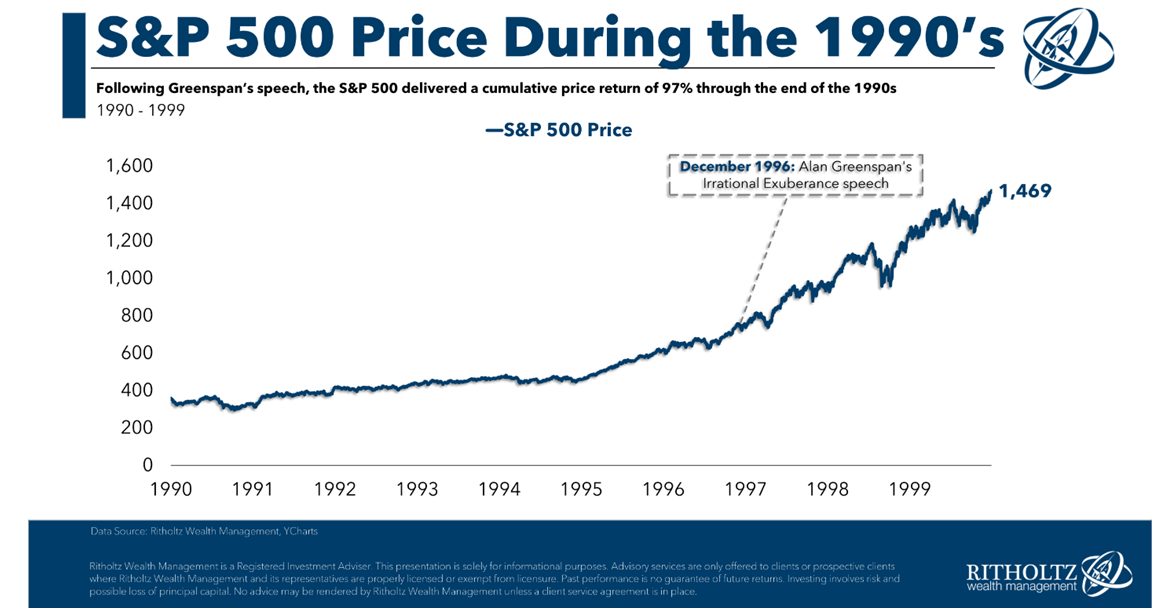
The same was true of Alan Greenspan’s famous “irrational exuberance” speech on December 5, 1996. He single-handedly spooked the market near the start of its greatest 5-year growth span over the last century.
As you can see, the market took off like an Elon Musk SpaceX rocket following Greenspan’s speech:
Graphs are for illustrative and discussion purposes only. Please read important disclosures at the end of this commentary.
In early 1995, one of my other editors was boldly predicting 7,000 Dow in 1997, and it turns out he was way low, with the Dow reaching 8,000. I aligned mostly with his view, so I didn’t sell all (or any) of my stocks in 1996, and I’m truly sorry for those who sold out and missed most of the next year’s 50% gains.
Here are the real gains after Gene’s July 23 sell signal, and Greenspan’s market-chilling December talk:

What Happens When Investors Panic and “Sell All Stocks”?
This story reminds me of the dog chasing a school bus down the street. What will he do if his teeth are buried in a turning wheel? Selling in a panic is like biting into a turning wheel. When an investor “sells all stocks” into a panic situation, bids are low and you sell at a short-term loss, while paying capital gain tax, an insult and an injury, I’d say. You tend not to get a fair bid on your stocks if you sell into a panic.
Taxes on capital gains are not indexed to inflation, and that is a major impediment to selling big winners, so I have gradually transferred my taxable stocks to create a retirement account and take out the minimum required distributions and pay ordinary income on the total sum, rather than computing past capital gains.
As a result, I only have one-stock left in my taxable account: Taiwan Semiconductor (TSM). It’s now a 40-bagger for me, as I bought it over 20-years ago, after the technology stock collapse in 2000 to 2022, when its adjusted price was in single-digits. It’s now over $400 a share, so capital gains taxes would be quite large.
In this regard, I want to cite a paragraph from Louis Navellier’s column this week, which parallels my feelings about selling my sole remaining taxable stock (I hold over 25 still in my retirement accounts):
Louis writes: “In case you wonder why I am so careful before I sell any stocks, I would incur 23.8% in long-term capital gain taxes (including the 3.8% Obamacare tax above $250,000) in federal tax-free states like Alaska, Floridia, Nevada, New Hampshire, South Dakota, Tennessee, Texas and Wyoming. Even worse, clients in California could incur 37.1% in long-term capital gain taxes (including the surcharge).”
Then, Louis adds: “I believe the key to success in America is to identify great companies and ride them as long as they are scoring highly in my 8-factor Fundamental model. That is why I never sold Super Micro Computer, despite relentless short seller attacks,” and that’s why I haven’t sold TSM. Instead, I am hoping for some capital gains tax reform, indexing gains to inflation, so that we only pay taxes on the real gains, not the phantom inflationary component. This would help homeowners and business owners as well as investors, and it seems like a financially honest way to compute capital gains.
The Capital Gains Inflation Relief Act of 2025 (S. 798), introduced by Senator Ted Cruz, would allow individuals to adjust their cost basis of certain assets — including common stock, tangible property, and digital assets — for inflation (as measured by the PCE index) if held for more than three years.
Until a bill like this becomes law, I’m holding TSM as my last fully taxable stock holding, betting on the fact China would never invade Taiwan and take over or destroy Taiwan’s massive semiconductor market.
Navellier & Associates; own Taiwan Semiconductor (TSM) and Super Micro Computer (SMCI) in managed accounts. Gary Alexander owns Taiwan Semiconductor (TSM) personally but does not own Super Micro Computer (SMCI) personally.
All content above represents the opinion of Gary Alexander of Navellier & Associates, Inc.
Also In This Issue
A Look Ahead by Louis Navellier
What to Expect from Mid-Term Elections (and Trump’s Trade Wars)
Income Mail by Bryan Perry
The Amazing Stock Buyback Phenomenon Continues
Growth Mail by Gary Alexander
The Perils of Market Seasonality (or “Selling All Stocks”)
Global Mail by Ivan Martchev
Why U.S. Investors Should Care About EU Natural Gas Prices
Sector Spotlight by Jason Bodner
AI (Like the Transistor, PCs and Internet) Will Change Everything
View Full Archive
Read Past Issues Here
About The Author

Gary Alexander
SENIOR EDITOR
Gary Alexander has been Senior Writer at Navellier since 2009. He edits Navellier’s weekly Marketmail and writes a weekly Growth Mail column, in which he uses market history to support the case for growth stocks. For the previous 20-years before joining Navellier, he was Senior Executive Editor at InvestorPlace Media (formerly Phillips Publishing), where he worked with several leading investment analysts, including Louis Navellier (since 1997), helping launch Louis Navellier’s Blue Chip Growth and Global Growth newsletters.
Prior to that, Gary edited Wealth Magazine and Gold Newsletter and wrote various investment research reports for Jefferson Financial in New Orleans in the 1980s. He began his financial newsletter career with KCI Communications in 1980, where he served as consulting editor for Personal Finance newsletter while serving as general manager of KCI’s Alexandria House book division. Before that, he covered the economics beat for news magazines. All content of “Growth Mail” represents the opinion of Gary Alexander
Important Disclosures:
Although information in these reports has been obtained from and is based upon sources that Navellier believes to be reliable, Navellier does not guarantee its accuracy and it may be incomplete or condensed. All opinions and estimates constitute Navellier’s judgment as of the date the report was created and are subject to change without notice. These reports are for informational purposes only and are not a solicitation for the purchase or sale of a security. Any decision to purchase securities mentioned in these reports must take into account existing public information on such securities or any registered prospectus.To the extent permitted by law, neither Navellier & Associates, Inc., nor any of its affiliates, agents, or service providers assumes any liability or responsibility nor owes any duty of care for any consequences of any person acting or refraining to act in reliance on the information contained in this communication or for any decision based on it.
Past performance is no indication of future results. Investment in securities involves significant risk and has the potential for partial or complete loss of funds invested. It should not be assumed that any securities recommendations made by Navellier. in the future will be profitable or equal the performance of securities made in this report. Dividend payments are not guaranteed. The amount of a dividend payment, if any, can vary over time and issuers may reduce dividends paid on securities in the event of a recession or adverse event affecting a specific industry or issuer.
None of the stock information, data, and company information presented herein constitutes a recommendation by Navellier or a solicitation to buy or sell any securities. Any specific securities identified and described do not represent all of the securities purchased, sold, or recommended for advisory clients. The holdings identified do not represent all of the securities purchased, sold, or recommended for advisory clients and the reader should not assume that investments in the securities identified and discussed were or will be profitable.
Information presented is general information that does not take into account your individual circumstances, financial situation, or needs, nor does it present a personalized recommendation to you. Individual stocks presented may not be suitable for every investor. Investment in securities involves significant risk and has the potential for partial or complete loss of funds invested. Investment in fixed income securities has the potential for the investment return and principal value of an investment to fluctuate so that an investor’s holdings, when redeemed, may be worth less than their original cost.
One cannot invest directly in an index. Index is unmanaged and index performance does not reflect deduction of fees, expenses, or taxes. Presentation of Index data does not reflect a belief by Navellier that any stock index constitutes an investment alternative to any Navellier equity strategy or is necessarily comparable to such strategies. Among the most important differences between the Indices and Navellier strategies are that the Navellier equity strategies may (1) incur material management fees, (2) concentrate its investments in relatively few stocks, industries, or sectors, (3) have significantly greater trading activity and related costs, and (4) be significantly more or less volatile than the Indices.
ETF Risk: We may invest in exchange traded funds (“ETFs”) and some of our investment strategies are generally fully invested in ETFs. Like traditional mutual funds, ETFs charge asset-based fees, but they generally do not charge initial sales charges or redemption fees and investors typically pay only customary brokerage fees to buy and sell ETF shares. The fees and costs charged by ETFs held in client accounts will not be deducted from the compensation the client pays Navellier. ETF prices can fluctuate up or down, and a client account could lose money investing in an ETF if the prices of the securities owned by the ETF go down. ETFs are subject to additional risks:
- ETF shares may trade above or below their net asset value;
- An active trading market for an ETF’s shares may not develop or be maintained;
- The value of an ETF may be more volatile than the underlying portfolio of securities the ETF is designed to track;
- The cost of owning shares of the ETF may exceed those a client would incur by directly investing in the underlying securities; and
- Trading of an ETF’s shares may be halted if the listing exchange’s officials deem it appropriate, the shares are delisted from the exchange, or the activation of market-wide “circuit breakers” (which are tied to large decreases in stock prices) halts stock trading generally.
Grader Disclosures: Investment in equity strategies involves substantial risk and has the potential for partial or complete loss of funds invested. The sample portfolio and any accompanying charts are for informational purposes only and are not to be construed as a solicitation to buy or sell any financial instrument and should not be relied upon as the sole factor in an investment making decision. As a matter of normal and important disclosures to you, as a potential investor, please consider the following: The performance presented is not based on any actual securities trading, portfolio, or accounts, and the reported performance of the A, B, C, D, and F portfolios (collectively the “model portfolios”) should be considered mere “paper” or pro forma performance results based on Navellier’s research.
Investors evaluating any of Navellier & Associates, Inc.’s, (or its affiliates’) Investment Products must not use any information presented here, including the performance figures of the model portfolios, in their evaluation of any Navellier Investment Products. Navellier Investment Products include the firm’s mutual funds and managed accounts. The model portfolios, charts, and other information presented do not represent actual funded trades and are not actual funded portfolios. There are material differences between Navellier Investment Products’ portfolios and the model portfolios, research, and performance figures presented here. The model portfolios and the research results (1) may contain stocks or ETFs that are illiquid and difficult to trade; (2) may contain stock or ETF holdings materially different from actual funded Navellier Investment Product portfolios; (3) include the reinvestment of all dividends and other earnings, estimated trading costs, commissions, or management fees; and, (4) may not reflect prices obtained in an actual funded Navellier Investment Product portfolio. For these and other reasons, the reported performances of model portfolios do not reflect the performance results of Navellier’s actually funded and traded Investment Products. In most cases, Navellier’s Investment Products have materially lower performance results than the performances of the model portfolios presented.
This report contains statements that are, or may be considered to be, forward-looking statements. All statements that are not historical facts, including statements about our beliefs or expectations, are “forward-looking statements” within the meaning of The U.S. Private Securities Litigation Reform Act of 1995. These statements may be identified by such forward-looking terminology as “expect,” “estimate,” “plan,” “intend,” “believe,” “anticipate,” “may,” “will,” “should,” “could,” “continue,” “project,” or similar statements or variations of such terms. Our forward-looking statements are based on a series of expectations, assumptions, and projections, are not guarantees of future results or performance, and involve substantial risks and uncertainty as described in Form ADV Part 2A of our filing with the Securities and Exchange Commission (SEC), which is available at www.adviserinfo.sec.gov or by requesting a copy by emailing info@navellier.com. All of our forward-looking statements are as of the date of this report only. We can give no assurance that such expectations or forward-looking statements will prove to be correct. Actual results may differ materially. You are urged to carefully consider all such factors.
FEDERAL TAX ADVICE DISCLAIMER: As required by U.S. Treasury Regulations, you are informed that, to the extent this presentation includes any federal tax advice, the presentation is not written by Navellier to be used, and cannot be used, for the purpose of avoiding federal tax penalties. Navellier does not advise on any income tax requirements or issues. Use of any information presented by Navellier is for general information only and does not represent tax advice either express or implied. You are encouraged to seek professional tax advice for income tax questions and assistance.
IMPORTANT NEWSLETTER DISCLOSURE:The hypothetical performance results for investment newsletters that are authored or edited by Louis Navellier, including Louis Navellier’s Growth Investor, Louis Navellier’s Breakthrough Stocks, Louis Navellier’s Accelerated Profits, and Louis Navellier’s Platinum Club, are not based on any actual securities trading, portfolio, or accounts, and the newsletters’ reported hypothetical performances should be considered mere “paper” or proforma hypothetical performance results and are not actual performance of real world trades. Navellier & Associates, Inc. does not have any relation to or affiliation with the owner of these newsletters. There are material differences between Navellier Investment Products’ portfolios and the InvestorPlace Media, LLC newsletter portfolios authored by Louis Navellier. The InvestorPlace Media, LLC newsletters contain hypothetical performance that do not include transaction costs, advisory fees, or other fees a client might incur if actual investments and trades were being made by an investor. As a result, newsletter performance should not be used to evaluate Navellier Investment services which are separate and different from the newsletters. The owner of the newsletters is InvestorPlace Media, LLC and any questions concerning the newsletters, including any newsletter advertising or hypothetical Newsletter performance claims, (which are calculated solely by Investor Place Media and not Navellier) should be referred to InvestorPlace Media, LLC at (800) 718-8289.
Please note that Navellier & Associates and the Navellier Private Client Group are managed completely independent of the newsletters owned and published by InvestorPlace Media, LLC and written and edited by Louis Navellier, and investment performance of the newsletters should in no way be considered indicative of potential future investment performance for any Navellier & Associates separately managed account portfolio. Potential investors should consult with their financial advisor before investing in any Navellier Investment Product.
Navellier claims compliance with Global Investment Performance Standards (GIPS). To receive a complete list and descriptions of Navellier’s composites and/or a presentation that adheres to the GIPS standards, please contact Navellier or click here. It should not be assumed that any securities recommendations made by Navellier & Associates, Inc. in the future will be profitable or equal the performance of securities made in this report.
FactSet Disclosure: Navellier does not independently calculate the statistical information included in the attached report. The calculation and the information are provided by FactSet, a company not related to Navellier. Although information contained in the report has been obtained from FactSet and is based on sources Navellier believes to be reliable, Navellier does not guarantee its accuracy, and it may be incomplete or condensed. The report and the related FactSet sourced information are provided on an “as is” basis. The user assumes the entire risk of any use made of this information. Investors should consider the report as only a single factor in making their investment decision. The report is for informational purposes only and is not intended as an offer or solicitation for the purchase or sale of a security. FactSet sourced information is the exclusive property of FactSet. Without prior written permission of FactSet, this information may not be reproduced, disseminated or used to create any financial products. All indices are unmanaged and performance of the indices include reinvestment of dividends and interest income, unless otherwise noted, are not illustrative of any particular investment and an investment cannot be made in any index. Past performance is no guarantee of future results.