
by Gary Alexander
January 13, 2026
As Louis Navellier has often reminded us, an economy needs population growth and new family formation to generate economic growth. As appealing as it sounds to imagine fewer people, smaller crowds and less congestion on roads and in airports, the dangers of a shrinking population (like the dangers of deflation) are less advertised by doomsday writers, but equally (or even more) dangerous.
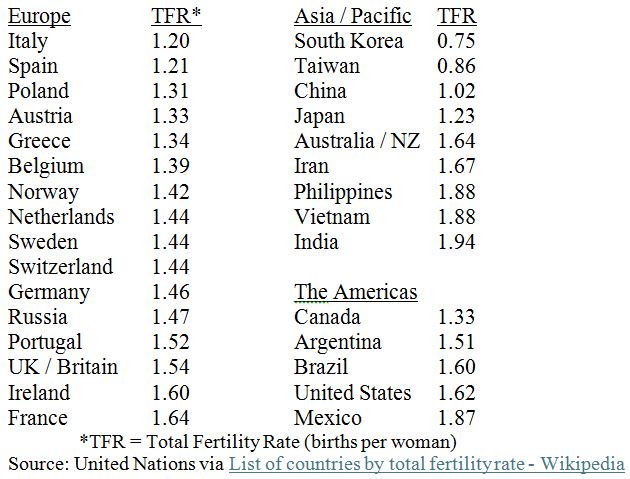
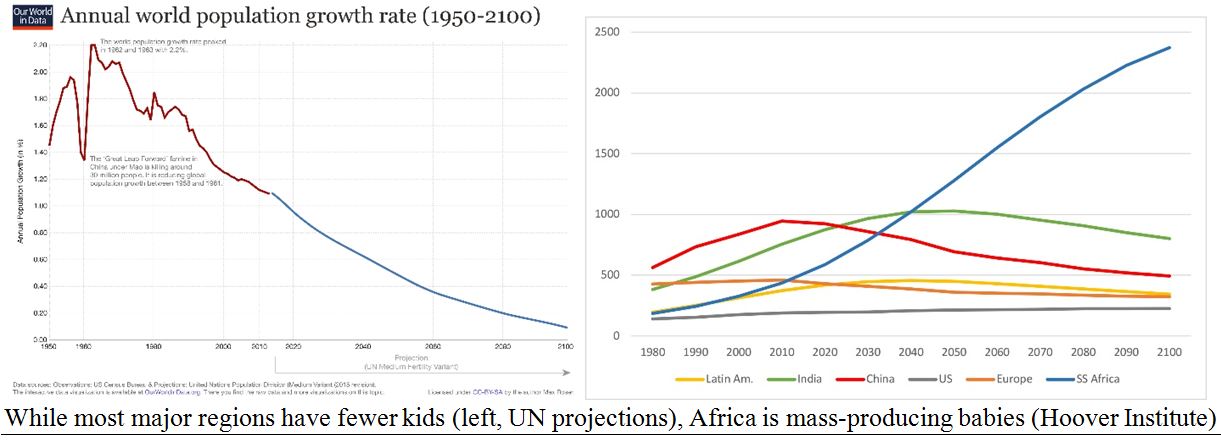
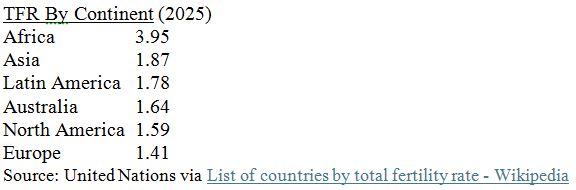
When it comes to “total fertility rate” (TFR, the number of births per woman), demographers say we need at least 2.1-births per female just to maintain our current population level (the last 0.1 mostly accounts for infant mortality). Last year, the overall global TFR rate was 2.24, but if you omit Africa, the TFR rate is well under 2.0. Most of the largest advanced industrial nations reported TFR rates under 2.0 during 2025:
Graphs are for illustrative and discussion purposes only. Please read important disclosures at the end of this commentary.
No major developed (rich) nation has averaged a TFR over 2.1 (replacement level). Except for Africa, the world is shrinking. Back in 1950 through 1970, the world’s richest nations averaged over 2.7-births per woman, then averaged only 1.6-births per woman since 1995, with an all-time low at 1.5 from 2020-2025.
As a whole, world population is slowly increasing – due mostly to Africa and the longer lives of our elderly – but Asia’s two-biggest economies – China and Japan – are shrinking in population, which implies a limited capacity for economic growth. More seriously, the fewer younger workers in those nations can’t afford to underwrite the costs of servicing their long-living (and often ill) elderly forebears.

Graphs are for illustrative and discussion purposes only. Please read important disclosures at the end of this commentary.
China has repudiated its long-held “one child” policy, but the habit stuck. Young couples don’t want even one child these days. They want more work and bigger paychecks, while the fruits of the one child policy sowed seeds of a major problem – of couples (pre-2010) discovering the sex of their embryo and aborting girls so they could raise a “Young Emperor” to support them in their old age. This created a dangerous surfeit of male children (118 males to 100 female births from 2002 to 2008) with fewer females to marry.
When a group of our newsletter subscribers toured China in 1996, we noticed the typical household was seven – four-grandparents, two-parents and a spoiled, coddled “Young Emperor,” whom all six-adults relied on for their security in old age. This inverted demographic pyramid doesn’t add up, financially.
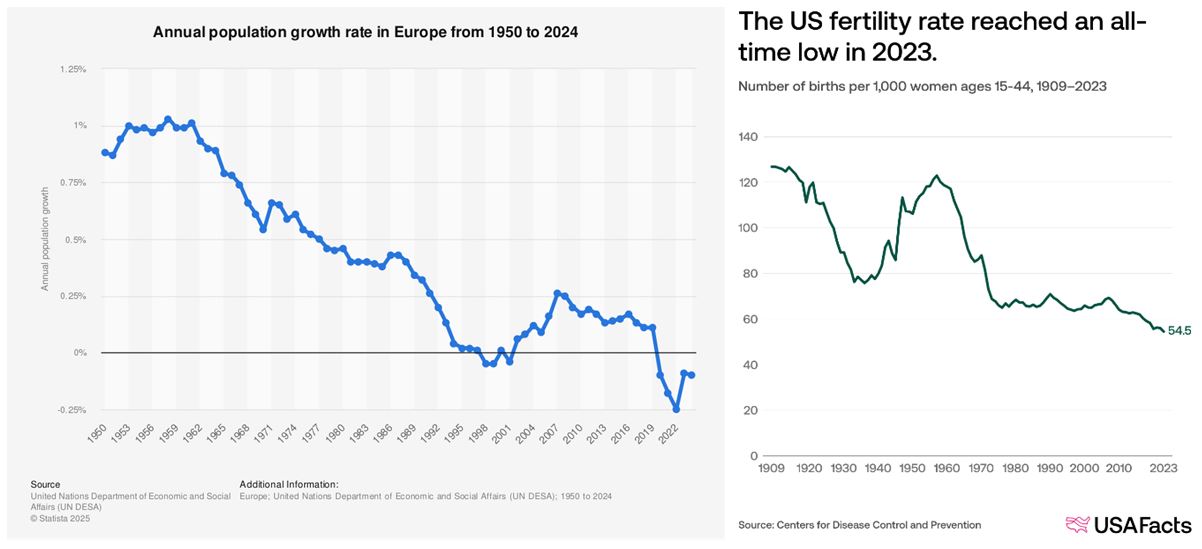
Europe is even worse off in the fertility sweepstakes, averaging just 1.4-children per woman, and Europe has an even more generous safety net of old age pensions. This is why Europe has delegated its security costs to the U.S, a strategy which may backfire as President Trump insists they fund their own defense.
Graphs are for illustrative and discussion purposes only. Please read important disclosures at the end of this commentary.
The United States is in better shape than Europe or Asia – partly due our fairly rapid assimilation of immigrants and high family formation rates in our more conservative regions of the nation – but with the President’s new limitations on immigration, while capturing and shipping out undocumented workers – I have to wonder if we have enough willing young workers to fill up all those new “on-shored” factories.
There is another time bomb implanted in these charts and trends. Social Security (and Medicare) are a time compact between generations, with younger workers funding the immediate needs of the elderly and their rising medical costs. Unlike a 401(k) or IRA, these aren’t savings accounts but are unfunded entitlements based on past demographic trends of higher birth rates. With the current generations less likely to marry and have children – also, less likely to create lucrative careers instead of “gig” jobs – we will face major challenges for funding these future benefits for those unwilling to beget new Americans.
A Personal Recollection Brings This Crisis Home
My wife Karen and I were married 58-years ago this week, on January 14, 1968 – a Super Bowl Sunday (#2, or II), and we weren’t even aware of the game going on. (Now, we both love to watch football!).

Wedding day aside, 1968 was a year of terrible events – far worse than any recent year, in my view. During our honeymoon, North Korea seized the U.S.S. Pueblo and imprisoned its 83-man crew for 11-months. Then came the Tet Offensive in Vietnam, followed by the My Lai massacre, multiple campus riots and racial riots, the assassinations of Dr. Martin Luther King, Jr. in April, and Robert Kennedy in June. In August, Russian tanks rolled into Prague, followed by riots at Chicago’s Democratic convention. Then, Richard Nixon edged Hubert Humphrey, after LBJ retired and decent candidates were forced out.
In such a cauldron, why bring new children into the world? But we created three in quick order, our first in December 1968, then two more in 1970 and 1972, during times of hijacked airplanes, campus riots and thousands of domestic bombings each year. In addition, 1968 books warned of a “Population Bomb” and “Famine in 1975,” so by what right (or logic) did we bring three new lives into such a troubled world?
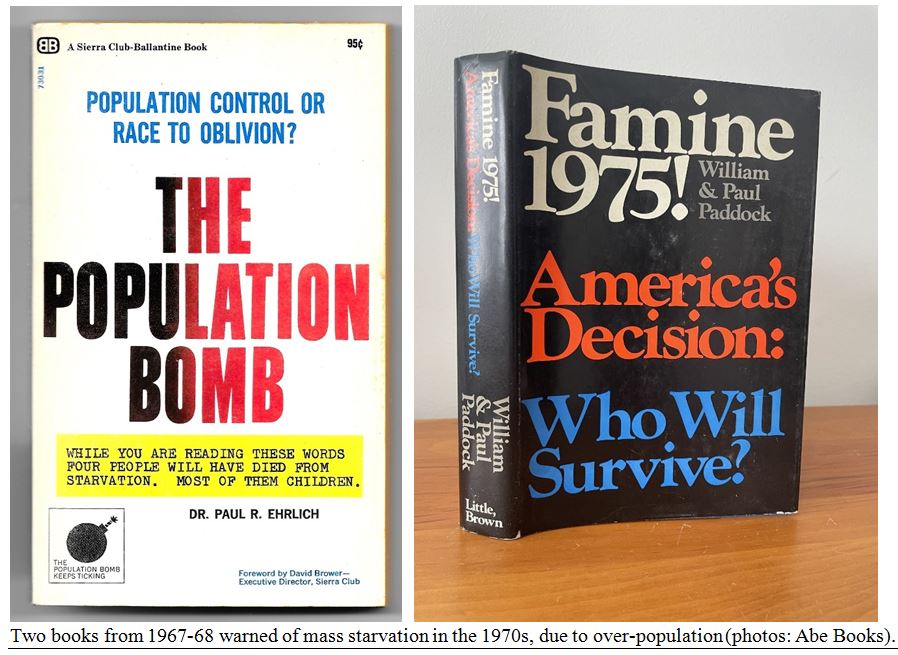
Due to improved agriculture, no mass starvation ensued. Now, many of us are battling obesity instead.
Today, our children in their 50s have wonderful life-affirming careers, giving us six-grandchildren along the way, but our four-grandsons in their late 20s (born 1996 to 1998) express no inclination to mate or reproduce, generally citing “affordability” issues, or crises like global warming, pandemics and the like.
There’s no way for me to convince young people not alive in 1968 to 1972 to know how much worse times were when we were in our mid-20s. Affordability also challenged us, as I took home about $100 a week in 1968, but somehow managed a down payment on our first home in 1972. Perhaps I can appeal to their self-interest – with fewer children, shrinking Social Security funding can’t enrich their retirement.
Demography is destiny. So we need more new families and great innovation, creating better lives for all.
All content above represents the opinion of Gary Alexander of Navellier & Associates, Inc.
Also In This Issue
A Look Ahead by Louis Navellier
Major Moves in the Caribbean Region Keep Oil Flowing
Income Mail by Bryan Perry
The New Year Is Loaded with Lots of Moving Parts
Growth Mail by Gary Alexander
As Birth Rates Shrink, Demography Defines Our Destiny
Global Mail by Ivan Martchev
As the First Week in January Goes, So Goes the Year
Sector Spotlight by Jason Bodner
The New Year Brings a New Hunt for Market Winners
View Full Archive
Read Past Issues Here
About The Author

Gary Alexander
SENIOR EDITOR
Gary Alexander has been Senior Writer at Navellier since 2009. He edits Navellier’s weekly Marketmail and writes a weekly Growth Mail column, in which he uses market history to support the case for growth stocks. For the previous 20-years before joining Navellier, he was Senior Executive Editor at InvestorPlace Media (formerly Phillips Publishing), where he worked with several leading investment analysts, including Louis Navellier (since 1997), helping launch Louis Navellier’s Blue Chip Growth and Global Growth newsletters.
Prior to that, Gary edited Wealth Magazine and Gold Newsletter and wrote various investment research reports for Jefferson Financial in New Orleans in the 1980s. He began his financial newsletter career with KCI Communications in 1980, where he served as consulting editor for Personal Finance newsletter while serving as general manager of KCI’s Alexandria House book division. Before that, he covered the economics beat for news magazines. All content of “Growth Mail” represents the opinion of Gary Alexander
Important Disclosures:
Although information in these reports has been obtained from and is based upon sources that Navellier believes to be reliable, Navellier does not guarantee its accuracy and it may be incomplete or condensed. All opinions and estimates constitute Navellier’s judgment as of the date the report was created and are subject to change without notice. These reports are for informational purposes only and are not a solicitation for the purchase or sale of a security. Any decision to purchase securities mentioned in these reports must take into account existing public information on such securities or any registered prospectus.To the extent permitted by law, neither Navellier & Associates, Inc., nor any of its affiliates, agents, or service providers assumes any liability or responsibility nor owes any duty of care for any consequences of any person acting or refraining to act in reliance on the information contained in this communication or for any decision based on it.
Past performance is no indication of future results. Investment in securities involves significant risk and has the potential for partial or complete loss of funds invested. It should not be assumed that any securities recommendations made by Navellier. in the future will be profitable or equal the performance of securities made in this report. Dividend payments are not guaranteed. The amount of a dividend payment, if any, can vary over time and issuers may reduce dividends paid on securities in the event of a recession or adverse event affecting a specific industry or issuer.
None of the stock information, data, and company information presented herein constitutes a recommendation by Navellier or a solicitation to buy or sell any securities. Any specific securities identified and described do not represent all of the securities purchased, sold, or recommended for advisory clients. The holdings identified do not represent all of the securities purchased, sold, or recommended for advisory clients and the reader should not assume that investments in the securities identified and discussed were or will be profitable.
Information presented is general information that does not take into account your individual circumstances, financial situation, or needs, nor does it present a personalized recommendation to you. Individual stocks presented may not be suitable for every investor. Investment in securities involves significant risk and has the potential for partial or complete loss of funds invested. Investment in fixed income securities has the potential for the investment return and principal value of an investment to fluctuate so that an investor’s holdings, when redeemed, may be worth less than their original cost.
One cannot invest directly in an index. Index is unmanaged and index performance does not reflect deduction of fees, expenses, or taxes. Presentation of Index data does not reflect a belief by Navellier that any stock index constitutes an investment alternative to any Navellier equity strategy or is necessarily comparable to such strategies. Among the most important differences between the Indices and Navellier strategies are that the Navellier equity strategies may (1) incur material management fees, (2) concentrate its investments in relatively few stocks, industries, or sectors, (3) have significantly greater trading activity and related costs, and (4) be significantly more or less volatile than the Indices.
ETF Risk: We may invest in exchange traded funds (“ETFs”) and some of our investment strategies are generally fully invested in ETFs. Like traditional mutual funds, ETFs charge asset-based fees, but they generally do not charge initial sales charges or redemption fees and investors typically pay only customary brokerage fees to buy and sell ETF shares. The fees and costs charged by ETFs held in client accounts will not be deducted from the compensation the client pays Navellier. ETF prices can fluctuate up or down, and a client account could lose money investing in an ETF if the prices of the securities owned by the ETF go down. ETFs are subject to additional risks:
- ETF shares may trade above or below their net asset value;
- An active trading market for an ETF’s shares may not develop or be maintained;
- The value of an ETF may be more volatile than the underlying portfolio of securities the ETF is designed to track;
- The cost of owning shares of the ETF may exceed those a client would incur by directly investing in the underlying securities; and
- Trading of an ETF’s shares may be halted if the listing exchange’s officials deem it appropriate, the shares are delisted from the exchange, or the activation of market-wide “circuit breakers” (which are tied to large decreases in stock prices) halts stock trading generally.
Grader Disclosures: Investment in equity strategies involves substantial risk and has the potential for partial or complete loss of funds invested. The sample portfolio and any accompanying charts are for informational purposes only and are not to be construed as a solicitation to buy or sell any financial instrument and should not be relied upon as the sole factor in an investment making decision. As a matter of normal and important disclosures to you, as a potential investor, please consider the following: The performance presented is not based on any actual securities trading, portfolio, or accounts, and the reported performance of the A, B, C, D, and F portfolios (collectively the “model portfolios”) should be considered mere “paper” or pro forma performance results based on Navellier’s research.
Investors evaluating any of Navellier & Associates, Inc.’s, (or its affiliates’) Investment Products must not use any information presented here, including the performance figures of the model portfolios, in their evaluation of any Navellier Investment Products. Navellier Investment Products include the firm’s mutual funds and managed accounts. The model portfolios, charts, and other information presented do not represent actual funded trades and are not actual funded portfolios. There are material differences between Navellier Investment Products’ portfolios and the model portfolios, research, and performance figures presented here. The model portfolios and the research results (1) may contain stocks or ETFs that are illiquid and difficult to trade; (2) may contain stock or ETF holdings materially different from actual funded Navellier Investment Product portfolios; (3) include the reinvestment of all dividends and other earnings, estimated trading costs, commissions, or management fees; and, (4) may not reflect prices obtained in an actual funded Navellier Investment Product portfolio. For these and other reasons, the reported performances of model portfolios do not reflect the performance results of Navellier’s actually funded and traded Investment Products. In most cases, Navellier’s Investment Products have materially lower performance results than the performances of the model portfolios presented.
This report contains statements that are, or may be considered to be, forward-looking statements. All statements that are not historical facts, including statements about our beliefs or expectations, are “forward-looking statements” within the meaning of The U.S. Private Securities Litigation Reform Act of 1995. These statements may be identified by such forward-looking terminology as “expect,” “estimate,” “plan,” “intend,” “believe,” “anticipate,” “may,” “will,” “should,” “could,” “continue,” “project,” or similar statements or variations of such terms. Our forward-looking statements are based on a series of expectations, assumptions, and projections, are not guarantees of future results or performance, and involve substantial risks and uncertainty as described in Form ADV Part 2A of our filing with the Securities and Exchange Commission (SEC), which is available at www.adviserinfo.sec.gov or by requesting a copy by emailing info@navellier.com. All of our forward-looking statements are as of the date of this report only. We can give no assurance that such expectations or forward-looking statements will prove to be correct. Actual results may differ materially. You are urged to carefully consider all such factors.
FEDERAL TAX ADVICE DISCLAIMER: As required by U.S. Treasury Regulations, you are informed that, to the extent this presentation includes any federal tax advice, the presentation is not written by Navellier to be used, and cannot be used, for the purpose of avoiding federal tax penalties. Navellier does not advise on any income tax requirements or issues. Use of any information presented by Navellier is for general information only and does not represent tax advice either express or implied. You are encouraged to seek professional tax advice for income tax questions and assistance.
IMPORTANT NEWSLETTER DISCLOSURE:The hypothetical performance results for investment newsletters that are authored or edited by Louis Navellier, including Louis Navellier’s Growth Investor, Louis Navellier’s Breakthrough Stocks, Louis Navellier’s Accelerated Profits, and Louis Navellier’s Platinum Club, are not based on any actual securities trading, portfolio, or accounts, and the newsletters’ reported hypothetical performances should be considered mere “paper” or proforma hypothetical performance results and are not actual performance of real world trades. Navellier & Associates, Inc. does not have any relation to or affiliation with the owner of these newsletters. There are material differences between Navellier Investment Products’ portfolios and the InvestorPlace Media, LLC newsletter portfolios authored by Louis Navellier. The InvestorPlace Media, LLC newsletters contain hypothetical performance that do not include transaction costs, advisory fees, or other fees a client might incur if actual investments and trades were being made by an investor. As a result, newsletter performance should not be used to evaluate Navellier Investment services which are separate and different from the newsletters. The owner of the newsletters is InvestorPlace Media, LLC and any questions concerning the newsletters, including any newsletter advertising or hypothetical Newsletter performance claims, (which are calculated solely by Investor Place Media and not Navellier) should be referred to InvestorPlace Media, LLC at (800) 718-8289.
Please note that Navellier & Associates and the Navellier Private Client Group are managed completely independent of the newsletters owned and published by InvestorPlace Media, LLC and written and edited by Louis Navellier, and investment performance of the newsletters should in no way be considered indicative of potential future investment performance for any Navellier & Associates separately managed account portfolio. Potential investors should consult with their financial advisor before investing in any Navellier Investment Product.
Navellier claims compliance with Global Investment Performance Standards (GIPS). To receive a complete list and descriptions of Navellier’s composites and/or a presentation that adheres to the GIPS standards, please contact Navellier or click here. It should not be assumed that any securities recommendations made by Navellier & Associates, Inc. in the future will be profitable or equal the performance of securities made in this report.
FactSet Disclosure: Navellier does not independently calculate the statistical information included in the attached report. The calculation and the information are provided by FactSet, a company not related to Navellier. Although information contained in the report has been obtained from FactSet and is based on sources Navellier believes to be reliable, Navellier does not guarantee its accuracy, and it may be incomplete or condensed. The report and the related FactSet sourced information are provided on an “as is” basis. The user assumes the entire risk of any use made of this information. Investors should consider the report as only a single factor in making their investment decision. The report is for informational purposes only and is not intended as an offer or solicitation for the purchase or sale of a security. FactSet sourced information is the exclusive property of FactSet. Without prior written permission of FactSet, this information may not be reproduced, disseminated or used to create any financial products. All indices are unmanaged and performance of the indices include reinvestment of dividends and interest income, unless otherwise noted, are not illustrative of any particular investment and an investment cannot be made in any index. Past performance is no guarantee of future results.