
by Bryan Perry
March 31, 2026
After what is now a six-week stock market correction, investors must reset their expectations for 2026. What seemed like a strong year of bullish conditions has given way to war-inflicted inflation, Anthropic disruption, TSA disarray, AI-induced job displacement, tariff uncertainty and higher energy prices biting into the much-heralded tax benefits of the One Big Beautiful Bill, in a quagmire of challenging issues.
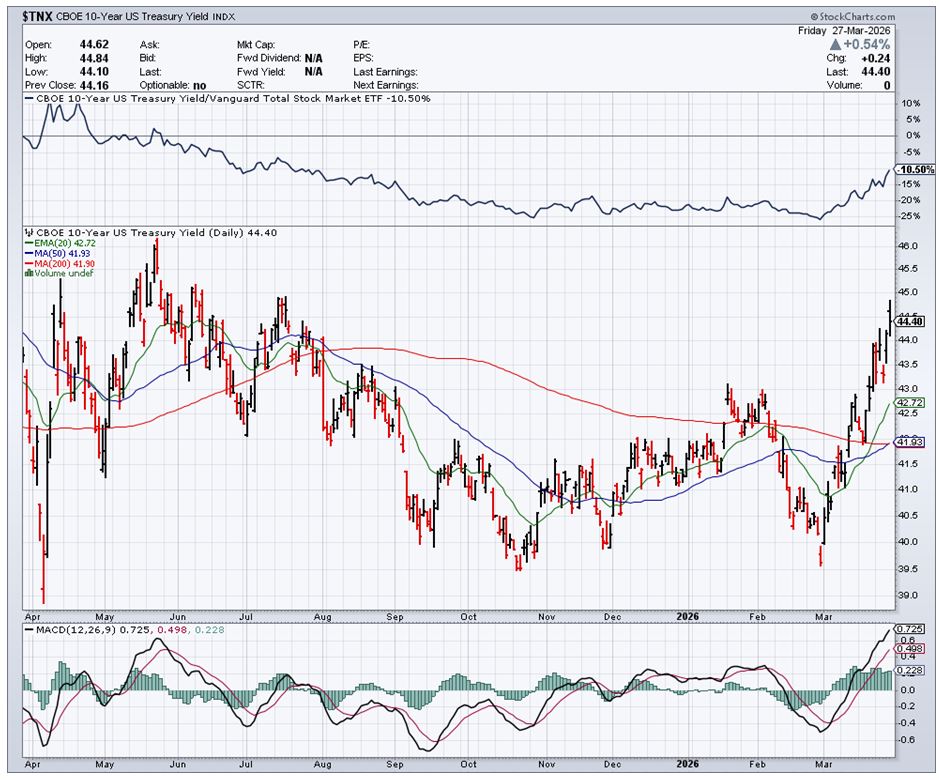
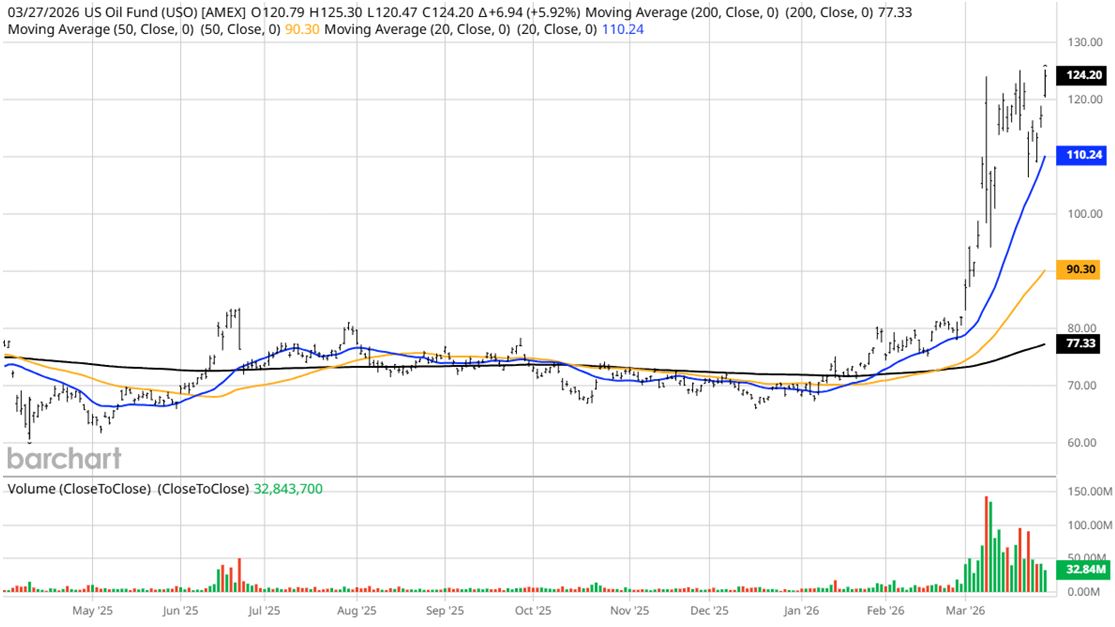
As if this set of headwinds weren’t enough to contend with, a more troubling development is the rise in Treasury yields and the poor performance of the most recent Treasury auctions. In addition, wholesale inflation is sticky and will become even stickier during any prolonged siege of $100 per barrel WTI oil.
Graphs are for illustrative and discussion purposes only. Please read important disclosures at the end of this commentary.
Last week’s poor Treasury auctions have become a major talking point. When investors demand a higher premium to lend their money to the U.S. government, even when the dollar is higher, it waves a caution flag, and this recent string of weak demand is the worst the market has seen in over three years.
The primary reason for last week’s tepid bond demand is a shift in the risk-reward calculation for safe-haven assets: With the new Iranian war entering its second month, investors are increasingly concerned over a long-term energy shock. If oil stays above $100, inflation won’t just be sticky but could accelerate. That’s why few want to lock in a 4.4% yield on a 10-year note if they think inflation might hit 5% again.
Graphs are for illustrative and discussion purposes only. Please read important disclosures at the end of this commentary.
These tepid bond auctions also tell us the market is finally choking on the sheer volume of U.S. debt. With $10-trillion needing to be refinanced this year alone, and the Pentagon seeking massive supplemental funding for this new war, bond vigilantes are starting to push back against the supply.
Earlier this year, the market expected multiple rate cuts. After last week’s auctions, those odds have cratered. The 2-year yield surged roughly 60 basis points in March alone. This isn’t just a technical glitch; it has created real-world consequences rippling through the economy: The market is now sending a clear signal to Washington – the era of cheap debt is over, as long as energy prices and geopolitical risks remain unanchored. And because the 10-year Treasury is the benchmark for home loans, the 30-year fixed mortgage average has jumped back toward 6.6% or even 6.8%, stalling the spring housing market.
Seasoned investors know the stock market looks forward 6 to 9-months, pricing stocks accordingly. High-multiple tech stocks have been victims of a clear rotation out of growth into other sectors. Buying into dips on Mag-7, cybersecurity, enterprise software, and other high P/E darlings has not worked out yet.
The bottom line is this: There is no denying the war in Iran is bigger and more difficult than President Trump and his advisors expected. It is now clear Iran has been planning for this conflict for a long time.
If things are going as well as the President assures us, then why is the Strait of Hormuz still closed? Why haven’t the Houthis, Hezbollah, Hamas, and other “H”-branded proxy forces supported by Iran been smashed? Because the IRGC has an effective guerilla marine warfare strategy. Thousands of small, one-way attack drones (the Shahed-series and newer variants) are launched from mobile trucks in the rugged Zagros Mountains along the coast. (You can’t sink a truck hidden in a cave as easily as a ship at sea).
That is the core of the decapitation paradox currently haunting the Pentagon. While Operation Epic Fury succeeded in its tactical goal of severing the head of the regime, the political vacuum has been filled by the most uncompromising elements of the security state. By eliminating old guard clerics, the U.S. may have removed the only voices in Tehran who viewed survival through the lens of cautious diplomacy.
In their place, a military junta has emerged, led by the Habib Circle, a group of IRGC hardliners who have spent decades preparing for exactly this kind of holy war. Hence, the U.S., Israel, and their allies need to bring in assets to eliminate the IRGC hierarchy and splinter their forces to liberate the country. Anything short of this objective is only going to foment a resurgent fanatical theocracy in the future.
But there is good news: A few pockets of equities are working well in a market suffering from widespread technical damage. For instance, the pace of data center construction and engineering continues to soar. Domestic chemical companies are in major rally mode as their primary feed-stock is U.S.-sourced cheap natural gas. Space stocks are rising on accelerating spending. Same for select healthcare and utilities.
This week will be instrumental in how the momentum in Iran goes for the White House and U.S. forces. Significant progress is required for the market to recover, and no one knows this better than the President.