
by Gary Alexander
December 25, 2025
Christmas morning races toward us on Thursday morning. Last week, I ran down the first six of my 10-recommended new books (published in 2025). In this issue, I’ll continue (and conclude) that list – a bit too late for Christmas shopping, but just in time for New Year’s resolutions, especially for young males who seem adrift, with the final book selection addressing the dilemma facing young males these days.
Books #7 to #9: More History Books with Some Investment Lessons
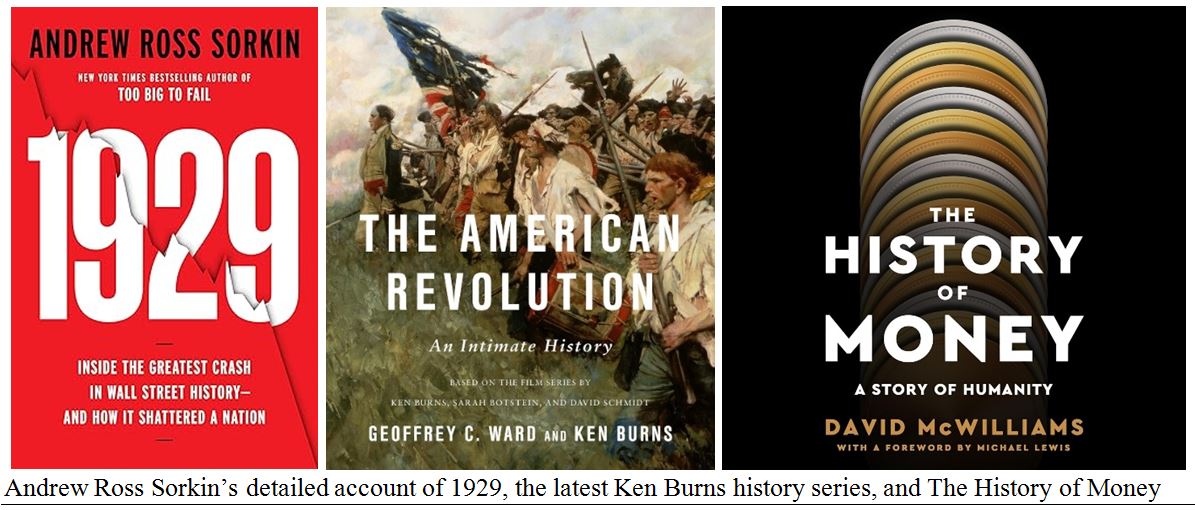
Book #7: “1929: Inside the Greatest Crash in Wall Street History – and How it Shattered a Nation” by Andrew Ross Sorkin (October 14, 492-pages). I already reviewed this in a recent column, along with the unfortunate after-effect of journalists focusing on any “parallels between the 1920s and 2020s,” which are not a part of the book itself. Like Sorkin’s predecessor, “Too Big to Fail” (about the 2008 financial crisis), the author provides a superbly researched blow-by-blow, day-by-day reconstruction of events leading up to, and following, the crisis in question. Despite all the press wrangling since its publication, the 1929 crash clearly did not cause the 1930s Depression, as I recently wrote, since several other major crashes (like 1906, 1920, 1962, 1987 and 2008 itself) did not lead to a lost decade. A series of poor political and financial decisions in 1930 and 1931 caused the “great contraction,” not the 1929 crash itself, but “1929” provides a crucial blueprint for understanding cycles of speculation and the cause of financial upheavals.
Book #8: “The American Revolution: An Intimate History,” by Geoffrey C. Ward and Ken Burns (November 11, 2025, 608-pages) is a generously illustrated coffee table companion to Ken Burns’ latest series on great American historical themes – following Jazz, the Civil War and Baseball, three of my favorite subjects – and timed for our nation’s 250th birthday next year. I’m not enamored with all of his wanderings into revisionist history, but for this 250th birthday party, the big takeaway I see in Geoffrey C. Ward’s book is that the ultimate military victory by colonists in that war was either lucky, miraculous, or fore-ordained, depending on your bias. Colonists had no business winning that war, which pitted our rich landowner generals in constant retreat – but betting “all-in” on victory – when the more predictable defeat would have them all swinging from a rope. That’s my way of saying that I think Burns covers the war well, but there’s too much about the war itself and not enough about why they risked their lives to fight.
Also, the many commentators in the TV series gave me ideas of what Revolutionary Era authors to read next, and I believe I’ll look into Rick Atkinson (“The British Are Coming” and “Fate of the Day”) first.
Book #9: “The History of Money: A Story of Humanity,” by David McWilliams (November 11, 2025, 416-pages) is a humanistic look at filthy lucre. Far from being “the root of all evil,” that famous Biblical curse is better translated as “the love of money is A (not the) root of evil.” McWilliams, a former central bank economist (from Dublin), sports a refreshingly brisk style and (as the sub-title claims) treats money as a humanist salve. His introduction says: “Most economists do not really understand money… They take the fun out of it. A highly emotional substance, money can be transgressive, sexy, dangerous, mind-altering. Money is power, it is domination, but it can also be literation. “Money defines the relationship between worker and employer, buyer and seller, merchant and producer. But not only that: it also defines the bond between the governed and the governor, the state and the citizen. Money unlocks pleasure, puts a price on desire, art and creativity. It motivates us to strive, achieve, invent and take risks. Money also brings out humanity’s darker side, invoking greed, envy, hatred, violence and, of course, colonialism.”
I like most of his coverage of gold in Chapter 16 (“The Yellow Brick Road”), but I wonder why he said FDR ended gold convertibility in 1936 (it was 1933), while barely touching Nixon’s 1971 gold moves.
Book #10 (Dealer’s Choice) – Helping Rootless Young Males Set Realistic Resolutions for 2026
I’ve written often about the job (and life) dilemma facing Generation Z males – boys and men facing long and apparently pointless lives. The percent of working-age males in the Labor Force has been declining drastically this century, despite today’s seven million unfilled job listings. It seems that many Generation-Z (and some Millennial) youth are seemingly without hope – they can’t afford a home on low-wage jobs, they carry killer loads of college debt and (partly as a result of that) they aren’t marrying or procreating, in fear of financial failure or the climate crisis, or other real or manufactured fears. To address that need, here is a Christmas gift idea (or two, or three) for young males in crisis, providing a road map out, and up.
Last Year’s Encore: “The Algebra of Wealth: A Simple Formula for Financial Security, by Scott Galloway (a book from my 2024 list). Last year, I recommended Scott Galloway’s “Algebra of Wealth,” as a great Christmas idea for young people facing financial obstacles (which many of us older folks also faced, at their age) to find a valuable and successful life path toward money and more satisfaction. And now, here are two more solutions for those in that situation – focusing on the challenge to young males.
Book #10: “Notes on Being a Man” by Scott Galloway (November 4, 304-pages) is one of many recent books about Western (U.S. and European) boys and men in crisis. After the excesses of a male-dominated patriarchy, in which males were also deemed more expendable – in wars, or risky jobs – we now face a crisis in young males: Boys are less likely to graduate from high school or college than girls. One in seven men reports having no friends, half live with their parents in their mid-20s, and men account for three of every four suicides and other deaths of despair in America. Sadly, young males are also now the main assassins acting out in violent public killings. (Note: I wrote this before the recent murders of Rob and Michelle Reiner, the Brown killings and more.) Since the pendulum seldom stops in the middle, this seems like payback against patriarchy, accused of “toxic masculinity” instead of getting a helping hand.
In Notes on Being a Man, Galloway promotes a healthier form of masculinity, using his life’s journey to create examples – as he did in his 2024 investment book. He offers some helpful advice, along these lines:
- Get out of the house (or basement), since “action absorbs anxiety.”
- Take risks and be willing to feel like an imposter, at first: Don’t let rejection stop you.
- Be kind, a major secret to success in any relationship.
- Find what you’re good at, then follow your talent (not necessarily your “passions”).
- Acknowledge your blessings—and create opportunities for others.
- Relate to women, marry and be a good dad, and especially be good to the mother of your children.
- Life isn’t about what happens to you, but how you respond to it.
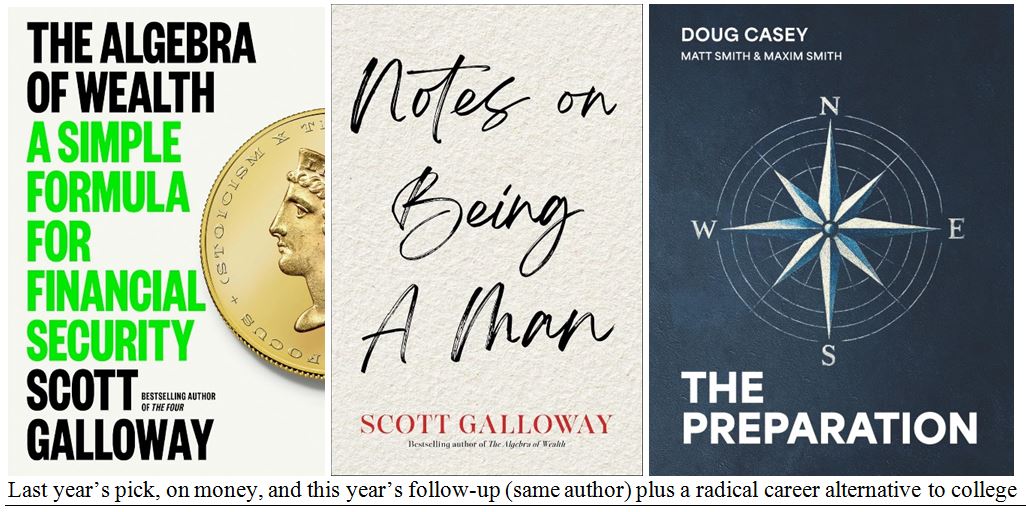
Alternative Book #10: “The Preparation” by Doug Casey, Matt Smith and Maxim Smith (August 18, 2025, 298-pages) is a radical solution for seeking a meaningful life and career without college. Doug Casey uses the real life example of Matt (father) and Maxim (son) Smith to show how and why to skip college, trading in four stagnant years of lecture halls, political correctness, massive debts and a sheepskin of dubious value for a debt-free launching pad into several skills, like becoming an EMT, a pilot, welder, web-application builder, rancher or business owner. This is a practical “field manual for young men” (and the parents who love them) in creating a roadmap that rapidly builds career competence, confidence and real‑world value. I would fault this game plan for its scattershot ambitions – doing too much instead of one thing well – but “The Preparation” favors a Renaissance Man who can build, heal, sell, or lead others.
Some other 2025 (mostly history) books are in a pile to read… I’ll finish them soon. They would include:
- “Why Nothing Works,” by Marc Dunkelman (February 18, 2025, 332-pages).
- “The Fate of the Day” by Rick Atkinson, volume II on the Revolutionary War (April 29, 2025, 863-pages).
- “Our Dollar, Your Problem,” by Kenneth Rogoff (May 6, 2025, 360-pages).
- “History Matters,” by David McCullough (published posthumously, September16, 2025, 192-pages).
- “To Rescue the American Spirit: Teddy Roosevelt and the Birth of a Superpower,” by Bret Baier (October 21, 2025, 416-pages).
That concludes my 10 (or 17) best books for 2025. Let’s hope 2026 delivers more gems between covers.
All content above represents the opinion of Gary Alexander of Navellier & Associates, Inc.
Also In This Issue
A Look Ahead by Louis Navellier
“Bad” Economic News Is Often Seen as Good Market News
Income Mail by Bryan Perry
Gold Has More Room to Rise in 2026
Growth Mail by Gary Alexander
My Top 10 Books from 2025 (Part 2: Conclusion)
Global Mail by Ivan Martchev
There is Still Time to Get to S&P 7,000 in 2025
Sector Spotlight by Jason Bodner
Seeing Beyond Our Stubborn Biases
View Full Archive
Read Past Issues Here
About The Author

Gary Alexander
SENIOR EDITOR
Gary Alexander has been Senior Writer at Navellier since 2009. He edits Navellier’s weekly Marketmail and writes a weekly Growth Mail column, in which he uses market history to support the case for growth stocks. For the previous 20-years before joining Navellier, he was Senior Executive Editor at InvestorPlace Media (formerly Phillips Publishing), where he worked with several leading investment analysts, including Louis Navellier (since 1997), helping launch Louis Navellier’s Blue Chip Growth and Global Growth newsletters.
Prior to that, Gary edited Wealth Magazine and Gold Newsletter and wrote various investment research reports for Jefferson Financial in New Orleans in the 1980s. He began his financial newsletter career with KCI Communications in 1980, where he served as consulting editor for Personal Finance newsletter while serving as general manager of KCI’s Alexandria House book division. Before that, he covered the economics beat for news magazines. All content of “Growth Mail” represents the opinion of Gary Alexander
Important Disclosures:
Although information in these reports has been obtained from and is based upon sources that Navellier believes to be reliable, Navellier does not guarantee its accuracy and it may be incomplete or condensed. All opinions and estimates constitute Navellier’s judgment as of the date the report was created and are subject to change without notice. These reports are for informational purposes only and are not a solicitation for the purchase or sale of a security. Any decision to purchase securities mentioned in these reports must take into account existing public information on such securities or any registered prospectus.To the extent permitted by law, neither Navellier & Associates, Inc., nor any of its affiliates, agents, or service providers assumes any liability or responsibility nor owes any duty of care for any consequences of any person acting or refraining to act in reliance on the information contained in this communication or for any decision based on it.
Past performance is no indication of future results. Investment in securities involves significant risk and has the potential for partial or complete loss of funds invested. It should not be assumed that any securities recommendations made by Navellier. in the future will be profitable or equal the performance of securities made in this report. Dividend payments are not guaranteed. The amount of a dividend payment, if any, can vary over time and issuers may reduce dividends paid on securities in the event of a recession or adverse event affecting a specific industry or issuer.
None of the stock information, data, and company information presented herein constitutes a recommendation by Navellier or a solicitation to buy or sell any securities. Any specific securities identified and described do not represent all of the securities purchased, sold, or recommended for advisory clients. The holdings identified do not represent all of the securities purchased, sold, or recommended for advisory clients and the reader should not assume that investments in the securities identified and discussed were or will be profitable.
Information presented is general information that does not take into account your individual circumstances, financial situation, or needs, nor does it present a personalized recommendation to you. Individual stocks presented may not be suitable for every investor. Investment in securities involves significant risk and has the potential for partial or complete loss of funds invested. Investment in fixed income securities has the potential for the investment return and principal value of an investment to fluctuate so that an investor’s holdings, when redeemed, may be worth less than their original cost.
One cannot invest directly in an index. Index is unmanaged and index performance does not reflect deduction of fees, expenses, or taxes. Presentation of Index data does not reflect a belief by Navellier that any stock index constitutes an investment alternative to any Navellier equity strategy or is necessarily comparable to such strategies. Among the most important differences between the Indices and Navellier strategies are that the Navellier equity strategies may (1) incur material management fees, (2) concentrate its investments in relatively few stocks, industries, or sectors, (3) have significantly greater trading activity and related costs, and (4) be significantly more or less volatile than the Indices.
ETF Risk: We may invest in exchange traded funds (“ETFs”) and some of our investment strategies are generally fully invested in ETFs. Like traditional mutual funds, ETFs charge asset-based fees, but they generally do not charge initial sales charges or redemption fees and investors typically pay only customary brokerage fees to buy and sell ETF shares. The fees and costs charged by ETFs held in client accounts will not be deducted from the compensation the client pays Navellier. ETF prices can fluctuate up or down, and a client account could lose money investing in an ETF if the prices of the securities owned by the ETF go down. ETFs are subject to additional risks:
- ETF shares may trade above or below their net asset value;
- An active trading market for an ETF’s shares may not develop or be maintained;
- The value of an ETF may be more volatile than the underlying portfolio of securities the ETF is designed to track;
- The cost of owning shares of the ETF may exceed those a client would incur by directly investing in the underlying securities; and
- Trading of an ETF’s shares may be halted if the listing exchange’s officials deem it appropriate, the shares are delisted from the exchange, or the activation of market-wide “circuit breakers” (which are tied to large decreases in stock prices) halts stock trading generally.
Grader Disclosures: Investment in equity strategies involves substantial risk and has the potential for partial or complete loss of funds invested. The sample portfolio and any accompanying charts are for informational purposes only and are not to be construed as a solicitation to buy or sell any financial instrument and should not be relied upon as the sole factor in an investment making decision. As a matter of normal and important disclosures to you, as a potential investor, please consider the following: The performance presented is not based on any actual securities trading, portfolio, or accounts, and the reported performance of the A, B, C, D, and F portfolios (collectively the “model portfolios”) should be considered mere “paper” or pro forma performance results based on Navellier’s research.
Investors evaluating any of Navellier & Associates, Inc.’s, (or its affiliates’) Investment Products must not use any information presented here, including the performance figures of the model portfolios, in their evaluation of any Navellier Investment Products. Navellier Investment Products include the firm’s mutual funds and managed accounts. The model portfolios, charts, and other information presented do not represent actual funded trades and are not actual funded portfolios. There are material differences between Navellier Investment Products’ portfolios and the model portfolios, research, and performance figures presented here. The model portfolios and the research results (1) may contain stocks or ETFs that are illiquid and difficult to trade; (2) may contain stock or ETF holdings materially different from actual funded Navellier Investment Product portfolios; (3) include the reinvestment of all dividends and other earnings, estimated trading costs, commissions, or management fees; and, (4) may not reflect prices obtained in an actual funded Navellier Investment Product portfolio. For these and other reasons, the reported performances of model portfolios do not reflect the performance results of Navellier’s actually funded and traded Investment Products. In most cases, Navellier’s Investment Products have materially lower performance results than the performances of the model portfolios presented.
This report contains statements that are, or may be considered to be, forward-looking statements. All statements that are not historical facts, including statements about our beliefs or expectations, are “forward-looking statements” within the meaning of The U.S. Private Securities Litigation Reform Act of 1995. These statements may be identified by such forward-looking terminology as “expect,” “estimate,” “plan,” “intend,” “believe,” “anticipate,” “may,” “will,” “should,” “could,” “continue,” “project,” or similar statements or variations of such terms. Our forward-looking statements are based on a series of expectations, assumptions, and projections, are not guarantees of future results or performance, and involve substantial risks and uncertainty as described in Form ADV Part 2A of our filing with the Securities and Exchange Commission (SEC), which is available at www.adviserinfo.sec.gov or by requesting a copy by emailing info@navellier.com. All of our forward-looking statements are as of the date of this report only. We can give no assurance that such expectations or forward-looking statements will prove to be correct. Actual results may differ materially. You are urged to carefully consider all such factors.
FEDERAL TAX ADVICE DISCLAIMER: As required by U.S. Treasury Regulations, you are informed that, to the extent this presentation includes any federal tax advice, the presentation is not written by Navellier to be used, and cannot be used, for the purpose of avoiding federal tax penalties. Navellier does not advise on any income tax requirements or issues. Use of any information presented by Navellier is for general information only and does not represent tax advice either express or implied. You are encouraged to seek professional tax advice for income tax questions and assistance.
IMPORTANT NEWSLETTER DISCLOSURE:The hypothetical performance results for investment newsletters that are authored or edited by Louis Navellier, including Louis Navellier’s Growth Investor, Louis Navellier’s Breakthrough Stocks, Louis Navellier’s Accelerated Profits, and Louis Navellier’s Platinum Club, are not based on any actual securities trading, portfolio, or accounts, and the newsletters’ reported hypothetical performances should be considered mere “paper” or proforma hypothetical performance results and are not actual performance of real world trades. Navellier & Associates, Inc. does not have any relation to or affiliation with the owner of these newsletters. There are material differences between Navellier Investment Products’ portfolios and the InvestorPlace Media, LLC newsletter portfolios authored by Louis Navellier. The InvestorPlace Media, LLC newsletters contain hypothetical performance that do not include transaction costs, advisory fees, or other fees a client might incur if actual investments and trades were being made by an investor. As a result, newsletter performance should not be used to evaluate Navellier Investment services which are separate and different from the newsletters. The owner of the newsletters is InvestorPlace Media, LLC and any questions concerning the newsletters, including any newsletter advertising or hypothetical Newsletter performance claims, (which are calculated solely by Investor Place Media and not Navellier) should be referred to InvestorPlace Media, LLC at (800) 718-8289.
Please note that Navellier & Associates and the Navellier Private Client Group are managed completely independent of the newsletters owned and published by InvestorPlace Media, LLC and written and edited by Louis Navellier, and investment performance of the newsletters should in no way be considered indicative of potential future investment performance for any Navellier & Associates separately managed account portfolio. Potential investors should consult with their financial advisor before investing in any Navellier Investment Product.
Navellier claims compliance with Global Investment Performance Standards (GIPS). To receive a complete list and descriptions of Navellier’s composites and/or a presentation that adheres to the GIPS standards, please contact Navellier or click here. It should not be assumed that any securities recommendations made by Navellier & Associates, Inc. in the future will be profitable or equal the performance of securities made in this report.
FactSet Disclosure: Navellier does not independently calculate the statistical information included in the attached report. The calculation and the information are provided by FactSet, a company not related to Navellier. Although information contained in the report has been obtained from FactSet and is based on sources Navellier believes to be reliable, Navellier does not guarantee its accuracy, and it may be incomplete or condensed. The report and the related FactSet sourced information are provided on an “as is” basis. The user assumes the entire risk of any use made of this information. Investors should consider the report as only a single factor in making their investment decision. The report is for informational purposes only and is not intended as an offer or solicitation for the purchase or sale of a security. FactSet sourced information is the exclusive property of FactSet. Without prior written permission of FactSet, this information may not be reproduced, disseminated or used to create any financial products. All indices are unmanaged and performance of the indices include reinvestment of dividends and interest income, unless otherwise noted, are not illustrative of any particular investment and an investment cannot be made in any index. Past performance is no guarantee of future results.