
Gold Retreats from Record Highs for the Second Time in 2026
Will the Gold Rush Resume or Has the Bubble Popped?
A healthy correction? Or the bubble popping?
Those are the two big questions weighing on every gold investor’s mind right now.
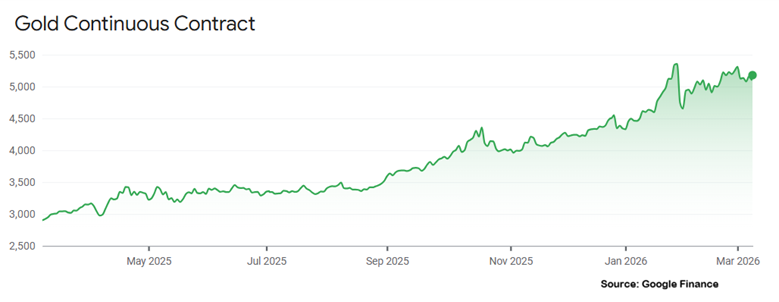
As you may know, gold prices soared 64% higher in 2025, and many financial institutions were predicting that gold would rise to between $4,900 per ounce and $5,000 per ounce by late 2026.
But gold broke through these levels in January!
The Atlanta Fed currently expects 5.1% annual GDP growth in the fourth quarter, as estimates nearly doubled recently. Based on January 5 estimates, the Atlanta Fed expected the fourth-quarter 2025 GDP growth of only 2.7%. But the January 9 estimate showed the expectation for 5.1%.
Clearly, this is my “I told you so” moment!
Not only did my prediction for 4% GDP growth in 2025 come to fruition, but it looks like my projection for the U.S. economy to grow at a 5% annual pace is already happening.
The reality is there are several factors currently in play that should help the U.S. economy continue to accelerate in the upcoming months.
Reason #1: Favorable Trade Data
Gold prices hit new record highs of $5,586 per ounce on January 29. But prices didn’t stay at that level long, plunging 17% to $4,622 per ounce in two days. So, there were a lot of folks claiming that the bubble had finally popped. Sure, gold prices had soared to dizzying heights in only weeks in January—and they were definitely due for a correction.
But we had a similar correction back in late October.
Gary Alexander, a Senior Writer at Navellier & Associates, pointed out: “From October 20 to October 30, gold fell 10%, from $4,360 to $3,920 but it quickly recovered to $4,200. As usual, silver declines and recovered by greater percentage swings, falling from $53 to $46 in October (and from $78 to $70 after Christmas), then shooting up over $120 in January. In these recent cases, gold and silver investors clearly bought more on dips, and they should continue doing the same this time, too.”
Source: Navellier Market Mail 2/3/26
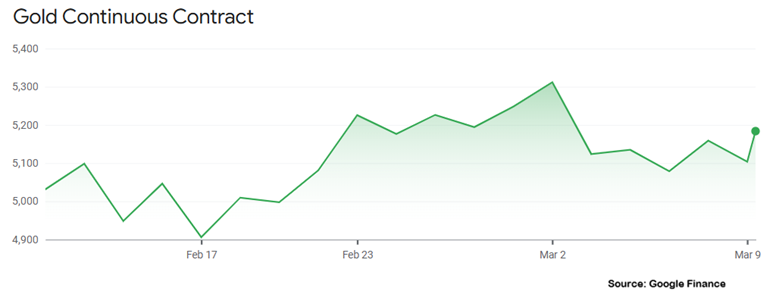
And that’s exactly what played out again. Gold prices rebounded from the $4,622 per ounce low on February 2 to about $5,311 per ounce on March 2.
Now, the escalating tensions in the Middle East threw a bit of a wrench in gold’s climb to new record highs. One would have thought that gold’s safe haven status would have driven more folks to its door, but the strengthening U.S. dollar and a bout of profit taking took the legs out of gold’s recent run back to all-time highs.
In fact, gold prices fell more than 4% in three days, falling from $5,311 per ounce on March 2 to about $5,078 per ounce on March 5.
Gold prices have slowly started to recover from the latest drop, and it’s been with its own fits and starts. So, again, there are some folks claiming the bubble has finally popped. But, in my opinion, nothing could be further from the truth.
Just like the corrections in October and January, the recent pullback will likely be the “pause that refreshes.” If so, we could be facing a screaming buying opportunity in gold right now.
Three Reasons Why Gold Prices Could Be Headed Back to Record Highs
There is a perfect storm of structural demand and macroeconomic shifts that have historically added to gold’s strength and could provide a tailwind in the upcoming months (and even years).
Reason #1: Persistent Global Central Bank Buying
One of the primary reasons why I think gold prices will continue to climb is that global central banks are buying gold hand over first.
The World Gold Council estimates that central banks purchased 328 tonnes of gold in 2025, or about 27 tonnes per month. That’s down slightly from the record 345 tonnes purchased by global central banks in 2024. The biggest net buyer of gold last year was Poland, with 102 tonnes.
Source: Kitco 02/04/26
Please note: Tonnes are a metric measure equaling 2,205 pounds.
One of the biggest boosts to U.S. GDP growth is the shrinking trade deficit.
First, the Commerce Department revealed that the U.S. trade deficit plunged 11% in September to $52.8 billion, well below estimates of $63.1 billion. U.S. exports increased 3% to $289.3 billion, which represented the second-highest level on record. Imports rose 0.6% to $342.1 billion.
So, in September, the U.S. trade deficit was at its lowest level in five years!
I thought that was pretty impressive, but then the October trade deficit data was released in early January—and the numbers were even better.
In fact, the U.S. trade deficit is now at its lowest level in 16 years!
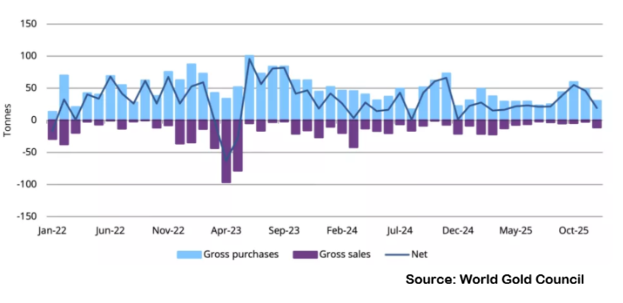
According to Bryan Perry, a Senior Director with Navellier Private Client Group, “Emerging market central banks (notably China, India, Turkey and the BRICS nations) are aggressively diversifying away from the U.S. dollar. Central banks have become steady, high-volume accumulators with central banks’ demand to stay elevated at roughly 775 tonnes in 2026.”
Gold is a legitimate reserve currency for central banks. So, ongoing central bank purchases should continue to propel gold prices higher this year.
Reason #2: Economic, Geopolitical, and Diplomatic Chaos
There’s been a lot of upheaval around the world.
From the ongoing trade tensions and tariff threats to the tensions between the U.S. and Venezuela, from the Israel-Hamas War to the Ukraine-Russia conflict… there’s a lot of instability in the world and that creates a lot of anxiety.
The latest point of contention is the U.S.’s and Israel’s coordinated strikes on Iran’s nuclear facilities, missiles and leadership. The U.S. and Israel’s attacks, Iran’s retaliation and the closure of the Strait of Hormuz have set the world on edge and created a lot of uncertainty—all of which drove the stock market lower and oil prices higher.
Whether the conflict will be “fast and furious” as President Trump initially intended, or a prolonged conflict, will determine the lasting impact on the stock market, oil prices, and gold prices.
But the fact remains gold is a safe haven.
So, even though, gold prices pulled back initially as the U.S. dollar strengthened in the wake of the Iran conflict, gold prices should resume their climb amidst the diplomatic, economic and geopolitical chaos around the world.
Reason #3: Key Interest Rate Cuts
Even with the uptick in oil prices recently, deflation is a very real risk to the global economy.
Consider this: When a population shrinks, then households decline, housing prices soften, and consumption weakens. This is happening throughout Asia and Northern Europe. The only countries growing are the U.S. and India due to higher birthrates, as well as immigration in the U.S.
Shrinking households due to aging demographics and a failure to assimilate immigrants could cause the deflationary spiral that’s enveloped China and Japan to spread around the world. Deflation in China has been particularly concerning, as wholesale and consumer prices declined rapidly in recent years.
Source: Wall Street Journal 1/27/26
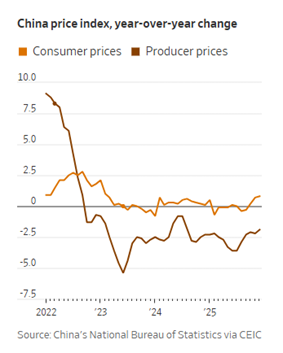
More concerning is the fact that deflation is starting to be imported from China. Chinese manufacturers exported even more goods in 2025, flooding foreign markets with cheap Chinese products.
Now, all central bankers fight deflation—and the best way to fight it is with key interest rate cuts.
The Federal Reserve is currently expected to cut key interest rates at least two times in 2026, though I’d personally like to see three rate cuts this year. And with Kevin Warsh taking the helm of the Fed in a few months, multiple key interest rate cuts seem more likely than ever.
With more rate cuts, it’s important to note that lower interest rates can weaken the U.S. dollar. One of the best ways to benefit from the U.S. dollar debasement is gold. The fact is a softer greenback drives more folks into safe havens like gold.
So, when you add it all up, it’s not too surprising that Yardeni Research predicts that gold prices will reach $6,000 per ounce this year—and hit $10,000 per ounce by the end of the decade.
There Is No Alternative
Despite the three aforementioned reasons for higher prices, gold’s unprecedented surge over the past two years still has some folks convinced that gold prices have topped out. So, they’re seeking other safe havens or options other than gold.
But, in my opinion, there is no alternative. All of the potential alternatives to gold are lacking—and that’s another reason why gold prices are heading to $10,000 per ounce by 2030.
Just consider the six potential alternatives…
Alternative #1 – Cryptocurrencies: Due to a poor performance in 2025 and accelerating losses in 2026, more and more cryptocurrency investors will be looking for alternatives due to its superior performance. Also, many crypto ETFs have had hideous bid/ask spread problems. iShares Ethereum Trust (ETHA), for example, has lost 38.45% since inception in less than two years. So, wide bid/ask spreads on cryptocurrency ETFs are undermining the credibility of cryptocurrencies.
Alternative #2 – Chinese Yuan: Deflation has enveloped China since May 2022, with wholesale and consumer prices declining rapidly in the past four years. Chinese interest rates are also now below Japan. Due to shrinking households from the “one baby” policy enacted decades ago, China’s domestic economy is in a terminal decline that cannot be reversed. The only way China can possibly stop its deflationary spiral is to devalue the yuan, which it did before it joined the World Trade Organization.
Alternative #3 – Japanese Yen: Now, Japan has the highest birth rate in Asia, but it is not high enough to offset an acute population decline. Japan is also not very open to immigration. So, Japan is also losing households, and its economy is shrinking, which is making paying off its government debt next to impossible.
I should add that the new Prime Minister of Japan is spending more money, and that is hindering the Bank of Japan (BOJ). So, the BOJ is expected to increasingly print money via quantitative easing to make ends meet. The net result will continue to be ultralow interest rates and a depreciating Japanese yen.
Alternative #4 – British Pound: In the U.K.: 1) approximately half of its residents have to be subsidized to pay their electric bills; 2) its quest to be NetZero by 2050 has caused a manufacturing exodus; and 3) wealthy Brits have moved to Guernsey, Jersey and other offshore centers.
So, when you add it all up, there is a government budget shortfall, and middle-class Brits need to pay higher taxes that they can’t afford. The Bank of England also has no choice but to cut key interest rates and enact quantitative easing, all of which undermines the value of the British pound.
Alternative #5 – The Euro: The European Union (EU) has been growing and now has 27 member countries. But the U.K. left the EU, and more countries are expected to leave in 2027. The reason for the EU exodus is the upcoming elections in 2027. More anti-EU parties are expected to be elected to leadership.
What has transpired is that Brussels has become a bureaucratic octopus that is systematically destroying many industries, like the farming and auto sectors. I should also add that Brussels is no longer just a monetary and trade union. Instead, the EU leadership in Brussels has evolved to become a shrewd political operator that meddled in elections in Romania, France, Germany, Italy, and Poland, as well as other countries.
Long-term, I expect that the euro will erode in value due to poor GDP growth and endless infighting. Many countries are also dealing with debt problems and shrinking populations, like France—and that will also continue to hurt the value of the euro.
Alternative #6 – U.S. Dollar: The U.S. is demographically superior to other counties simply because it is younger, has a higher birthrate and better assimilates immigrants. Now, the U.S. has substantial government debt per capita (approximately $109,000), but we also have substantial assets, such as natural gas, crude oil, gold and other commodities. There is also plenty of valuable land owned by the federal government that is excellent collateral.
So, the U.S. economy continues to expand and should hit a 5% annual pace this year—and potentially a 6% annual rate. The fact is our 50 states naturally compete with each other, which in turn creates a perpetual economic machine. As a result, the U.S. dollar should get its mojo back.
The bottom line: When you consider the lack of alternatives, it’s clear that investors two primary safe havens right now are gold and the U.S. dollar. But since interest rates in the U.S. are expected to decline over the next few years, then gold is forecast to remain a popular investment.
As a result, I agree with Yardeni and think gold prices could hit $10,000 per ounce by 2030.
The Pause that Refreshes
When you consider everything that we’ve discussed today, it’s easy to see why I anticipate gold prices will continue to hit new record high after new record high in 2026. And also, why I’ve advised folks to take advantage of the recent pullback in gold prices to add to their positions in gold-related stocks.
The fact is the early March drop will merely be the “pause that refreshes.” Gold prices have already started to meander higher—and as geopolitical tensions escalate around the world, gold should resume its safe haven status.
If you’re not sure which gold stocks to start buying, you’re not alone. Not all gold stocks are created equally. But let me tell you what I’m doing to uncovering the positions likely to receive maximum benefit from gold’s next move higher: I’m focusing on fundamentals.
The reason why is simple: Earnings are set to accelerate in every quarter of 2026.
The folks at FactSet recently revealed that the S&P 500 is expected to achieve 11.5% average annual earnings growth in the first quarter. While that’s impressive, the first quarter will represent the slowest earnings growth of the year.
According to FactSet, the S&P 500 is projected to achieve 15.5%, 16.5% and 15.6% average annual earnings growth in the second, third and fourth quarters, respectively. For calendar year 2026, analysts anticipate 15% average annual earnings growth.
Source: Factset 03/06/26
So, gold stocks with accelerating earnings momentum are at the intersection of two important trends that are positioned to lead the market higher this year.
Personally, I’ve been obsessed with fundamentally superior stocks since the start of my career.
My fascination with growth stocks started back in the late 1970s during my college years at Cal State Hayward. I wanted to uncover how to beat the market without taking on too much risk—and what I discovered was that a select group of stocks can consistently outperform the S&P 500: stocks with superior fundamentals.
In other words, stocks with strong sales and earnings growth, as well as positive analyst revisions.
Today, I’m a self-proclaimed “number guys” because the numbers do not lie—and right now, the numbers are telling me that stocks with accelerating earnings and sales momentum are the best way to prosper in 2026.
How to Start Building Your Portfolio Today
Navellier & Associates is a money management firm with a primary goal to help individuals like you develop a customized investment strategy.
Our team of professionals work closely with you to answer questions about your retirement goals, how long you have to reach these goals and what your risk tolerance is—to name a new!—and then we discuss a customized solution tailored specifically for you and your goals.
A no-obligation portfolio review is the first step to creating your custom investment solution.
The fact is everyone is different—and a portfolio review helps us better understand your specific financial needs and goals now and in the future. And in order to reach these goals, we cannot stress enough the importance of a well-balanced portfolio.
A well-balanced portfolio can literally neutralize the stock market’s uncertainty and take advantage of unique growth opportunities the market throws our way.
That’s why at Navellier & Associates, we encourage our clients to take a diversified approach to managing their investments—one that can include growth, income, and capital preservation strategies.
Growth Portfolios
These portfolios feature companies that are committed to growing their sales and earnings. Our growth portfolios are segmented by market capitalization, are actively managed, and seek inefficiently priced growth stocks with opportunities for long-term price appreciation. We screen for small- and large-cap companies that are consistently growing sales and earnings. Our team actively manages this portfolio to find undervalued growth stocks.
Income Portfolios
These offerings provide dividend growth and income opportunities with capital appreciation. At Navellier, our dividend and income portfolios strive for portfolio growth through securities with capital appreciation, strong dividend growth and income opportunities. We seek out companies that have a history of growing and paying dividends. Most importantly, these dividend-paying companies have free cash flow to cover each dividend payment. This can make it much easier to have reliable income in retirement.
Capital Preservation/Defensive Portfolios
These portfolios aim to outperform in up markets and limit losses in declining markets by moving to cash or bonds. This asset allocation plan allows investors to play defense in a declining market. Our capital preservation strategies can help you mitigate steep market losses with defensive ETFs and covered calls. Defensive ETFs can serve this need as they shift to cash or bonds when conditions permit.
Simply put, the power of a well-balanced portfolio cannot be overstated.
So, in your no-obligation portfolio review, we’ll dive deeper into the details of our exclusive portfolios and strategies. What you’ll discover is that many of them cross boundaries and can be combined to form an overall portfolio strategy. That portfolio can then be customized to your personal financial goals and risk tolerance.
But to help you better understand how we build a portfolio tailored to your specific needs, here’s a sneak peak at how we select stocks for each of our custom portfolio offerings…
Our Proprietary 3-Step Stock Selection Process
At Navellier & Associates, our system was built to find inefficiency in the market, uncover what we think are the market’s best growth stocks, and utilize a disciplined quantitative and fundamental analysis system to create a customized portfolio for individual investors.
Consider an example of the three-step proprietary stock-selection process that we utilize for most portfolios:
- Quantitative Analysis: Using our proprietary screening process, we measure reward (alpha) and risk (standard deviation) indicators to the appropriate market capitalization range for each portfolio. We rank stocks based on the reward/risk measure and reduce the initial investment universe to a select bucket of stocks that fall into the upper percentiles of the reward/risk measure.
- Fundamental Analysis: We then apply fundamental variable screens to the stocks with the highest reward/risk measures. This shines the spotlight on which companies have exceptional profit margins, excellent earnings growth (and positive earnings surprise potential!) and reasonable price/earnings ratios (based on expected future earnings).
- Securities Optimization: We use a proprietary optimization model to maximize alpha, while minimizing portfolio standard deviation. This can efficiently allocate the stocks and create portfolios that are well diversified across sectors and industries.
Primarily, our goal with the three-step stock selection process is to develop portfolios that have a low correlation to their benchmarks, increasing diversification, decreasing risk and maximizing profits for investors like you.
So, no matter what’s happening in the market—whether we’re in a raging bull market or a gut-wrenching bear market—all of us at Navellier & Associates believe in the importance of a custom investment strategy that focuses on your financial goals and risk tolerance, as well as diversification.
And we can help you build your own customized portfolio strategy.
Navellier & Associates relies on extensive research, trend analysis, customized strategies, and historic market knowledge to manage client-only portfolios and to help clients take advantage of opportunities that are presented by market corrections—short and long-term—as well as bull market situations.
Our proprietary models are built to work on U.S.-based portfolios with a minimum account value of $250,000. If your portfolio meets these criteria, please contact my Navellier & Associates team. They are standing by, ready to discuss your personal portfolio and investment strategy to help you make the most of 2026—and beyond!
Schedule Your Portfolio Review Today
Are you ready to prosper in 2026?
Then, now is the perfect time to contact Navellier & Associates to set up a no-obligation portfolio review.
A portfolio review gives us an opportunity to learn more about you. We want to know about your long- and short-term goals, your current and future income/expenses and your overall financial outlook, so that we can make the right suggestions for your personal situation.
And don’t worry… there is never a charge for this portfolio review.
If you decide you would like Navellier & Associates to manage your portfolio—or one aspect of your portfolio—we will discuss any management fees for that service.
If you decide you’d like to continue to manage things yourself, we hope that we have given you some important information to consider during your portfolio review.
We are not here to simply preach to you but rather to share information that we have gained from our extensive market research and analysis.
Click here now to schedule your no-obligation portfolio review.
I’m confident that Navellier & Associates can help guide you to build a portfolio to navigate the current environment and tailor your strategy to your individual risk tolerance.
All the best to you and yours,
Louis Navellier
Chief Investment Officer
Navellier & Associates, Inc. │ Private Client Group
Get Started
Sign me up for a portfolio review. I look forward to a conversation about my holdings, risk tolerance, and investment goals.
At Navellier & Associates, we help serious investors like you:
- Identify hidden risks in your portfolio
- Position for growth even in volatile markets
- Build a strategy that balances protection and opportunity
We have a limited number of spots for these sought-after portfolio reviews. We expect they could all be spoken for in the coming 48 hours.
This opportunity is for qualified investors with $250,000+ in investable assets. You must live and invest in the United States. And you must be able to share your holdings for a full risk assessment.
Act Now—Spots Are Limited!
For fastest service, call 1-800-887-8671.
Or, fill out our consultation form below.
About Louis Navellier
 My name is Louis Navellier and I’m most widely known as an investment adviser and market analyst. Since 1980, I’ve been publishing my quantitative analysis on growth stocks and I’ve made it my life’s work to continuously refine and develop my analysis for investors like you.
My research and analysis have led to regular appearances on CNBC and Fox Business News and I am frequently quoted by MarketWatch and Bloomberg.
I also manage money for private and institutional clients through my money management company, Navellier & Associates, Inc.
Wealthy individuals and institutional investors want access to my 30+ years of quantitative research experience.
Our work with these professionals requires tight controls on investment risk and an exhaustive due diligence process.
The overall goal for our clients focuses on how to achieve steady, long-term returns in up and down markets.
At Navellier & Associates, our proprietary quantitative models are designed to balance stocks, mutual funds, and income-producing investments to maximize returns while controlling risk.
And today, I’m thrilled to give you the opportunity to put this same rigorous screening criteria and quantitative and fundamental analysis to work for your portfolio. For U.S.-based portfolios from $250,000 to $100+ million — my firm is here to help.
Important Disclosures
Investment in stocks involves substantial risk and has the potential for partial or complete loss of funds invested. The accompanying charts are for informational purposes only and are not to be construed as an offer to buy or sell any financial instrument or investment strategy and should not be relied upon in an investment making decision. This is not an offer of investment advice and is not an investment strategy. It is simply a disclosure of the results of Navellier’s proprietary analysis. The performance presented is not based on any actual securities trading, portfolio, or accounts, and the reported hypothetical performance of the A, B, C, D, and F stock groups graded should not be considered investment advice or an investment strategy.
The charts and other information presented here do not represent actual funded trades and are not actual funded portfolios. There are material differences between hypothetical and the research, and hypothetical performance figures presented here. The research results (1) may contain stocks that are illiquid and difficult to trade; (2) may contain stock holdings materially different from actual funded investments; (3) include the reinvestment of all dividends and other earnings, estimated trading costs, commissions, or management fees; and, (4) may not reflect prices obtained in an actual funded investment. For these and other reasons, the reported performances do not reflect the performance results of actually funded and traded Investment Products.
As a matter of important disclosure regarding the hypothetical results presented for Stock Grader and Dividend Grader, the following factors must be considered when evaluating the long- and short-term performance figures presented:
(1) Historical or illustrated results presented herein do not indicate future performance; Investment in securities involves significant risk and has the potential for partial or complete loss of funds invested.
(2) The results presented were generated during a period of mixed (improving and deteriorating) economic conditions in the U.S. and positive and negative market performance. There can be no assurance that these same market conditions will occur again in the future. Navellier has no data regarding actual performance in different economic or market cycles or conditions.
(3) The back-tested historical look back performance was derived from the hypothetical application of a particular Navellier analysis applying investment criteria with the benefit of hindsight.
(4) The hypothetical results portrayed reflect the hypothetical reinvestment of dividends and other income.
(5) The hypothetical net performance results portrayed include the hypothetical reinvestment of all dividends and other earnings. Hypothetical net results also include our estimation of investment advisory fees, administrative fees, transaction expenses, or other expenses that an investor might have paid. A 1.75% annualized advisory fee is built into the net return calculations although that fee is higher than actual advisory fees investors normally pay for investment advisory services.
(6) LIMITATIONS INHERENT IN HYPOTHETICAL RESULTS: The hypothetical performance results presented are not from actually funded investments, and may not reflect the impact that material economic and market factors might have had on adviser’s or investors decision making if an adviser were actually managing a clients’ money, and thus present returns which are greater than what an actual investor would have experienced for the time period. The results are presented for informational purposes only. No real money has been invested in this analysis of hypothetical performance. The hypothetical performance results should not be considered and are not actual performance.
Copyright © 2026 Navellier. All rights reserved.
Terms of Use | Privacy Policy | Voting Proxy Policy
1 East Liberty, Suite 504 Reno, Nevada 89501 | (800)-887-8671