
5 Reasons for 5% GDP Growth in 2026
Did you catch my interview with Maria Bartiromo on Fox Business?
My prediction that the U.S. will achieve 5% GDP growth in 2026 raised some eyebrows. And while my outlook has been deemed “outlandish” by some, a Fox News clip is now circulating on YouTube.
Personally, I refuse to be deterred by the Negative Nellies. Rather, I have actually felt pretty vindicated about my 5% GDP outlook based on recent economic data.
The Commerce Department revised its third-quarter 2025 GDP estimate to a 4.3% annual pace. That not only represents the strongest rate of GDP growth in two years, but it is also substantially higher than economists’ expectations for 3% annual GDP growth. I should add that it’s also up from the 3.8% annual pace recorded in the second quarter of 2025.
For the fourth quarter of 2025, estimates are even higher.
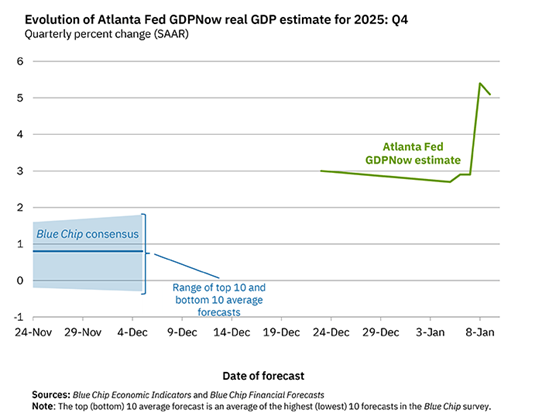
The Atlanta Fed currently expects 5.1% annual GDP growth in the fourth quarter, as estimates nearly doubled recently. Based on January 5 estimates, the Atlanta Fed expected the fourth-quarter 2025 GDP growth of only 2.7%. But the January 9 estimate showed the expectation for 5.1%.
Clearly, this is my “I told you so” moment!
Not only did my prediction for 4% GDP growth in 2025 come to fruition, but it looks like my projection for the U.S. economy to grow at a 5% annual pace is already happening.
The reality is there are several factors currently in play that should help the U.S. economy continue to accelerate in the upcoming months.
Reason #1: Favorable Trade Data
One of the biggest boosts to U.S. GDP growth is the shrinking trade deficit.
First, the Commerce Department revealed that the U.S. trade deficit plunged 11% in September to $52.8 billion, well below estimates of $63.1 billion. U.S. exports increased 3% to $289.3 billion, which represented the second-highest level on record. Imports rose 0.6% to $342.1 billion.
So, in September, the U.S. trade deficit was at its lowest level in five years!
I thought that was pretty impressive, but then the October trade deficit data was released in early January—and the numbers were even better.
In fact, the U.S. trade deficit is now at its lowest level in 16 years!
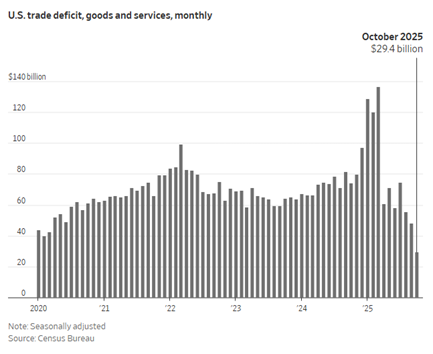
The Commerce Department reported that the trade deficit declined by 39%, coming in at $29.4 billion in October. Economists expected a trade deficit of $58.9 billion. Imports dropped 3.2% in October to $331.4 billion, while exports grew 2.6% to a record $302.0 billion.
The trade deficit is now at its lowest level since June 2009.
Reason #2: Lower Interest Rates
Federal Reserve Chairman Jerome Powell is out—or at least he will be when his term is up in May—and the next Fed Chairman is expected to toe the line with President Trump’s demands for rate cuts.
As you may know, the Fed cut key interest rates three times in 2025. But at its December Federal Open Market Committee (FOMC) meeting, it only signaled one rate cut of 0.25% in 2026.
Interestingly, the latest “dot plot” showed very differing opinions on the central bank’s way forward. Four members expect one 0.25% rate cut, four anticipate two 0.25% cuts, and four think that rates should remain between 3.5% and 3.75% in 2026.
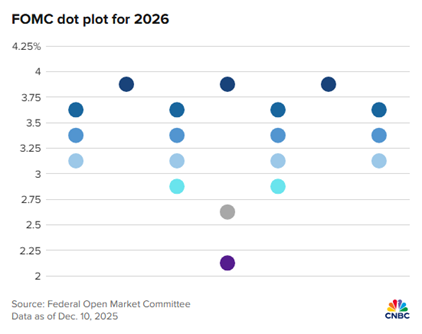
So, the “dot plot” showed only one rate cut in 2026, with the median estimate of 3.4%. However, the Fed funds futures market expects two key interest rate cuts in 2026.
The fact is deflation is a very real problem, and it’s spreading from China to other corners of the world. All central bankers are taught to fight deflation. So, any deflation news will likely to cause the Fed to slash key interest rates a lot more in the upcoming months.
I should also add that the Fed still has a dual mandate of tame inflation and maximum employment.
The latest inflation data revealed that inflation has moderated—and it should no longer be a big concern for the Fed. The Consumer Price Index (CPI) rose 0.3% in December and was up 2.7% in the past 12 months. Core CPI, which excludes food and energy, increased 0.2% in December and was up 2.6% in the past 12 months. Economists anticipated a 2.8% annual pace.
So, inflation is now running at its slowest pace since March 2021.
The jobs market, though, continues to struggle. The unemployment rate rose to 4.6% in November, compared to 4.4% in September. That was slightly higher than estimates of 4.5%.
Personally, I think the Fed needs to cut key interest rates at least two more times in 2026 and move to a “neutral” rate.
Reason #3: Companies Move Operations Back to U.S.
International companies are now being forced to onshore their operations to the U.S. in order to avoid the Trump 2.0 tariffs. And the automotive, aerospace and pharmaceutical industries are leading the charge back to American soil.
Speaking of the pharmaceutical industry, companies like Eli Lilly & Company (LLY), Novartis AG (NVS), AstraZeneca (AZN), Gilead Sciences (GILD), Sanofi (SNY), and Bristol-Myers Squibb (BMY) have all committed to boosting their manufacturing facilities in the U.S.
From major drugmakers alone, more than $370.0 billion has been earmarked for investments in the U.S. over the next five years. Novartis has earmarked $23.0 billion to boosting its U.S. infrastructure, setting a goal for its new manufacturing facilities in North Carolina to be operational by 2027-2028.
In the automotive industry, General Motors (GM) has committed to expanding its U.S. manufacturing to help offset tariffs. It has a $4.0 billion onshoring and manufacturing expansion plan in place. Toyota (TM) has also dedicated $10.0 billion to its U.S. operations over the next five years, which brings its total investment in the U.S. to nearly $60.0 billion.
So, onshoring is expected to be a boon to the U.S. economy, as it will boost U.S. manufacturing and production, create new jobs and lead to further investment in U.S. infrastructure.
Reason #4: Data Center Boom
Now, there was a lot of negative chatter about AI Revolution and data center boom in 2025 that drove most AI- and data center-related stocks lower at several points throughout the year. Specifically, there were bearish bets on AI-related stocks, claims about an AI bubble and fears that the outdated U.S. energy grid couldn’t keep up with increased demand from data centers.
But the reality is that the AI Revolution is very real, and the data center boom is incredible. Speaking of the latter, the data center build out globally has accelerated in recent years.
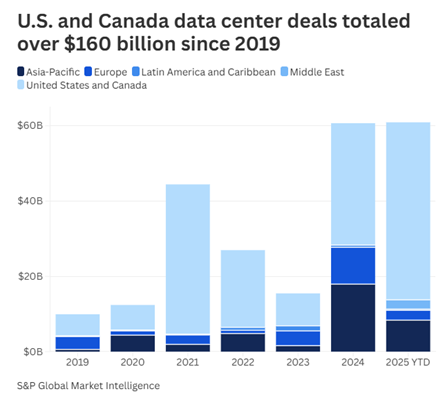
S&P Global Market Intelligence reports that more than $61.0 billion poured into the data center market in 2025, compared to $60.8 billion in 2024. The record spending comes amidst a “global construction frenzy,” as new data centers were built around the world.
S&P Global Market Intelligence also notes that the massive data center buildout in North America is eclipsing data center growth in other corners of the globe.
With data center infrastructure spending ramping up, it’s no surprise that the data center construction backlog has expanded at a rapid clip. According to the Associated Builders and Contractors trade association, the data center construction project backlog reached 11 months in October 2025.
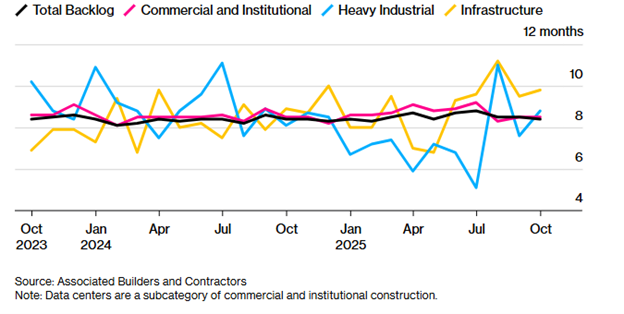
So, the data center boom is still accelerating, and rising order backlogs should continue to boost U.S. GDP growth going forward.
Reason #5: “Drill, Baby, Drill”
The U.S. is the Saudi Arabia of natural gas: U.S. total natural gas proved reserves are estimated at about 691 trillion cubic feet.
Thanks to President Trump’s “drill, baby, drill,” natural gas production is expected to accelerate in the upcoming years. In fact, we’ve already seen an uptick in liquified natural gas (LNG) exports, with a record 111 million metric tons exported in 2025.
The U.S. is now the first country to exceed 100 million tons in only a year—and it has secured the title as the world’s biggest LNG supplier.
Yet, the U.S. will not rest on its laurels. LNG exporters plan to boost U.S. liquefaction capacity by adding about 13.9 billion cubic feet per day between 2025 and 2029. Currently, the U.S. has the capacity of 15.4 billion cubic feet per day.
So, increased LNG exports are expected to continue to add billions to U.S. GDP growth.
The Bottom Line: Prepare for Accelerating GDP Growth In 2026
The combination of a shrinking trade deficit, key interest rate cuts, trillions of dollars from onshoring, lower crude oil prices and the data center boom are creating the perfect environment for explosive GDP growth in 2026.
We are now in what I like to call “economic nirvana”—and the opportunities to prosper are seemingly limitless. In fact, I fully expect 2026 to be similar to 1999, which was my best-performing year ever since several of my portfolios surged more than 100%.
Where to Invest in 2026
Personally, I’m convinced that growth stocks will lead the market higher this year, and the reason why is simple: Earnings are set to accelerate in every quarter of 2026.
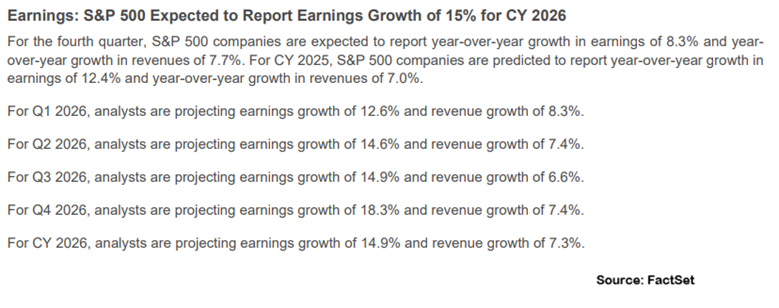
The folks at FactSet recently revealed that the S&P 500 is expected to achieve 12.6% average annual earnings growth in the first quarter. While that’s impressive, the first quarter will represent the slowest earnings growth of the year.
According to FactSet, the S&P 500 is projected to achieve 14.6%, 14.9% and 18.3% average annual earnings growth in the second, third and fourth quarters, respectively. For calendar year 2026, analysts anticipate 14.9% average annual earnings growth.
That’s why I’m convinced that 2026 could be a strong year for growth stocks.
You may already know this about me… I’m obsessed with fundamentally superior stocks.
My fascination with growth stocks started back in the late 1970s during my college years at Cal State Hayward. I wanted to uncover how to beat the market without taking on too much risk—and what I discovered was that a select group of stocks can consistently outperform the S&P 500: stocks with superior fundamentals.
In other words, stocks with strong sales and earnings growth, as well as positive analyst revisions.
Today, I’m a self-proclaimed “number guys” because the numbers do not lie—and right now, the numbers are telling me that stocks with accelerating earnings and sales momentum are the best way to prosper in 2026.
How to Start Building Your Portfolio Today
Navellier & Associates is a money management firm with a primary goal to help individuals like you develop a customized investment strategy.
Our team of professionals work closely with you to answer questions about your retirement goals, how long you have to reach these goals and what your risk tolerance is—to name a new!—and then we discuss a customized solution tailored specifically for you and your goals.
A no-obligation portfolio review is the first step to creating your custom investment solution.
The fact is everyone is different—and a portfolio review helps us better understand your specific financial needs and goals now and in the future. And in order to reach these goals, we cannot stress enough the importance of a well-balanced portfolio.
A well-balanced portfolio can literally neutralize the stock market’s uncertainty and take advantage of unique growth opportunities the market throws our way.
That’s why at Navellier & Associates, we encourage our clients to take a diversified approach to managing their investments—one that can include growth, income, and capital preservation strategies.
Growth Portfolios
These portfolios feature companies that are committed to growing their sales and earnings. Our growth portfolios are segmented by market capitalization, are actively managed, and seek inefficiently priced growth stocks with opportunities for long-term price appreciation. We screen for small- and large-cap companies that are consistently growing sales and earnings. Our team actively manages this portfolio to find undervalued growth stocks.
Income Portfolios
These offerings provide dividend growth and income opportunities with capital appreciation. At Navellier, our dividend and income portfolios strive for portfolio growth through securities with capital appreciation, strong dividend growth and income opportunities. We seek out companies that have a history of growing and paying dividends. Most importantly, these dividend-paying companies have free cash flow to cover each dividend payment. This can make it much easier to have reliable income in retirement.
Capital Preservation/Defensive Portfolios
These portfolios aim to outperform in up markets and limit losses in declining markets by moving to cash or bonds. This asset allocation plan allows investors to play defense in a declining market. Our capital preservation strategies can help you mitigate steep market losses with defensive ETFs and covered calls. Defensive ETFs can serve this need as they shift to cash or bonds when conditions permit.
Simply put, the power of a well-balanced portfolio cannot be overstated.
So, in your no-obligation portfolio review, we’ll dive deeper into the details of our exclusive portfolios and strategies. What you’ll discover is that many of them cross boundaries and can be combined to form an overall portfolio strategy. That portfolio can then be customized to your personal financial goals and risk tolerance.
But to help you better understand how we build a portfolio tailored to your specific needs, here’s a sneak peak at how we select stocks for each of our custom portfolio offerings…
Our Proprietary 3-Step Stock Selection Process
At Navellier & Associates, our system was built to find inefficiency in the market, uncover what we think are the market’s best growth stocks, and utilize a disciplined quantitative and fundamental analysis system to create a customized portfolio for individual investors.
Consider an example of the three-step proprietary stock-selection process that we utilize for most portfolios:
- Quantitative Analysis: Using our proprietary screening process, we measure reward (alpha) and risk (standard deviation) indicators to the appropriate market capitalization range for each portfolio. We rank stocks based on the reward/risk measure and reduce the initial investment universe to a select bucket of stocks that fall into the upper percentiles of the reward/risk measure.
- Fundamental Analysis: We then apply fundamental variable screens to the stocks with the highest reward/risk measures. This shines the spotlight on which companies have exceptional profit margins, excellent earnings growth (and positive earnings surprise potential!) and reasonable price/earnings ratios (based on expected future earnings).
- Securities Optimization: We use a proprietary optimization model to maximize alpha, while minimizing portfolio standard deviation. This can efficiently allocate the stocks and create portfolios that are well diversified across sectors and industries.
Primarily, our goal with the three-step stock selection process is to develop portfolios that have a low correlation to their benchmarks, increasing diversification, decreasing risk and maximizing profits for investors like you.
So, no matter what’s happening in the market—whether we’re in a raging bull market or a gut-wrenching bear market—all of us at Navellier & Associates believe in the importance of a custom investment strategy that focuses on your financial goals and risk tolerance, as well as diversification.
And we can help you build your own customized portfolio strategy.
Navellier & Associates relies on extensive research, trend analysis, customized strategies, and historic market knowledge to manage client-only portfolios and to help clients take advantage of opportunities that are presented by market corrections—short and long-term—as well as bull market situations.
Our proprietary models are built to work on U.S.-based portfolios with a minimum account value of $250,000. If your portfolio meets these criteria, please contact my Navellier & Associates team. They are standing by, ready to discuss your personal portfolio and investment strategy to help you make the most of 2026—and beyond!
Schedule Your Portfolio Review Today
Are you ready to prosper in 2026?
Then, now is the perfect time to contact Navellier & Associates to set up a no-obligation portfolio review.
A portfolio review gives us an opportunity to learn more about you. We want to know about your long- and short-term goals, your current and future income/expenses and your overall financial outlook, so that we can make the right suggestions for your personal situation.
And don’t worry… there is never a charge for this portfolio review.
If you decide you would like Navellier & Associates to manage your portfolio—or one aspect of your portfolio—we will discuss any management fees for that service.
If you decide you’d like to continue to manage things yourself, we hope that we have given you some important information to consider during your portfolio review.
We are not here to simply preach to you but rather to share information that we have gained from our extensive market research and analysis.
Click here now to schedule your no-obligation portfolio review.
I’m confident that Navellier & Associates can help guide you to build a portfolio to navigate the current environment and tailor your strategy to your individual risk tolerance.
All the best to you and yours,

Louis Navellier
Chief Investment Officer
Navellier & Associates, Inc. │ Private Client Group
Get Started
Sign me up for a portfolio review. I look forward to a conversation about my holdings, risk tolerance, and investment goals.
At Navellier & Associates, we help serious investors like you:
- Identify hidden risks in your portfolio
- Position for growth even in volatile markets
- Build a strategy that balances protection and opportunity
We have a limited number of spots for these sought-after portfolio reviews. We expect they could all be spoken for in the coming 48 hours.
This opportunity is for qualified investors with $250,000+ in investable assets. You must live and invest in the United States. And you must be able to share your holdings for a full risk assessment.
Act Now—Spots Are Limited!
For fastest service, call 1-800-887-8671.
Or, fill out our consultation form below.
About Louis Navellier
 My name is Louis Navellier and I’m most widely known as an investment adviser and market analyst. Since 1980, I’ve been publishing my quantitative analysis on growth stocks and I’ve made it my life’s work to continuously refine and develop my analysis for investors like you.
My research and analysis have led to regular appearances on CNBC and Fox Business News and I am frequently quoted by MarketWatch and Bloomberg.
I also manage money for private and institutional clients through my money management company, Navellier & Associates, Inc.
Wealthy individuals and institutional investors want access to my 30+ years of quantitative research experience.
Our work with these professionals requires tight controls on investment risk and an exhaustive due diligence process.
The overall goal for our clients focuses on how to achieve steady, long-term returns in up and down markets.
At Navellier & Associates, our proprietary quantitative models are designed to balance stocks, mutual funds, and income-producing investments to maximize returns while controlling risk.
And today, I’m thrilled to give you the opportunity to put this same rigorous screening criteria and quantitative and fundamental analysis to work for your portfolio. For U.S.-based portfolios from $250,000 to $100+ million — my firm is here to help.
Important Disclosures
Navellier & Associates owns Bristol-Myers Squibb Company (BMY), and Eli Lilly and Company (LLY), in managed accounts. We do not own Novo Nordisk A/S Sponsored ADR Class B (NVO), AstraZeneca (AZN), Gilead Sciences, Inc. (GILD), Sanofi (SNY), General Motors (GM) or Toyota ( TM). Louis Navellier and his family own and Eli Lilly and Company (LLY), via a Navellier managed account, Thet do not own Novo Nordisk A/S Sponsored ADR Class B (NVO), AstraZeneca (AZN), Gilead Sciences, Inc. (GILD), Bristol-Myers Squibb Company (BMY), Sanofi (SNY), General Motors (GM) or Toyota ( TM), personally.
Investment in stocks involves substantial risk and has the potential for partial or complete loss of funds invested. The accompanying charts are for informational purposes only and are not to be construed as an offer to buy or sell any financial instrument or investment strategy and should not be relied upon in an investment making decision. This is not an offer of investment advice and is not an investment strategy. It is simply a disclosure of the results of Navellier’s proprietary analysis. The performance presented is not based on any actual securities trading, portfolio, or accounts, and the reported hypothetical performance of the A, B, C, D, and F stock groups graded should not be considered investment advice or an investment strategy.
The charts and other information presented here do not represent actual funded trades and are not actual funded portfolios. There are material differences between hypothetical and the research, and hypothetical performance figures presented here. The research results (1) may contain stocks that are illiquid and difficult to trade; (2) may contain stock holdings materially different from actual funded investments; (3) include the reinvestment of all dividends and other earnings, estimated trading costs, commissions, or management fees; and, (4) may not reflect prices obtained in an actual funded investment. For these and other reasons, the reported performances do not reflect the performance results of actually funded and traded Investment Products.
As a matter of important disclosure regarding the hypothetical results presented for Stock Grader and Dividend Grader, the following factors must be considered when evaluating the long- and short-term performance figures presented:
(1) Historical or illustrated results presented herein do not indicate future performance; Investment in securities involves significant risk and has the potential for partial or complete loss of funds invested.
(2) The results presented were generated during a period of mixed (improving and deteriorating) economic conditions in the U.S. and positive and negative market performance. There can be no assurance that these same market conditions will occur again in the future. Navellier has no data regarding actual performance in different economic or market cycles or conditions.
(3) The back-tested historical look back performance was derived from the hypothetical application of a particular Navellier analysis applying investment criteria with the benefit of hindsight.
(4) The hypothetical results portrayed reflect the hypothetical reinvestment of dividends and other income.
(5) The hypothetical net performance results portrayed include the hypothetical reinvestment of all dividends and other earnings. Hypothetical net results also include our estimation of investment advisory fees, administrative fees, transaction expenses, or other expenses that an investor might have paid. A 1.75% annualized advisory fee is built into the net return calculations although that fee is higher than actual advisory fees investors normally pay for investment advisory services.
(6) LIMITATIONS INHERENT IN HYPOTHETICAL RESULTS: The hypothetical performance results presented are not from actually funded investments, and may not reflect the impact that material economic and market factors might have had on adviser’s or investors decision making if an adviser were actually managing a clients’ money, and thus present returns which are greater than what an actual investor would have experienced for the time period. The results are presented for informational purposes only. No real money has been invested in this analysis of hypothetical performance. The hypothetical performance results should not be considered and are not actual performance.
Copyright © 2025 Navellier. All rights reserved.
Terms of Use | Privacy Policy | Voting Proxy Policy
1 East Liberty, Suite 504 Reno, Nevada 89501 | (800)-887-8671