
AI Revolution & Data Center Boom Heat Up:
5 Ways Investors Are Positioning for Growth
The AI Revolution has captured the attention of investors since ChatGPT burst onto the scene in late 2022.
But the real story may not be the headlines.
It’s the extraordinary amount of money being invested behind the scenes to make artificial intelligence possible.
From advanced semiconductors and data storage to networking equipment, power systems, and massive data centers, companies are committing hundreds of billions of dollars to support the next phase of AI growth.
I’ve spent a lot of time discussing the similarities between today’s AI Revolution and the Internet Boom of the 1990s.
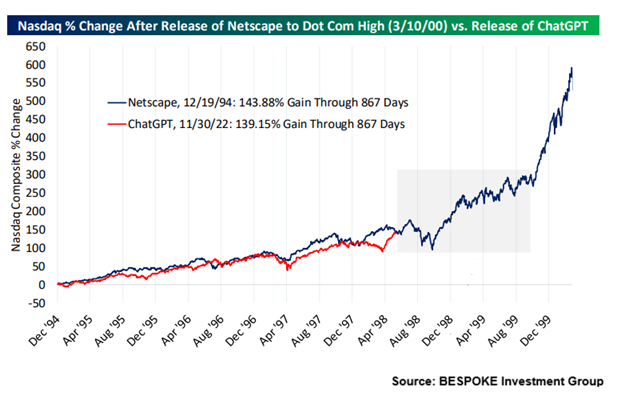
Recently, our friends at BESPOKE Investment Group published a chart that helps illustrate exactly why this comparison continues to resonate with investors.
According to BESPOKE, the market’s reaction to artificial intelligence is following a path that looks surprisingly similar to the early stages of the Internet Revolution.
Take a look at the chart below.
It compares the NASDAQ’s performance following Netscape’s launch in late 1994 with its performance since ChatGPT was introduced in late 2022. While no two market cycles are identical, the similarities are difficult to ignore.
For investors who lived through the Internet Boom, that comparison probably brings back mixed memories.
The technology was exciting, but it was also confusing. New companies seemed to appear overnight. Stock prices moved wildly. Many investors wondered whether the opportunity was real or simply too risky to touch.
Yet beneath all the excitement and speculation, something very important was happening.
Businesses were investing billions of dollars into a technology that would eventually reshape the economy.
That’s what makes today’s AI Revolution so compelling.
Back in the late 1990s, companies spent heavily on infrastructure, software, networking equipment and the technologies needed to bring the internet into homes and businesses around the world. Dot-com era spending grew at more than a 15% annual pace as the internet transformed from an interesting idea into an essential part of everyday life.
Today, we’re seeing a similar wave of investment around artificial intelligence.
The biggest opportunities may not come from the AI applications grabbing headlines today. They may come from the companies providing the chips, storage, networking equipment, power systems and data center infrastructure needed to make artificial intelligence possible.
In fact, four of the so-called Magnificent Seven companies—Alphabet, Amazon, Meta and Microsoft—recently increased their AI spending projections. Combined spending estimates for 2026 have risen from roughly $670 billion to approximately $725 billion.
And many believe we’re still in the early innings.
Current projections call for AI-related spending to exceed $1 trillion in 2027. NVIDIA CEO Jensen Huang has suggested that AI-related capital expenditures could eventually approach $4 trillion by the end of the decade.
Whether those forecasts prove accurate remains to be seen. But one thing is clear: businesses are committing enormous resources to artificial intelligence and the infrastructure required to support it.
In my opinion, that’s where the opportunity for an investment strategy will likely be found.
Not in chasing every company with “AI” attached to its name, but in identifying the businesses that stand to benefit from the massive investment taking place behind the scenes.
Let’s take a closer look at five areas of the market that could benefit from the AI Revolution and data center boom.
AI Buildout Opportunity #1: Chips
There are two critical chips to the AI Revolution.
GPUs—Graphics Processing Units—were primarily developed to enhance and accelerate the creation of images and videos. But GPUs’ speed, as well as ability to handle data and computational demands, also makes them the perfect candidates to power AI models. Also notable, GPUs are capable of handling multiple tasks simultaneously.
CPUs—Central Processing Units—were designed to focus on coordination, logic and decision-making. CPUs are essentially the “brain” in servers and data centers. Unlike GPUs, though, CPUs focus on one task at a time, which makes them a great candidate for AI workloads like inference.
As AI evolves, demand for both GPUs and CPUs are expected to skyrocket.
In 2025, the global GPU market was valued at $78.6 billion, and it is projected to grow to $100.55 billion in 2026—and to $642.74 billion by 2034! Breaking this down, the global GPU market is anticipated to grow at a more than 26% compound annual growth rate.
Source: Fortune Business Insights 5/18/2026
According to Citi, the server CPU market is expected to breach $132.0 billion by 2030, as agentic AI workloads need more CPU processing power. That’s up from an estimated $29.3 billion in 2025. Even demand for traditional CPUs is forecast to increase at a 20% compound annual growth rate and reach $50.9 billion by 2030.
Source: Yahoo Finance 5/23/2026
Simply put, semiconductor companies appear well positioned to benefit from growing demand for AI-related computing power.
At Navellier & Associates, we’ve advised our clients to add a few strategic chip stocks to their personal portfolios. A couple of our favorites include the best of the best AI GPU manufacturer NVIDIA Corporation (NVDA), and Advanced Micro Devices (AMD), which is one company powering the full spectrum of AI with CPUs, GPUs and other adaptive computing solutions.
AI Buildout Opportunity #2: Storage
Data is the most critical component of AI—and it is being created at lightning speeds.
AI training, inference and machine learning all require massive amounts of data. All of this data (whether it’s audio, images or video) needs to be readily accessible and prepared in order to better enable different AI projects. So, storage solutions that harness and maximize data’s potential are vital to the AI Revolution.
As a result, there has been a massive surge in demand for storage solutions.
The AI storage market is anticipated to increase from $35.95 billion in 2025 to a whopping $255.24 billion by 2034. In other words, the AI storage market is expected to grow at a 24.4% compound annual growth rate in the upcoming years.
Source: IBM 1/8/2026
And a lot of the growth in the AI storage market is coming from hard drives.
The fact is that the training and deployment of AI models require high-speed data; memory and storage technologies that balance cost, performance and scalability are important. In other words, storage options need to have high-speed data access, massive capacity, reliability and security—and that’s exactly what hard drives offer.
So, hard drives currently serve as the backbone of AI data storage.
The biggest hyperscale and cloud data centers around the world store about 90% of their AI data on hard drives, and the reason why is simple: Hard drives are six times more efficient than solid-state drives (SSDs) and use four times less operating power per terabyte than SSDs. Hard drives are also nine times more efficient than NAND.
Now, that doesn’t mean that SSDs and NAND don’t also have their own place in the AI Revolution.
One of the key differences between SSDs and hard drives is speed. SSDs are able to access data at a much faster pace than hard drives, which means they also utilize less power than a hard drive. So, SSDs can provide real-time inference and help prevent bottlenecks in AI model training.
Companies that provide hard drives and SSDs are both tantalizing investment opportunities today.
At Navellier & Associates, we understand the benefits of both the long-term, massive storage capacity of hard drives and the less power consumption and speed of SSDs. That’s why we like Micron Technology, Inc. (MU), Seagate Technology Holdings plc (STX) and Silicon Motion Technology Corporation (SIMO) as ways to benefit from increasing AI storage demands.
AI Buildout Opportunity #3: Infrastructure
There is an unprecedented construction boom happening in the U.S. right now.
Given increased demand for AI computing, new data centers are popping up across the U.S. There are currently plans for more than 150 gigawatts of new data center power capacity, up from the U.S.’s current capacity of less than 15 gigawatts.
The majority of data centers are centered in three states: Arizona, Texas and Virginia. However, 24 states expect to construct data centers with at least one gigawatt of new capacity.
Source: Reuters 1/22/2026
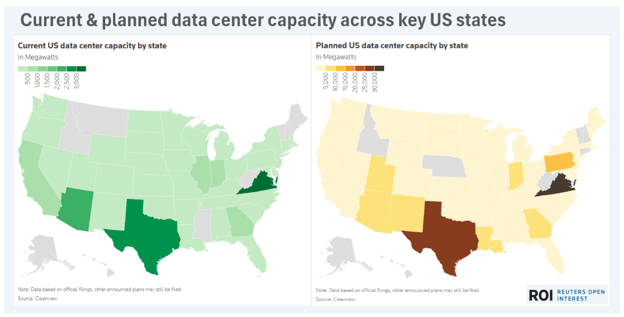
Now, there has been some pushback against data centers. But the vast majority of states still permit data center construction. Most data centers are going where there is fast internet, cheaper electricity and cold climates to vent heat at night. So, Georgia, Idaho, Kansas, Louisiana, Michigan, Nevada, North Carolina, Pennsylvania, South Carolina, South Dakota, Tennessee, Texas, Utah and Virginia are all big winners from the data center boom.
Data centers, though, are popping up around the world. According to McKinsey & Company, global spending on data centers is expected to hit $7.0 trillion by 2030.
Source: McKinsey & Company: 3/27/2026
Who benefits the most from the data center buildout?
Here at Navellier & Associates, we’ve had our eye on several companies involved in the construction of data centers. We’ve considered companies that develop the sites for a new data center, the construction companies actually building the facilities and the ones providing the guts (think HVAC, electrical and mechanical systems).
The opportunities are seemingly endless—and a few of our favorites include HVAC provider, Comfort Systems USA, Inc. (FIX); leading infrastructure construction company, MasTec, Inc. (MTZ); and leading electrical and mechanical construction provider, EMCOR Group, Inc. (EME).
AI Buildout Opportunity #4: Power
It’s no secret that the power grid in the U.S. is aging—and ailing.
The vast majority of the electrical infrastructure in the U.S. was constructed 50 to 75 years ago, and nearly 70% of the U.S.’s power transformers are more than 25 years old. So, rising power demands increase the potential for outages and even grid failure.
Source: University of Wisconsin-Madison: 5/14/2026
Some of the biggest strains on the U.S. power grid are data centers and AI computing.
With more data centers coming online this year, Goldman Sachs Commodities Research expects U.S. data center power demand to more than double to 66 gigawatts by 2027, up from 31 gigawatts in 2025. By the end of 2027, data center power demand could reach 95 gigawatts.
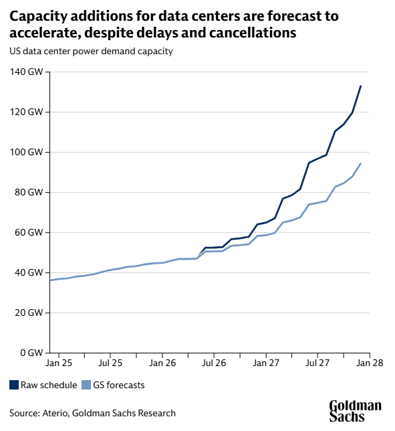
Due to increased power demands from these new data centers, Goldman Sachs Commodities Research also notes that peak summer demand—when folks are firing up the AC to beat the heat—will more than double to 8.5% in 2027, up from 4.1% in 2025.
Source: Goldman Sachs 5/20/2026
Talk about a strain on the U.S. power grid!
Now, data centers cannot afford a power outage. Even a brief loss of power can lead to equipment failure, damage to hardware, loss of data and security risks. As a result, data centers are equipped to monitor the power grid and uncover any risk of a power outage that could affect operations. And if a risk is uncovered, the data center switches to backup power sources.
But backup power can only do so much. So, there are two efforts currently underway attempting to ease the data center-related strain on the U.S.’s power grid.
First, new, reliable power plants—gas, solar, wind and even nuclear—are being constructed in the U.S. as we speak. Ground broke on nuclear power facilities in Wyoming and Tennessee in April, and the Energy Information Administration (EIA) expects natural gas-powered plants to add 18.7 gigawatts to the grid by 2028, with 4.3 gigawatts currently under construction.
Source: EIA 6/11/2025
Second, many data centers are taking back the power.
Data centers are not only being built in more power-friendly states, like Texas and Georgia, but Bloom Energy Corporation (BE) also estimates that one-third of all data centers will be powered by on-site sources and fully off-grid by 2030.
Source: Bloom Energy 1/20/2026
Solid oxide fuel cell systems that convert biogas, hydrogen, natural gas or a fuel blend into electricity is one of the top choices among data centers for on-site power—and that’s where Bloom Energy excels. The company’s fuel cell technology ensures 24/7 onsite power generation.
Along with Bloom Energy, another company that Navellier & Associates is keeping a close eye on is Argan, Inc. (AGX), an energy infrastructure construction company. Argan provides project construction, development and maintenance for power plant projects across the U.S.
Both BE and AGX appear to stand directly in line to benefit as data centers look to fulfill their power needs through on-site energy systems or new power plants.
AI Buildout Opportunity #5: Cooling Systems
One of the main reasons why data centers require massive amounts of reliable energy is for their cooling systems. In fact, about 40% of a data center’s energy consumption is from its cooling system.
You may know that data centers, as well as servers and other high-performance computing systems, generate a lot of heat. Essentially, all of the CPUs and GPUs are stacked tightly together on servers, and the energy necessary to process massive amounts of data creates heat.
So, in order to prevent servers and data centers as a whole from overheating, advanced cooling systems are a critical component to modern data centers.
Traditional air conditioning and fans are struggling to keep up with the increase in heat generation associated with AI workloads, machine learning and high-density computing. So, many data centers have turned to liquid cooling systems.
Essentially, these systems utilize water or another liquid coolant to absorb excess heat and move it away from the vital hardware (CPUs, GPUs, etc.) in a data center.
My favorite company in this space is Super Micro Computer, Inc. (SMCI), as the company develops liquid cooling solutions that capture up to 98% of heat. Simply put, its solutions are the best of the best. The company also boasts that its systems help reduce power costs by up to 40%.
So, with more data centers being built across the U.S. and each of these data centers needing a reliable cooling system to prevent systems from overheating and failing, more and more customers will be knocking on Super Micro Computer’s door.
The Numbers Don’t Lie: AI Is Driving Corporate Profits
Today, we delved into five corners of the market that are prospering amidst the AI Revolution and data center boom. And there is one primary reason why I believe many companies in these areas could continue to benefit from growing demand: Massive order backlogs.
As an example, companies like Bloom Energy, NVIDIA and Super Micro Computer are sitting on record backlogs of more than $20.0 billion, $1.0 trillion and $13.0 billion, respectively.
It will take these companies years to deliver what they have in the pipeline.
These massive order backlogs point to the possibility that the AI Revolution and data center boom will persist for at least the next three years.
Consider this…
Our friends at FactSet reported that five stocks contributed the most to the S&P 500’s earnings in the first quarter: Alphabet, Amazon.com, Meta Platforms, NVIDIA and Micron Technology. All five stocks are closely tied to the AI Revolution and data center boom.
Source: FACTSET 5/21/2026
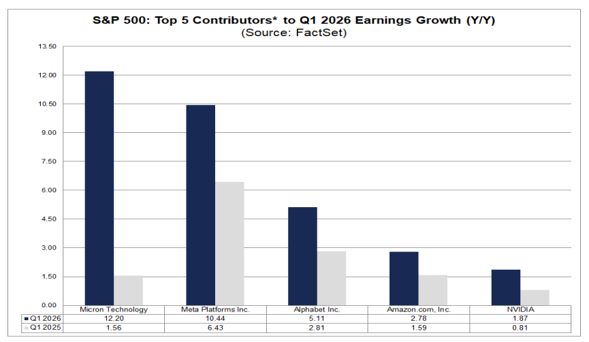
Looking forward, the so-called “Magnificent 7,” which includes Amazon.com, Alphabet, Meta Platforms and NVIDIA, as well as Apple (AAPL), Microsoft (MSFT) and Tesla (TSLA), are expected to achieve nearly 35% average earnings growth in 2026. That compares to estimates for nearly 18% average earnings growth for the remaining 493 companies in the S&P 500.
In other words, AI- and data center-related stocks with accelerating earnings momentum have historically attracted investor interest.
In my opinion, my favorite AI- and data center-related stocks could tack on at least another 30% gain between now and the end of the year—thanks to persistent demand, massive order backlogs and subsequent accelerating earnings momentum.
Bottom line: Investors may want to evaluate whether their portfolios are positioned to participate in these long-term trends.
Where to Invest in 2026
Personally, I’m convinced that growth stocks—especially AI and data center stocks—will lead the market higher this year, and the reason why is simple…
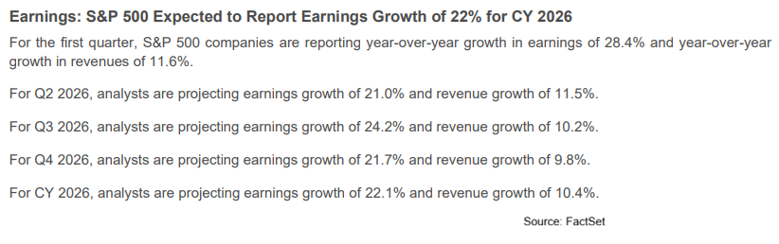
Earnings are set to accelerate in every quarter of 2026.
FactSet recently revealed that the S&P 500 achieved 28.4% average annual earnings growth in the first quarter—or the highest growth rate since the fourth quarter of 2021. Clearly, that’s impressive.
But what’s equally impressive is that earnings growth will remain robust all year.
According to FactSet, the S&P 500 is projected to achieve 21%, 24.2% and 21.7% average annual earnings growth in the second, third and fourth quarters, respectively. For calendar year 2026, analysts anticipate 22.1% average annual earnings growth.
Source: FACTSET 5/21/2026
That’s why I’m convinced that 2026 will be the year of growth stocks.
You may already know this about me… I’m obsessed with fundamentally superior stocks.
My fascination with growth stocks started back in the late 1970s during my college years at Cal State Hayward. I wanted to uncover how to beat the market without taking on too much risk—and what I discovered was that a select group of stocks can consistently outperform the S&P 500: stocks with superior fundamentals.
In other words, stocks with strong sales and earnings growth, as well as positive analyst revisions.
Today, I’m a self-proclaimed “number guy” because the numbers do not lie—and right now, the numbers are telling me that stocks with accelerating earnings and sales momentum could continue to attract investor interest in 2026.
How to Start Building Your Portfolio Today
Navellier & Associates is a money management firm with a primary goal to help individuals like you develop a customized investment strategy.
Our team of professionals work closely with you to answer questions about your retirement goals, how long you have to reach these goals and what your risk tolerance is—to name a new!—and then we discuss a customized solution tailored specifically for you and your goals.
A no-obligation portfolio review is the first step to creating your custom investment solution.
The fact is everyone is different—and a portfolio review helps us better understand your specific financial needs and goals now and in the future. And in order to reach these goals, we cannot stress enough the importance of a well-balanced portfolio.
A well-balanced portfolio can literally neutralize the stock market’s uncertainty and take advantage of unique growth opportunities the market throws our way.
That’s why at Navellier & Associates, we encourage our clients to take a diversified approach to managing their investments—one that can include growth, income, and capital preservation strategies.
Growth Portfolios
These portfolios feature companies that are committed to growing their sales and earnings. Our growth portfolios are segmented by market capitalization, are actively managed, and seek inefficiently priced growth stocks with opportunities for long-term price appreciation. We screen for small- and large-cap companies that are consistently growing sales and earnings. Our team actively manages this portfolio to find undervalued growth stocks.
Income Portfolios
These offerings provide dividend growth and income opportunities with capital appreciation. At Navellier, our dividend and income portfolios strive for portfolio growth through securities with capital appreciation, strong dividend growth and income opportunities. We seek out companies that have a history of growing and paying dividends. Most importantly, these dividend-paying companies have free cash flow to cover each dividend payment. This can make it much easier to have reliable income in retirement.
Capital Preservation/Defensive Portfolios
These portfolios aim to outperform in up markets and limit losses in declining markets by moving to cash or bonds. This asset allocation plan allows investors to play defense in a declining market. Our capital preservation strategies can help you mitigate steep market losses with defensive ETFs and covered calls. Defensive ETFs can serve this need as they shift to cash or bonds when conditions permit.
Simply put, the power of a well-balanced portfolio cannot be overstated.
So, in your no-obligation portfolio review, we’ll dive deeper into the details of our exclusive portfolios and strategies. What you’ll discover is that many of them cross boundaries and can be combined to form an overall portfolio strategy. That portfolio can then be customized to your personal financial goals and risk tolerance.
But to help you better understand how we build a portfolio tailored to your specific needs, here’s a sneak peak at how we select stocks for each of our custom portfolio offerings…
Our Proprietary 3-Step Stock Selection Process
At Navellier & Associates, our system was built to find inefficiency in the market, uncover what we think are the market’s best growth stocks, and utilize a disciplined quantitative and fundamental analysis system to create a customized portfolio for individual investors.
Consider an example of the three-step proprietary stock-selection process that we utilize for most portfolios:
- Quantitative Analysis: Using our proprietary screening process, we measure reward (alpha) and risk (standard deviation) indicators to the appropriate market capitalization range for each portfolio. We rank stocks based on the reward/risk measure and reduce the initial investment universe to a select bucket of stocks that fall into the upper percentiles of the reward/risk measure.
- Fundamental Analysis: We then apply fundamental variable screens to the stocks with the highest reward/risk measures. This shines the spotlight on which companies have exceptional profit margins, excellent earnings growth (and positive earnings surprise potential!) and reasonable price/earnings ratios (based on expected future earnings).
- Securities Optimization: We use a proprietary optimization model to maximize alpha, while minimizing portfolio standard deviation. This can efficiently allocate the stocks and create portfolios that are well diversified across sectors and industries.
Primarily, our goal with the three-step stock selection process is to develop portfolios that have a low correlation to their benchmarks, increasing diversification, decreasing risk and maximizing profits for investors like you.
So, no matter what’s happening in the market—whether we’re in a raging bull market or a gut-wrenching bear market—all of us at Navellier & Associates believe in the importance of a custom investment strategy that focuses on your financial goals and risk tolerance, as well as diversification.
And we can help you build your own customized portfolio strategy.
Navellier & Associates relies on extensive research, trend analysis, customized strategies, and historic market knowledge to manage client-only portfolios and to help clients take advantage of opportunities that are presented by market corrections—short and long-term—as well as bull market situations.
Our proprietary models are built to work on U.S.-based portfolios with a minimum account value of $250,000. If your portfolio meets these criteria, please contact my Navellier & Associates team. They are standing by, ready to discuss your personal portfolio and investment strategy to help you make the most of 2026—and beyond!
Schedule Your Portfolio Review Today
Are you ready to prosper in 2026?
Then, now is the perfect time to contact Navellier & Associates to set up a no-obligation portfolio review.
A portfolio review gives us an opportunity to learn more about you. We want to know about your long- and short-term goals, your current and future income/expenses and your overall financial outlook, so that we can make the right suggestions for your personal situation.
And don’t worry… there is never a charge for this portfolio review.
If you decide you would like Navellier & Associates to manage your portfolio—or one aspect of your portfolio—we will discuss any management fees for that service.
If you decide you’d like to continue to manage things yourself, we hope that we have given you some important information to consider during your portfolio review.
We are not here to simply preach to you but rather to share information that we have gained from our extensive market research and analysis.
Click here now to schedule your no-obligation portfolio review.
I’m confident that Navellier & Associates can help guide you to build a portfolio to navigate the current environment and tailor your strategy to your individual risk tolerance.
All the best to you and yours,

Louis Navellier
Chief Investment Officer
Navellier & Associates, Inc. │ Private Client Group
Get Started
Sign me up for a portfolio review. I look forward to a conversation about my holdings, risk tolerance, and investment goals.
At Navellier & Associates, we help serious investors like you:
- Identify hidden risks in your portfolio
- Position for growth even in volatile markets
- Build a strategy that balances protection and opportunity
We have a limited number of spots for these sought-after portfolio reviews. We expect they could all be spoken for in the coming 48 hours.
This opportunity is for qualified investors with $250,000+ in investable assets. You must live and invest in the United States. And you must be able to share your holdings for a full risk assessment.
Act Now—Spots Are Limited!
For fastest service, call 1-800-887-8671.
Or, fill out our consultation form below.
About Louis Navellier
 My name is Louis Navellier and I’m most widely known as an investment adviser and market analyst. Since 1980, I’ve been publishing my quantitative analysis on growth stocks and I’ve made it my life’s work to continuously refine and develop my analysis for investors like you.
My research and analysis have led to regular appearances on CNBC and Fox Business News and I am frequently quoted by MarketWatch and Bloomberg.
I also manage money for private and institutional clients through my money management company, Navellier & Associates, Inc.
Wealthy individuals and institutional investors want access to my 30+ years of quantitative research experience.
Our work with these professionals requires tight controls on investment risk and an exhaustive due diligence process.
The overall goal for our clients focuses on how to achieve steady, long-term returns in up and down markets.
At Navellier & Associates, our proprietary quantitative models are designed to balance stocks, mutual funds, and income-producing investments to maximize returns while controlling risk.
And today, I’m thrilled to give you the opportunity to put this same rigorous screening criteria and quantitative and fundamental analysis to work for your portfolio. For U.S.-based portfolios from $250,000 to $100+ million — my firm is here to help.
Important Disclosures
Navellier & Associates owns Nvidia (NVDA), Super Micro Computer, Inc. (SMCI), Apple (AAPL), Advanced Micro Devices (AMD), Amazon.com, (AMZN), Microsoft Corporation (MSFT), Meta Platforms Inc Class A (META), Alphabet Inc. Class A (GOOGL), Micron Technology, Inc. (MU), Seagate Technology Holdings plc (STX), Silicon Motion Technology Corporation (SIMO), Comfort Systems USA, Inc. (FIX), MasTec, Inc. (MTZ), EMCOR Group, Inc. (EME), Argan, Inc. (AGX), and Bloom Energy Corporation Class A (BE), in managed accounts. A few accounts own Tesla per client request (TSLA).
Louis Navellier and his family owns Nvidia (NVDA), Super Micro Computer, Inc. (SMCI), Apple (AAPL), Advanced Micro Devices (AMD), Amazon.com, (AMZN), Microsoft Corporation (MSFT), Meta Platforms Inc Class A (META), Alphabet Inc. Class A (GOOGL), Micron Technology, Inc. (MU), Seagate Technology Holdings plc (STX), Silicon Motion Technology Corporation (SIMO), Comfort Systems USA, Inc. (FIX), MasTec, Inc. (MTZ), EMCOR Group, Inc. (EME), Argan, Inc. (AGX), and Bloom Energy Corporation Class A (BE),via a Navellier managed account and Nvidia (NVDA), Amazon.com, (AMZN), and Apple (AAPL), in a personal account. They do not own Tesla (TSLA), personally.
Investment in stocks involves substantial risk and has the potential for partial or complete loss of funds invested. The accompanying charts are for informational purposes only and are not to be construed as an offer to buy or sell any financial instrument or investment strategy and should not be relied upon in an investment making decision. This is not an offer of investment advice and is not an investment strategy. It is simply a disclosure of the results of Navellier’s proprietary analysis. The performance presented is not based on any actual securities trading, portfolio, or accounts, and the reported hypothetical performance of the A, B, C, D, and F stock groups graded should not be considered investment advice or an investment strategy.
The charts and other information presented here do not represent actual funded trades and are not actual funded portfolios. There are material differences between hypothetical and the research, and hypothetical performance figures presented here. The research results (1) may contain stocks that are illiquid and difficult to trade; (2) may contain stock holdings materially different from actual funded investments; (3) include the reinvestment of all dividends and other earnings, estimated trading costs, commissions, or management fees; and, (4) may not reflect prices obtained in an actual funded investment. For these and other reasons, the reported performances do not reflect the performance results of actually funded and traded Investment Products.
As a matter of important disclosure regarding the hypothetical results presented for Stock Grader and Dividend Grader, the following factors must be considered when evaluating the long- and short-term performance figures presented:
(1) Historical or illustrated results presented herein do not indicate future performance; Investment in securities involves significant risk and has the potential for partial or complete loss of funds invested.
(2) The results presented were generated during a period of mixed (improving and deteriorating) economic conditions in the U.S. and positive and negative market performance. There can be no assurance that these same market conditions will occur again in the future. Navellier has no data regarding actual performance in different economic or market cycles or conditions.
(3) The back-tested historical look back performance was derived from the hypothetical application of a particular Navellier analysis applying investment criteria with the benefit of hindsight.
(4) The hypothetical results portrayed reflect the hypothetical reinvestment of dividends and other income.
(5) The hypothetical net performance results portrayed include the hypothetical reinvestment of all dividends and other earnings. Hypothetical net results also include our estimation of investment advisory fees, administrative fees, transaction expenses, or other expenses that an investor might have paid. A 1.75% annualized advisory fee is built into the net return calculations although that fee is higher than actual advisory fees investors normally pay for investment advisory services.
(6) LIMITATIONS INHERENT IN HYPOTHETICAL RESULTS: The hypothetical performance results presented are not from actually funded investments, and may not reflect the impact that material economic and market factors might have had on adviser’s or investors decision making if an adviser were actually managing a clients’ money, and thus present returns which are greater than what an actual investor would have experienced for the time period. The results are presented for informational purposes only. No real money has been invested in this analysis of hypothetical performance. The hypothetical performance results should not be considered and are not actual performance.
Copyright © 2026 Navellier. All rights reserved.
Terms of Use | Privacy Policy | Voting Proxy Policy
1 East Liberty, Suite 504 Reno, Nevada 89501 | (800)-887-8671