
Should You Buy Now or Sell Now?
Markets rise. Markets fall. Headlines swing from optimism to caution.
And in moments of uncertainty or excitement, you might find yourself wondering:
If things look strong right now, is it time to take profits and get out? Or if momentum seems to be building, is it too late to get in?
Both are valid questions—and ones investors ask themselves all the time. When is the right time to buy? When is the right time to sell? And if you dwell on timing too long—worried about making the wrong move at the wrong moment—you risk doing nothing and missing out on real opportunities.
I’ve spent more than four decades helping investors work through those exact decisions. Early in my career, I built quantitative models to identify stocks with the strongest fundamentals—long before “data-driven investing” was a buzzword. Over the years, my research and strategies have been featured by The Wall Street Journal, Forbes, Bloomberg, and CNBC—not because I try to predict the future, but because I focus on what actually moves markets.
Timing the Market vs. Stock Picking
Many investors believe that the key to investment success is timing the market.
Warren Buffett once famously said, “I don’t think we’ve ever made a decision where either one of us said or been thinking: ‘We should buy or sell based on what the market is going to do. Or for that matter, what the economy is going to do.”
The reality is that none of us own a crystal ball, and none of us can predict the future. And essentially, that’s what timing the market is. It’s trying to predict the future direction of the market in order to buy at a low price and sell at a much higher price.
But did anyone predict the 2010 Flash Crash when the Dow plunged nearly 1,000 points in about 10 minutes? Or how about the COVID-19 pandemic and subsequent global shutdown that punished the financial markets and every economy across the planet? Or even the tariff tantrum that drove the S&P 500 nearly 19% lower in just seven weeks in early 2025?
Recent market events alone should be enough to convince us that timing the market is a losing gamble.
So, while Buffett may be a value investor, and here at Navellier & Associates, we’re known for our growth strategies, here is where we can agree…
The key to success isn’t about timing the stock market; it’s about investing in the right stocks.
And, in my opinion, when it comes to buying at the right time and selling at the right time to maximize your profits, it’s all about stock picking. You must own the crème de la crème. Period.
So, it really all comes down to one thing: fundamentals.
Fundamentally Superior Stocks Win—Hands Down
Every quarter, I perform a back test of Stock Grader and my 8-factor fundamental model—and every recent quarter has revealed the same thing: Fundamentally superior stocks outperform.
But let me back up for a second…
Stock Grader is a tool that grades individual stocks—A to F—based on several key fundamental metrics. In fact, Stock Grader considers eight key fundamental factors: positive earnings revisions, positive earnings surprises, increasing sales growth, expanding operating margins, free cash flow, earnings growth, positive earnings momentum and return on equity.
Clearly, the tool interprets reams of financial data every week, and each stocks’ grade is updated weekly based on the data. Approximately 6,000 stocks are evaluated by Stock Grader and assigned ratings ranging from A (strong buy) to F (strong sell).
Now, my latest quarterly back test of Stock Grader and my 8-factor fundamental model revealed once again that fundamentally superior stocks continue to rise to the top.
In fact, the latest back test confirmed that the top 25% of stocks in Stock Grader and the top 15% of stocks in my 8-factor fundamental model remain the best places to invest.
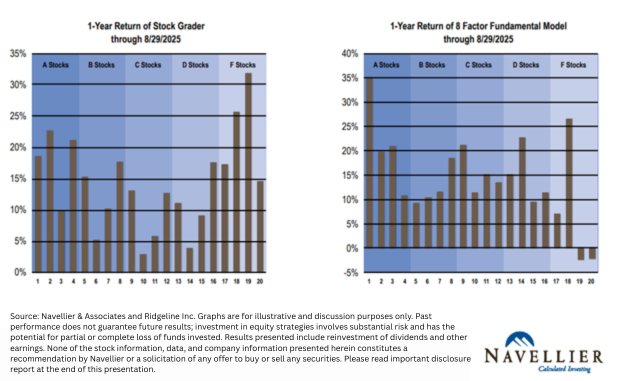
In other words, it is imperative that you own fundamentally superior stocks in the current market.
Along with a stock earning an A-rating or even a B-rating in Stock Grader, the best way to determine if a stock is worthy of your time is to get under the hood. Dive deeper into the company’s financials.
Is earnings and sales momentum accelerating? Have analysts increased earnings estimates for the current quarter, upcoming quarters and even year in the past three months? Does the company have a history of exceeding analysts’ earnings expectations?
If the answer is yes to all three of these questions—and the stock receives an A-rating or B-rating in Stock Grader—then you’re probably looking at a solid investment opportunity.
But before you load up, there’s one more question you need to ask: Is the stock being accumulated by individual and institutional investors alike? In other words, is the stock benefiting from persistent buying pressure?
Essentially, in the words of Jerry Maguire, “Show me the money!”
If more money is pouring into a stock, that stock has a lot more appreciation potential. So, Stock Grader “shows us the money” with a Quantitative grade. An A or B Quantitative grade highlights that there is persistent buying pressure in a stock—and we want to follow that money.
And once you’ve determined which stocks have superior fundamentals and persistent buying pressure, I know what the next question on your mind is.
When Is the Right Time to Buy—and Sell?
If we’re not making investment decisions based on the stock market’s day-to-day gyrations, and we’re focusing on stocks with superior fundamentals… how do we know when it is time to buy?
Personally, I always recommend buying on dips. You want to try to buy high-quality stocks when they are on sale.
This past April is a good example of an incredible buying opportunity. All of the major indices pulled back sharply due to the Trump Tariff tantrum—and the baby was thrown out with the bathwater. No industry, sector or stock was spared in the selloff.
But as you know, stocks have rebounded impressively since then, and investors who dove in with both hands are sitting pretty right now.
Another example… technology stocks, especially those related to artificial intelligence (AI), recently took it on the chin after Goldman Sachs issued a very unprofessional report that claimed AI stocks didn’t have much more room to run since it alleged that AI spending was tapering off. The report ignited some panic among AI investors, and many stocks sold off on the headline.
Again, the selloff didn’t last long.
Now, even if you missed the April selloff or the recent AI-related pullback, don’t worry. Another pullback is always just around the corner. You just need to be prepared for it.
Selling is just as simple.
Everyone wants to squeeze every last profit possible out of their investments, and sometimes that can lead to holding onto a stock far longer than necessary. While others are afraid that they’ll lose all their gains, and they end up exiting too early.
I only recommend selling a stock when we’re confident that a stock has reached the top of its growth curve. In other words, earnings momentum is starting to hit the brakes.
Weakening fundamentals and dwindling buying pressure are the first signs that I look for when a stock’s run may be losing steam. When a stock drops in the Stock Grader ratings and its Quantitative grade slips, those are the first signs that it may be time to take some profits off the table.
Let me be clear: That does not mean that you should immediately sell. Yes, a D- or F-rating is a BIG red flag, as are lowered analyst estimates, negative forecasted earnings growth and a drop off in buying pressure. But you should never panic and sell.
Rather, I always recommend selling into strength.
Wait for a market bounce or a positive industry development to boost a company’s shares—and then take advantage of that bounce to exit your position.
A Buy/Sell Strategy Is Only One Step to Achieving Your Goals
To sum up: Don’t try to time the market or be swayed by market volatility—whether its driving stocks higher or lower. Don’t allow pullbacks to scare you into selling. And don’t get greedy when the market soars higher.
Stay the course.
When you uncover a fundamentally superior stock or need to rebalance by adding to your current positions, always buy on dips. And when a stock’s fundamentals are deteriorating and buying pressure is drying up, always sell into strength.
I know what you’re thinking… Easier said than done. And if that’s how you’re feeling or if you’re feeling a bit overwhelmed, the great news is that you don’t have to go it alone.
Navellier & Associates is a money management firm with a primary goal to help individuals like you develop a customized investment strategy.
The fact is that determining which stocks to buy and which to sell is only one part of constructing a successful investment portfolio. While having a buy/sell strategy is important, you also need to ensure that you’re not overexposed in one stock or industry, and you need to determine when adding to positions or trimming positions is necessary to maintain balance and to reach your goals.
Navellier & Associates can help.
Our team of professionals work closely with you to answer questions about your retirement goals, how long you have to reach these goals and what your risk tolerance is—to name a new!—and then we discuss a customized solution tailored specifically for you and your goals.
A no-obligation portfolio review is the first step to creating your custom investment solution.
The fact is everyone is different—and a portfolio review helps us better understand your specific financial needs and goals now and in the future. And in order to reach these goals, we cannot stress enough the importance of a well-balanced portfolio.
A well-balanced portfolio can literally neutralize the stock market’s uncertainty and take advantage of unique growth opportunities the market throws our way.
That’s why at Navellier & Associates, we encourage our clients to take a diversified approach to managing their investments—one that can include growth, income, and capital preservation strategies.
Growth Portfolios
These portfolios feature companies that are committed to growing their sales and earnings. Our growth portfolios are segmented by market capitalization, are actively managed, and seek inefficiently priced growth stocks with opportunities for long-term price appreciation. We screen for small- and large-cap companies that are consistently growing sales and earnings. Our team actively manages this portfolio to find undervalued growth stocks.
Income Portfolios
These offerings provide dividend growth and income opportunities with capital appreciation. At Navellier, our dividend and income portfolios strive for portfolio growth through securities with capital appreciation, strong dividend growth and income opportunities. We seek out companies that have a history of growing and paying dividends. Most importantly, these dividend-paying companies have free cash flow to cover each dividend payment. This can make it much easier to have reliable income in retirement.
Capital Preservation/Defensive Portfolios
These portfolios aim to outperform in up markets and limit losses in declining markets by moving to cash or bonds. This asset allocation plan allows investors to play defense in a declining market. Our capital preservation strategies can help you mitigate steep market losses with defensive ETFs and covered calls. Defensive ETFs can serve this need as they shift to cash or bonds when conditions permit.
Simply put, the power of a well-balanced portfolio cannot be overstated.
So, in your no-obligation portfolio review, we’ll dive deeper into the details of our exclusive portfolios and strategies. What you’ll discover is that many of them cross boundaries and can be combined to form an overall portfolio strategy. That portfolio can then be customized to your personal financial goals and risk tolerance.
But to help you better understand how we build a portfolio tailored to your specific needs, here’s a sneak peak at how we select stocks for each of our custom portfolio offerings…
Our Proprietary 3-Step Stock Selection Process
At Navellier & Associates, our system was built to find inefficiency in the market, uncover what we think are the market’s best growth stocks, and utilize a disciplined quantitative and fundamental analysis system to create a customized portfolio for individual investors.
Consider an example of the three-step proprietary stock-selection process that we utilize for most portfolios:
- Quantitative Analysis: Using our proprietary screening process, we measure reward (alpha) and risk (standard deviation) indicators to the appropriate market capitalization range for each portfolio. We rank stocks based on the reward/risk measure and reduce the initial investment universe to a select bucket of stocks that fall into the upper percentiles of the reward/risk measure.
- Fundamental Analysis: We then apply fundamental variable screens to the stocks with the highest reward/risk measures. This shines the spotlight on which companies have exceptional profit margins, excellent earnings growth (and positive earnings surprise potential!) and reasonable price/earnings ratios (based on expected future earnings).
- Securities Optimization: We use a proprietary optimization model to maximize alpha, while minimizing portfolio standard deviation. This can efficiently allocate the stocks and create portfolios that are well diversified across sectors and industries.
Primarily, our goal with the three-step stock selection process is to develop portfolios that have a low correlation to their benchmarks, increasing diversification, decreasing risk and maximizing profits for investors like you.
So, no matter what’s happening in the market—whether we’re in a raging bull market or a gut-wrenching bear market—all of us at Navellier & Associates believe in the importance of a custom investment strategy that focuses on your financial goals and risk tolerance, as well as diversification.
And we can help you build your own customized portfolio strategy.
Navellier & Associates relies on extensive research, trend analysis, customized strategies, and historic market knowledge to manage client-only portfolios and to help clients take advantage of opportunities that are presented by market corrections—short and long-term—as well as bull market situations.
Our proprietary models are built to work on U.S.-based portfolios with a minimum account value of $250,000. If your portfolio meets these criteria, please contact my Navellier & Associates team. They are standing by, ready to discuss your personal portfolio and investment strategy to help you make the most of 2025—and beyond!
Schedule Your Portfolio Review Today
Again, the key to investment success is making smart decisions—and knowing when to buy and sell is just one piece of the puzzle. The financial advisors and portfolio managers can help you determine the right stocks to construct a portfolio that meets your specific needs.
So, if you’re ready to take a closer look at how your current portfolio is allocated—whether it’s mostly invested in stocks, bonds, ETFs or mutual funds—and you want to determine if any adjustments need to be made to maintain a well-balanced portfolio, then the first step you need to take is to contact Navellier & Associates to set up a no-obligation portfolio review today.
The fact is a portfolio review gives us an opportunity to learn more about you. We want to know about your long- and short-term goals, your current and future income/expenses and your overall financial outlook, so that we can make the right suggestions for your personal situation.
And don’t worry… there is never a charge for this portfolio review.
If you decide you would like Navellier & Associates to manage your portfolio—or one aspect of your portfolio—we will discuss any management fees for that service.
If you decide you’d like to continue to manage things yourself, we hope that we have given you some important information to consider during your portfolio review.
We are not here to simply preach to you but rather to share information that we have gained from our extensive market research and analysis.
Click here now to schedule your no-obligation portfolio review.
I’m confident that Navellier & Associates can help guide you to build a portfolio to navigate the current environment and help you achieve your individual financial goals now and in the future!
All the best to you and yours,

Louis Navellier
Chief Investment Officer
Navellier & Associates, Inc. │ Private Client Group
Get Started
Sign me up for a portfolio review. I look forward to a conversation about my holdings, risk tolerance, and investment goals.
At Navellier & Associates, we help serious investors like you:
- Identify hidden risks in your portfolio
- Position for growth even in volatile markets
- Build a strategy that balances protection and opportunity
We have a limited number of spots for these sought-after portfolio reviews. We expect they could all be spoken for in the coming 48 hours.
This opportunity is for qualified investors with $250,000+ in investable assets. You must live and invest in the United States. And you must be able to share your holdings for a full risk assessment.
Act Now—Spots Are Limited!
For fastest service, call 1-800-887-8671.
Or, fill out our consultation form below.
About Louis Navellier
 My name is Louis Navellier and I’m most widely known as an investment adviser and market analyst. Since 1980, I’ve been publishing my quantitative analysis on growth stocks and I’ve made it my life’s work to continuously refine and develop my analysis for investors like you.
My research and analysis have led to regular appearances on CNBC and Fox Business News and I am frequently quoted by MarketWatch and Bloomberg.
I also manage money for private and institutional clients through my money management company, Navellier & Associates, Inc.
Wealthy individuals and institutional investors want access to my 30+ years of quantitative research experience.
Our work with these professionals requires tight controls on investment risk and an exhaustive due diligence process.
The overall goal for our clients focuses on how to achieve steady, long-term returns in up and down markets.
At Navellier & Associates, our proprietary quantitative models are designed to balance stocks, mutual funds, and income-producing investments to maximize returns while controlling risk.
And today, I’m thrilled to give you the opportunity to put this same rigorous screening criteria and quantitative and fundamental analysis to work for your portfolio. For U.S.-based portfolios from $250,000 to $100+ million — my firm is here to help.
Important Disclosures
Investment in stocks involves substantial risk and has the potential for partial or complete loss of funds invested. The accompanying charts are for informational purposes only and are not to be construed as an offer to buy or sell any financial instrument or investment strategy and should not be relied upon in an investment making decision. This is not an offer of investment advice and is not an investment strategy. It is simply a disclosure of the results of Navellier’s proprietary analysis. The performance presented is not based on any actual securities trading, portfolio, or accounts, and the reported hypothetical performance of the A, B, C, D, and F stock groups graded should not be considered investment advice or an investment strategy.
The charts and other information presented here do not represent actual funded trades and are not actual funded portfolios. There are material differences between hypothetical and the research, and hypothetical performance figures presented here. The research results (1) may contain stocks that are illiquid and difficult to trade; (2) may contain stock holdings materially different from actual funded investments; (3) include the reinvestment of all dividends and other earnings, estimated trading costs, commissions, or management fees; and, (4) may not reflect prices obtained in an actual funded investment. For these and other reasons, the reported performances do not reflect the performance results of actually funded and traded Investment Products.
As a matter of important disclosure regarding the hypothetical results presented for Stock Grader and Dividend Grader, the following factors must be considered when evaluating the long- and short-term performance figures presented:
(1) Historical or illustrated results presented herein do not indicate future performance; Investment in securities involves significant risk and has the potential for partial or complete loss of funds invested.
(2) The results presented were generated during a period of mixed (improving and deteriorating) economic conditions in the U.S. and positive and negative market performance. There can be no assurance that these same market conditions will occur again in the future. Navellier has no data regarding actual performance in different economic or market cycles or conditions.
(3) The back-tested historical look back performance was derived from the hypothetical application of a particular Navellier analysis applying investment criteria with the benefit of hindsight.
(4) The hypothetical results portrayed reflect the hypothetical reinvestment of dividends and other income.
(5) The hypothetical net performance results portrayed include the hypothetical reinvestment of all dividends and other earnings. Hypothetical net results also include our estimation of investment advisory fees, administrative fees, transaction expenses, or other expenses that an investor might have paid. A 1.75% annualized advisory fee is built into the net return calculations although that fee is higher than actual advisory fees investors normally pay for investment advisory services.
(6) LIMITATIONS INHERENT IN HYPOTHETICAL RESULTS: The hypothetical performance results presented are not from actually funded investments, and may not reflect the impact that material economic and market factors might have had on adviser’s or investors decision making if an adviser were actually managing a clients’ money, and thus present returns which are greater than what an actual investor would have experienced for the time period. The results are presented for informational purposes only. No real money has been invested in this analysis of hypothetical performance. The hypothetical performance results should not be considered and are not actual performance.
Copyright © 2025 Navellier. All rights reserved.
Terms of Use | Privacy Policy | Voting Proxy Policy
1 East Liberty, Suite 504 Reno, Nevada 89501 | (800)-887-8671